Rejected by Every Dream Company, He Built a Hit YouTube Show
Rejected by every late-night show, Dan Toomey found his way at Morning Brew and created Good Work.
Dan Toomey applied to late-night shows for years in college and was rejected every time, which pushed him to Morning Brew. Starting as its first video hire, he eventually incubated Good Work, a YouTube show blending comedy and business explainers. He endured a failed year of corporate comedy sketches, a stand-up disaster in a bankrupt church in front of 30 people, and a Chinatown underground show where audience members threw up and walked out. He deliberately limits his reliance on view counts and algorithms, urging creators to trust their original instinct and arguing the algorithm shouldn't define quality. His advice to young people: after three rejections from the same dream, pivot and build experience, stay open and willing to change direction; and when hiring, he values a living portfolio over a résumé.
From Late-Night Dreams to Morning Brew: How Rejection Rewrote a Career
Dan Toomey's career began with a string of rejections. Throughout college, he applied every year for late-night show jobs—from The Colbert Report to The Daily Show to James Corden's Late Late Show—and struck out every single time. He describes that stretch as "brutal for a while." But those rejections pushed him down a different path: Morning Brew, a business and finance media company.
"I got rejected from every place I wanted to work in college," Dan told host Kyla Scanlon on the podcast Best of Luck. "Then someone told me: things will work out, just maybe not in the way you're picturing right now." That line became a footnote to his entire career.
The Low Points: A Year of Failed Comedy Sketches and a Disastrous Stand-Up Set
Dan's definition of a "low point" is specific. In his first year at Morning Brew, he tried to produce CollegeHumor-style comedy sketches—highly scripted, aimed at a corporate environment. The result "didn't work at all," and he admits he didn't even want anyone to see those videos. "When I made Good Work, it was the first time I was genuinely excited to show something to other people," he says. "That's the sign you've made something you're truly proud of, rather than something you felt you had to make."
The stand-up low point was even more dramatic. His agent booked him at a venue in Plymouth, Massachusetts—a Methodist church that had gone bankrupt three months earlier. Of 200 seats, only 60 tickets sold, and 30 people actually showed up—including his parents. He bombed for a full hour in front of his mom and dad.
That night, a comedian from Boston suggested they go chase a 420-friendly underground show to "get the feeling back." Dan describes the room at the top of an apartment in Chinatown as "so smoky you couldn't see your own hand." He went on last, and after he delivered his opening joke—about mailing a bomb threat to The Tonight Show—someone in the back row started throwing up and the audience trickled out. He finished his eight minutes in front of two people who stayed out of pity. On the drive home, his father said only one thing: "Some nights just aren't your night."
CollegeHumor is a well-known American comedy content platform, famous for highly scripted, fast-paced sketches and humor videos, once owned by IAC. Its style emphasizes polished production and a specific audience, and it has gone through multiple adjustments over the years as platforms and the media landscape shifted. When Dan mentions the "CollegeHumor style," he means imitating that kind of corporate-oriented, fully structured scripted sketch—but that content demands high creative flexibility and audience resonance, and simply copying the format doesn't work.
A Leap Off the Cliff: Bringing the Late-Night Dream to YouTube
Dan admits he never landed a late-night job. He got one interview with the James Corden show while he was in Eastern Europe for his brother's wedding, scheduled for 2 a.m. The first question was "If you were a sandwich, what sandwich would you be?" He answered a peanut butter and jelly sandwich. "I didn't deserve that job," he jokes.
The real turning point came from a random opportunity at Morning Brew. At the time, the company only had a podcast and a newsletter—no video team. Dan became its first video hire and even launched their TikTok account. He started editing social videos, gradually moved in front of the camera, and eventually incubated Good Work—a YouTube show blending comedy, business explainers, and expert interviews.
"This is arguably the peak of my career," Dan says. "The things I think about or get anxious about now are exactly the things I wanted to focus on back then. What I do now is what I'd be doing in my spare time anyway—I just tricked some people into paying me for it."
Late-night shows are a signature format in American TV culture, typically hosted by comedians and featuring monologues, celebrity interviews, and musical performances—think The Tonight Show, The Colbert Report, The Daily Show. These shows aren't just entertainment products; they're incubators for comedy talent, and many writers and performers break into the mainstream through them. Dan's early applications were essentially an attempt to enter the traditional comedy industry, but the bar is extremely high and competition fierce—which explains why, after repeated rejections, he pivoted to new media.
The Algorithm Isn't the Judge: Why He Stopped Staring at View Counts
Good Work videos generally rack up high view counts on YouTube, but Dan deliberately checks comments and algorithmic recommendations less. He admits that in the past, if a video didn't take off immediately, he'd rush to change the title or thumbnail—but his partner Henry Stockwell always told him to "relax, people will catch up in a few months."
"The algorithm shouldn't determine how you feel about the quality of your work," Kyla summed up during the conversation. "That's the best way to put it." Dan adds that his favorite videos aren't always the ones with the most views, but rather the ones that are "the clearest in their message, where someone told me it really helped them."
His advice to creators: hold on to your initial instinct when you made something, because that instinct wasn't shaped by later audiences or algorithms. "If people don't like it, you can tweak it—but this show isn't for everyone. You might not find it funny, but some people do, and that's what matters."
YouTube's recommendation algorithm relies mainly on signals like watch time, click-through rate, and engagement to decide how widely a video is distributed, with the goal of maximizing user retention and platform participation. But this mechanism doesn't directly measure depth, clarity, or value to a specific audience, so it tends to favor clickbait or short-term stimulation. Creators who let algorithmic feedback dictate everything may sacrifice long-term quality and their own style. Dan's approach—reducing reliance on real-time data and returning to his original judgment at the time of creation—aligns with the "long-termism" philosophy many creators emphasize.
Advice for Twenty-Somethings: Chase the Dream, but Don't Beat One Path to Death
When asked "What should someone do if they've been rejected from the same dream job three years in a row?" Dan gives a clear number: "Three is a good number. By the fourth year I'd feel like I was harassing them." He suggests going off to do something else, build experience, and come back later.
"You're in your twenties—you can go do something else," he says. "Go be a fly-fishing guide or something. That'd be cool." Kyla echoes the sentiment: when she graduated, she felt the pressure to climb onto the career ladder immediately, but in hindsight, "you don't need to work at Roblox right now—you can do something cool." Dan adds that when he looks at résumés, if someone has done an interesting stint somewhere, "that's the first thing I want to talk about."
As for "being unexpectedly pushed into a role—should you take the promotion?" Dan uses himself as an example: he went from running TikTok to leading the YouTube channel at Morning Brew, a gradual redirection within the same company. "Stay open, be willing to pivot," he says. "Your dream can move and evolve over time—that's exactly what got me to where I am today."
What He Looks for in Hiring: Portfolios Over Résumés
Dan reveals that the Good Work team has hired only one person in three years. What he values is the "generalist"—someone who can shoot and edit, is adaptable, and can take feedback. "Being able to absorb feedback and know how to apply it is a hard skill, and schools usually don't teach it directly."
In college, he worked 17 jobs on campus and joined a pile of clubs to pad his résumé, but what actually landed him his first job was a blog he wrote about stocks. Kyla shares that her first job came from a scaled-up stock blog—the hiring manager said "it's exciting to see a living, breathing portfolio."
"A portfolio is the most authentic proof," Dan says. "It shows what you genuinely care about in your spare time. I got the Morning Brew job because I made things."
In content creation teams, "generalist" usually refers to a multi-skilled person who can move across shooting, editing, planning, and on-camera work, rather than mastering just one skill. In small or fast-iterating media teams, generalists can flexibly fill gaps and reduce coordination costs—especially suited to scenarios with limited resources but a need for rapid experimentation. Dan's emphasis on "being able to absorb feedback and know how to apply it" points to a cultivable meta-skill—the ability to turn external input into concrete improvements—which school education often lacks systematic training for.
The Luck Questionnaire: Rejection Was the Biggest Blessing
In the rapid-fire round, Dan defines "luck" as "constantly shifting." Asked "What's something you were sure would end your career that turned out to be irrelevant?" he answers "things going wrong." And the "luckiest thing that happened that you didn't realize at the time" is "being rejected by late-night shows."
"I now need luck to find the resolve to keep evolving the channel," he says. "Making things can easily fall into repetition. Inspiration often comes from luck—you go to a show, and it sparks something else."
This article is based on an interview with Dan Toomey on the podcast Best of Luck.
Related articles
Mysterious Synchronized Disturbances Hit Global Power Grids — German Team Finds the Culprit
Mysterious synchronized power drops hit grids worldwide. A German team found the culprit. This article explains the coordinated disturbances, the research breakthrough, and what it means for grid monitoring and operations.
NVIDIA Board Investigates Espionage Ca…
NVIDIA Board Investigates Espionage Case: CEO's Admission of Extramarital Affair Sparks Internal Turmoil
NVIDIA's board has launched an espionage investigation following the CEO's admission of an extramarital affair. This article analyzes the background, corporate governance logic, and potential impact on NVIDIA, noting that current information is limited and should be viewed rationally.
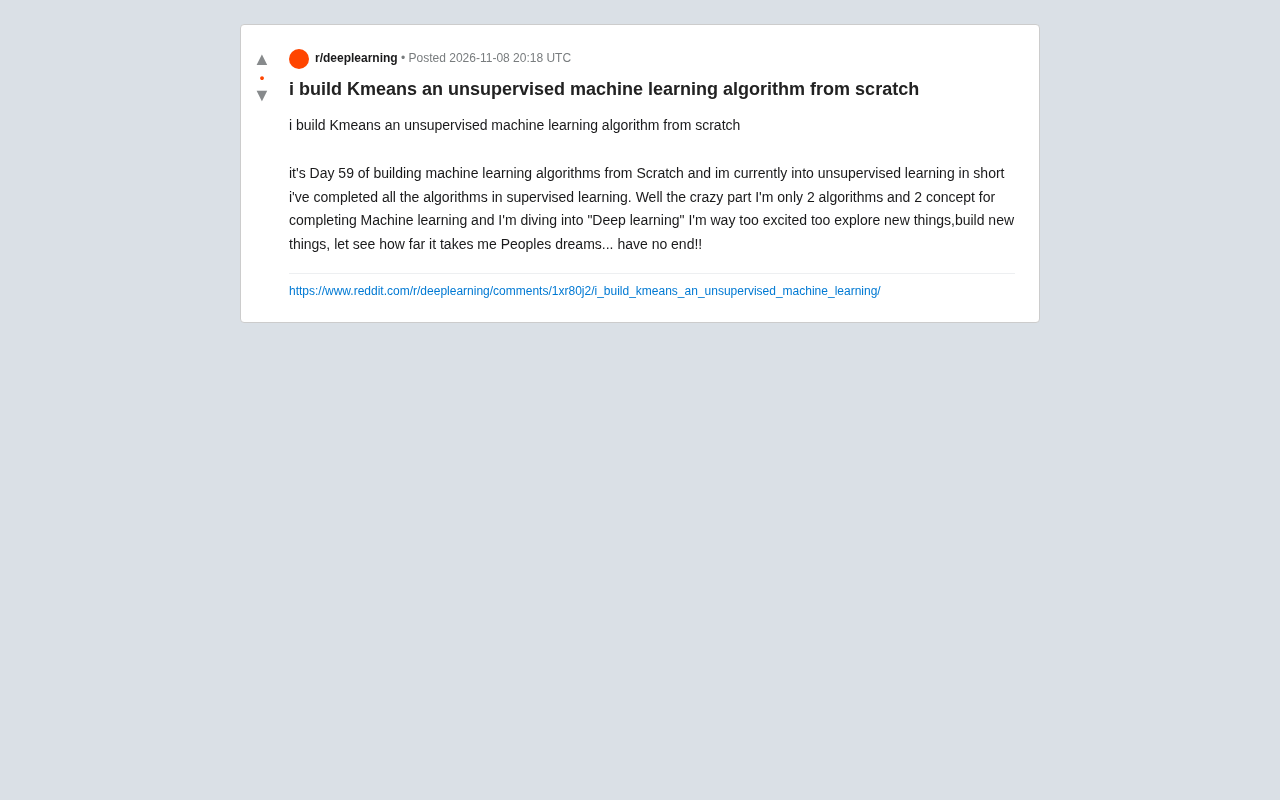
Writing K-Means from Scratch: One Developer's Journey into Machine Learning
A developer shares day 59 of writing K-Means from scratch: finishing all supervised learning algorithms and entering unsupervised learning, covering K-Means++ initialization, vectorized distances, convergence and empty clusters.