Remindly: A Cross-Platform Note-Taking App with Built-in Reminders
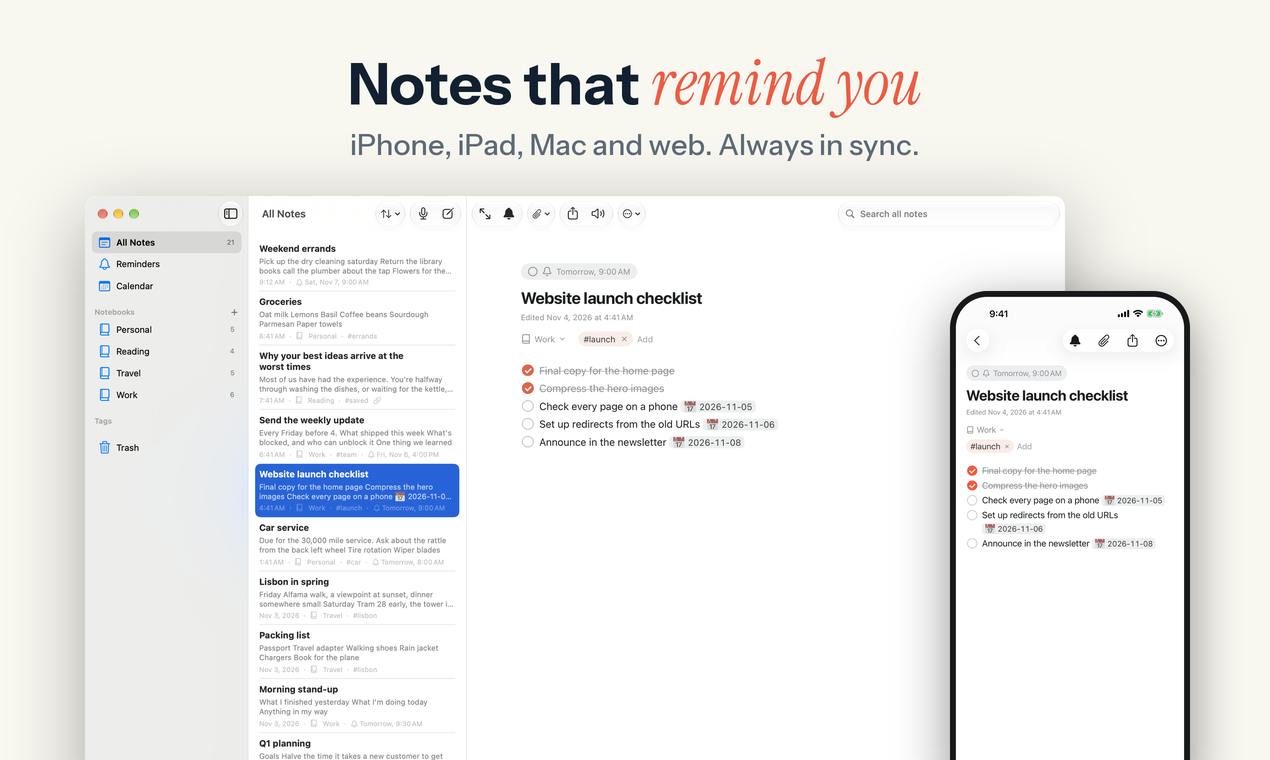
Remindly lets every note carry a reminder, entering the mature note market with a lightweight "notes + reminders" approach.
Remindly is a lightweight note-taking app that earned 78 upvotes and ranked 9th on Product Hunt. Its core selling point is binding reminders to every note, supporting one-time, repeating, all-day, and location-based triggers, turning notes from passive archives into active push notifications. It supports keyboard, voice, scanning, and web clipping input, syncs across iPhone, iPad, Mac, and web, and explicitly supports Evernote import to lower migration costs. Developed independently by Dylan Roy, it avoids competition in collaboration, bidirectional links, and databases, focusing on deepening reminders for users who don't need complex knowledge management but want their records awakened at the right time.
In today's crowded note-taking app market, a product called Remindly earned 78 upvotes on Product Hunt, ranking 9th for the day. Its core selling point is straightforward: every note can carry a reminder. This seemingly small feature angle may hit on a real pain point many people face in information management.
From "Recording" to "Triggering": The Second Layer of Value in Notes
Traditional note-taking apps solve the problem of "storage"—collecting ideas, to-dos, and inspirations—but once stored, they often get forgotten in layer upon layer of folders. Remindly's approach is to embed the reminder mechanism directly into the note itself, giving records a natural triggering property.
According to the product page, reminders come in four types: one-time reminders, repeating reminders, all-day reminders, and location-based reminders triggered upon arriving at a place. This means you can set a weekend repeating reminder for a shopping list, a one-time reminder before a meeting for meeting notes, or even bind a geographic location trigger to tasks like "buy milk at the supermarket."
This design turns notes from passive archives into active push notifications, blurring the boundary between note-taking apps and task management tools to some extent.
Location-based Reminder is a triggering mechanism based on Geofencing technology. The system uses phone GPS, Wi-Fi, or cellular base station positioning to automatically push a reminder when the user enters or leaves a preset geographic area. Unlike time-based reminders, it delegates the judgment of "when to remind" to spatial location, making it typically suitable for scenarios like "remind me to buy milk when I reach the supermarket" or "remind me to submit expenses when I arrive at the office." The technical challenge lies in balancing positioning accuracy and power consumption: continuous high-accuracy positioning significantly drains battery, so most apps use geofencing APIs (such as iOS's Core Location region monitoring) to listen for boundary-crossing events in the background with low power consumption. Location-based reminders also impose higher privacy requirements, requiring users to grant continuous location access.
Multi-modal Capture and Cross-Platform Sync
Remindly supports four content input methods: keyboard input, voice, scanning, and web clipping. For users accustomed to quickly capturing information, multiple entry channels lower the barrier to recording—say what you think of, clip what you see, and even paper materials can be scanned and stored.
For sync, the app covers iPhone, iPad, Mac, and web. For Apple ecosystem users, this means content jotted down on the phone can be further edited on the computer, while the web version fills in the flexibility of cross-device access.
Notably, Remindly explicitly supports importing Evernote libraries. For users who have long used Evernote but are dissatisfied with its recent experience, this provides a migration option that lowers switching costs.
Web Clipping refers to extracting and saving webpage body text, selected text, images, or even full-page snapshots into a note-taking app via a browser extension or share menu, while preserving the source link. It solves the problems of inefficient manual copy-pasting and easily lost formatting, and is a standard capability of knowledge management tools. In implementation, it usually relies on body extraction algorithms (such as Readability) to strip navigation and ads, then converts the content into structured form. For products like Remindly, the value of web clipping lies in connecting "see it, record it" with subsequent reminders—after clipping an article, you can directly set a reminder, avoiding the "save it and forget it" problem. However, clipping quality is heavily affected by webpage structure, and body text recognition on complex pages can still go wrong.
A Small but Beautiful Angle: Can It Crack a Mature Market?
The note-taking赛道 is fiercely competitive, with products like Apple Notes, Notion, and Obsidian each having their own followers. Remindly did not choose to go head-to-head in directions like collaboration, bidirectional links, or databases, but instead focused on deepening one specific feature: "reminders."
From its product positioning, it is more like a lightweight "notes + reminders" hybrid, suitable for users who do not need a complex knowledge management system but hope their recorded content can be awakened at the right time. The Product Hunt result of 78 upvotes is not explosive growth, but it does indicate that this demand direction has gained some recognition.
Currently there are only 3 comments, and community discussion is limited. The product is independently developed by Dylan Roy, and whether it can continue to break through in feature depth and user growth remains to be seen. For users looking for a lightweight note-taking solution and with a genuine need for reminders, Remindly is worth a try.
Bidirectional Links are the core mechanism of tools like Obsidian and Roam Research: when note A links to note B, B automatically records a backlink from A, forming a bidirectional network of associations. It lets knowledge grow naturally through reference relationships rather than relying on folder hierarchies, making it easier to discover implicit connections between notes. Database functionality, represented by Notion, upgrades notes into structured data tables that can be filtered, sorted, and viewed in multiple ways (table, kanban, calendar), suitable for project management and content operations. Collaboration capability refers to multi-user real-time editing, comments, and permission management. Remindly avoiding these directions means it gives up the ability to build complex knowledge systems in exchange for a lower barrier to use and a more focused reminder experience.
One-line Summary
Remindly lets every note carry a reminder, entering the mature note-taking market with a lightweight "notes + reminders" approach.
Paragraph Summary
Remindly is a lightweight note-taking app that earned 78 upvotes and ranked 9th on Product Hunt. Its core selling point is that every note can be bound to a reminder, supporting four types: one-time, repeating, all-day, and location-triggered, turning notes from passive archives into active push notifications. Content input covers keyboard, voice, scanning, and web clipping, with sync support for iPhone, iPad, Mac, and web, and explicit support for importing Evernote libraries to lower migration costs. The product is independently developed by Dylan Roy and avoids competing in directions like collaboration, bidirectional links, and databases that mature note-taking apps pursue, instead focusing on deepening reminder functionality. It targets users who do not need complex knowledge management but hope their records will be awakened at the right time. Currently community discussion is limited, and future growth remains to be seen.
Related articles

Gemini 4 Neon In-Depth: How to Get the Most Out of the Pro Plan's Strongest Model
Gemini 4 Neon replaces Argon on Google AI Pro, outscoring Carbon on several tests while API pricing flips in December. We break down the three models, thinking-level cost strategies, coding and office benchmarks, and selection advice.
Gemini 4's Three Coding Models Compared: How to Choose Between Neon, Hydrogen, and Argon
How to choose among Gemini 4's Neon, Hydrogen, and Argon coding models? This article compares official positioning, API pricing and the price-increase date, coding benchmark scores from Artificial Analysis and Cursor, and summarizes developer feedback to offer scenario-based selection advice.
Gemini 4 Neon Hands-On: Crushes Opus at Coding, but the Free Agent Hides Three Major Pitfalls
Gemini 4 Neon tops the Coding Agent Index, beating Carbon and Opus 5.5 in four real code battles—but hidden reasoning tokens bill at $15 and free Tasks silently fails.