Remora: Building a 15ms Long-Term Memory Layer for AI Agents

Remora provides a low-latency long-term memory layer for AI agents based on PostgreSQL + pgvector, focused on ingestion, deduplication, and recall.
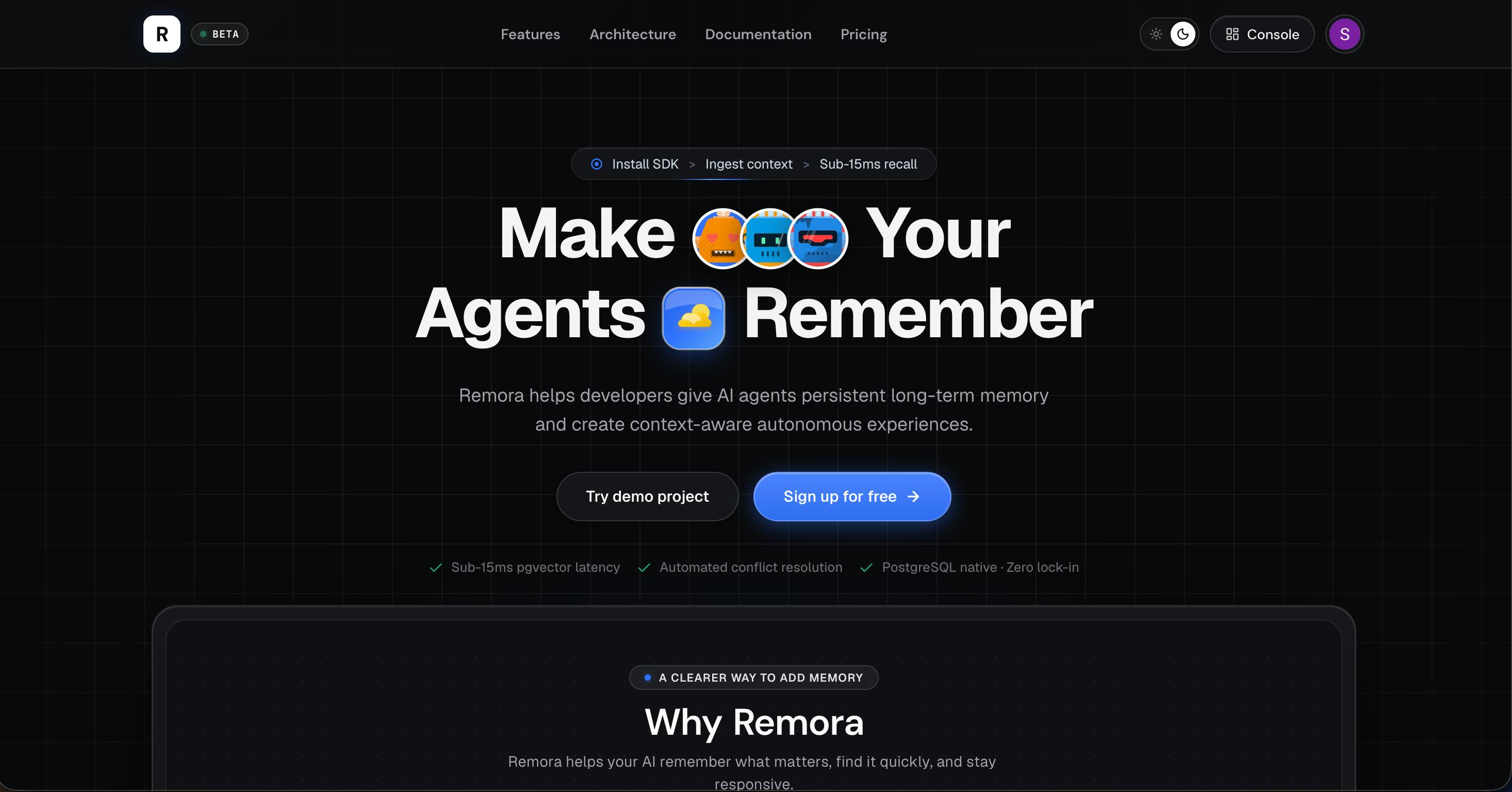
Remora is the #9 ranked long-term memory layer for AI agents on Product Hunt, addressing cross-session "amnesia." Built on PostgreSQL and pgvector, it offers native Python and TypeScript SDKs. Core workflow: continuous ingestion, fact deduplication, and sub-15ms context recall. It's infrastructure-layer, not tied to specific frameworks. Yet latency test scale, dedup accuracy, multimodal support, and data isolation remain unverified against competitors like Mem0, Zep, and cloud managed services.
AI agents often "lose their memory" during conversations, treating every interaction like a first meeting. Remora, ranked #9 on Product Hunt, aims to solve this pain point—it bills itself as "the long-term memory layer for AI agents," continuously ingesting conversations, deduplicating facts, and recalling relevant context within 15 milliseconds.
Why Do AI Agents Need a Dedicated Memory Layer?
Most AI applications today rely on context windows or temporary databases to store conversation history, but context length is limited, and each query requires recomputing embeddings—costly and high-latency. Developers are often forced to repeatedly write memory table schemas, falling into the trap of "reinventing the wheel." Remora's angle is to provide out-of-the-box memory infrastructure: no need to maintain your own vector tables, no need to hand-write deduplication logic—just call the SDK to achieve persistent memory and fast retrieval of conversations.
Context window refers to the upper limit of tokens a large language model can process in a single inference (e.g., GPT-4's 128K, Claude's 200K). Content within the window is visible to the model; anything beyond is truncated. Therefore, context windows alone cannot achieve long-term memory across sessions—once a conversation exceeds the length, earlier information is lost. Embedding is the process of mapping text into high-dimensional vectors, where the distance between vectors measures semantic similarity and forms the basis of vector retrieval. Recomputing embeddings for every query incurs extra API call overhead and computational latency—precisely the problem a dedicated memory layer avoids by persisting stored vectors.
Technical Foundation: PostgreSQL + pgvector
Remora is built on PostgreSQL and pgvector. This means it reuses the mature relational database ecosystem rather than starting from scratch. pgvector provides PostgreSQL with vector similarity search capabilities, and Remora wraps fact deduplication, context recall, and other logic on top of it. For teams already using PostgreSQL, operational costs are low, and data can be co-located with business databases. Official native Python and TypeScript SDKs are provided, covering mainstream AI application development stacks.
pgvector is an open-source extension for PostgreSQL that adds a vector type and approximate nearest neighbor (ANN) indexes to the relational database, supporting operators such as L2 distance, inner product, and cosine similarity. Common indexes include IVFFlat (inverted file with flat quantization) and HNSW (hierarchical navigable small world graph). The former builds quickly but its recall rate depends on parameters; the latter offers better query performance but higher memory usage. pgvector enables teams to implement semantic search on existing PostgreSQL instances without introducing a separate vector database (such as Pinecone or Milvus), while retaining relational capabilities like transactions, JOINs, and backups.
Core Capabilities: Ingestion, Deduplication, Recall
Remora's workflow can be summarized in three steps: continuously ingest conversation content; deduplicate facts to prevent memory bloat; and recall relevant context at query time, with official claims of sub-15ms latency. Deduplication is key to a memory layer—without processing, the same fact gets stored repeatedly, leading to redundant retrieval results and higher storage costs. Remora automates this process, letting developers focus on the agent logic itself.
Fact deduplication in memory systems typically relies on semantic similarity judgment: comparing newly extracted facts against existing memories via vector matching; if similarity exceeds a threshold, they are considered duplicates and can be skipped, merged, or updated. The challenge lies in threshold setting—too low and valuable new information gets wrongly deleted; too high and deduplication is incomplete. More sophisticated approaches also incorporate entity recognition and timestamps to distinguish "updates to the same fact" from "true duplicates." Deduplication quality directly affects recall accuracy and storage costs, making it an important metric for evaluating memory layer products.
Developer Experience and Positioning
Remora's tagline, "Stop reinventing the memory table," directly addresses developer pain points. It positions itself as an infrastructure layer rather than an end-to-end application framework. This means it isn't tied to a specific agent framework and can theoretically be used with tools like LangChain and LlamaIndex. Its 74 votes and 3 comments on Product Hunt indicate some attention, but the sample is small, and real-world production performance still needs more validation.
Challenges Worth Watching
The long-term memory layer space is highly competitive, with players like Mem0 and Zep as well as managed memory services from cloud providers. Remora's differentiation lies in its reliance on the PostgreSQL ecosystem and its low-latency promise. However, the data scale at which the 15ms recall latency was measured is not disclosed on the Product Hunt page. Additionally, deduplication accuracy, multimodal content support, and data privacy and isolation strategies are all dimensions enterprises need to further examine when selecting a solution.
For teams building AI agents that require cross-session memory, Remora offers a lightweight option. Whether to adopt it depends on the team's familiarity with PostgreSQL and specific requirements for latency and scale.
One-line Summary
Remora provides a low-latency long-term memory layer for AI agents based on PostgreSQL + pgvector, focused on ingestion, deduplication, and recall.
Paragraph Summary
Remora is the #9 ranked long-term memory layer product for AI agents on Product Hunt, designed to solve the "amnesia" problem across agent sessions. Built on PostgreSQL and pgvector, it reuses the mature relational database ecosystem and offers native Python and TypeScript SDKs. Its core workflow is continuous conversation ingestion, fact deduplication, and relevant context recall, with official claims of sub-15ms recall latency. Positioned as an infrastructure layer rather than an end-to-end framework, it isn't tied to specific agent tools and directly targets the pain point of developers repeatedly building memory tables. However, the data scale for its latency tests is undisclosed, and deduplication accuracy, multimodal support, and data isolation strategies remain to be validated. Amid fierce competition from Mem0, Zep, and cloud provider managed services, Remora differentiates itself through its PostgreSQL ecosystem reliance and low-latency promise.
Related articles

Nothing CMF Buds 2A Drops to $17.89 on Black Friday: A New Low for ANC Earbuds
Nothing CMF Buds 2A wireless earbuds Black Friday deal: just $17.89 on Amazon, about $11 off retail and a record low. ANC earbuds at an entry-level price.

When AI Creation Gets Accused of "Spitting": Hacker News Heats Up Over the Glaude Controversy
A Hacker News post, "Spitting in the Face of Glaude," sparks debate on AI creation transparency and attribution ethics. This analysis examines the blurred creator identity behind the controversy and offers practical advice for AI content production.

Akai Embraces Custom Firmware: MPC Sample 1.4 Lets Users AI-Program Their Sampler
Akai embraces the modding community with MPC Sample 1.4 firmware, supporting vibe-coded custom firmware and effects. We analyze the impact of this open strategy on music hardware and AI-assisted programming.