ReplaiBot Review: An AI-Powered Reputation Management Tool for Automated Customer Review Responses

ReplaiBot uses AI to auto-generate personalized review replies, helping small businesses manage online reputation efficiently.
ReplaiBot is an AI-driven reputation management tool that automatically generates personalized, brand-consistent replies to customer reviews across platforms like Google, Yelp, and Facebook. With sentiment recognition, platform context awareness, and brand voice matching, it helps small and medium businesses save up to 15 hours monthly while maintaining professional, consistent customer engagement.
When Online Reviews Become a Business Lifeline
For restaurants, hotels, e-commerce stores, local services, and other businesses that rely on word-of-mouth to survive, customer reviews are no longer a "nice-to-have" — they're a core factor that directly impacts revenue. Consumers heavily reference online reviews before making purchasing decisions, and whether a business thoughtfully responds to reviews also influences potential customers' trust in the brand.
According to BrightLocal's 2023 Local Consumer Review Survey, 98% of consumers read online reviews before choosing a local business, with 49% stating they trust online reviews as much as recommendations from friends and family. More critically, research from Harvard Business School shows that each additional star rating on Yelp corresponds to a 5%-9% average increase in restaurant revenue. A business's review response rate is equally impactful — Google's algorithm factors in a business's review interaction frequency as part of local search ranking considerations, meaning actively responding to reviews isn't just customer relationship management — it's part of an SEO strategy.
However, the reality is that responding to reviews is an extremely time-consuming task that's easily neglected. Businesses often need to switch back and forth between Google, Yelp, Facebook, and other platforms, reading each review individually, understanding the tone, and crafting an appropriate reply. When review volume scales up, this becomes nearly impossible to sustain through manual effort alone. ReplaiBot was built precisely to address this pain point.
What Is ReplaiBot
ReplaiBot is an AI-powered review reply generation and reputation management tool built by independent developer Mohit. It recently launched on Product Hunt, earning 14 upvotes and 3 comments, categorized under User Experience, Customer Communication, and Marketing.
Core Capabilities
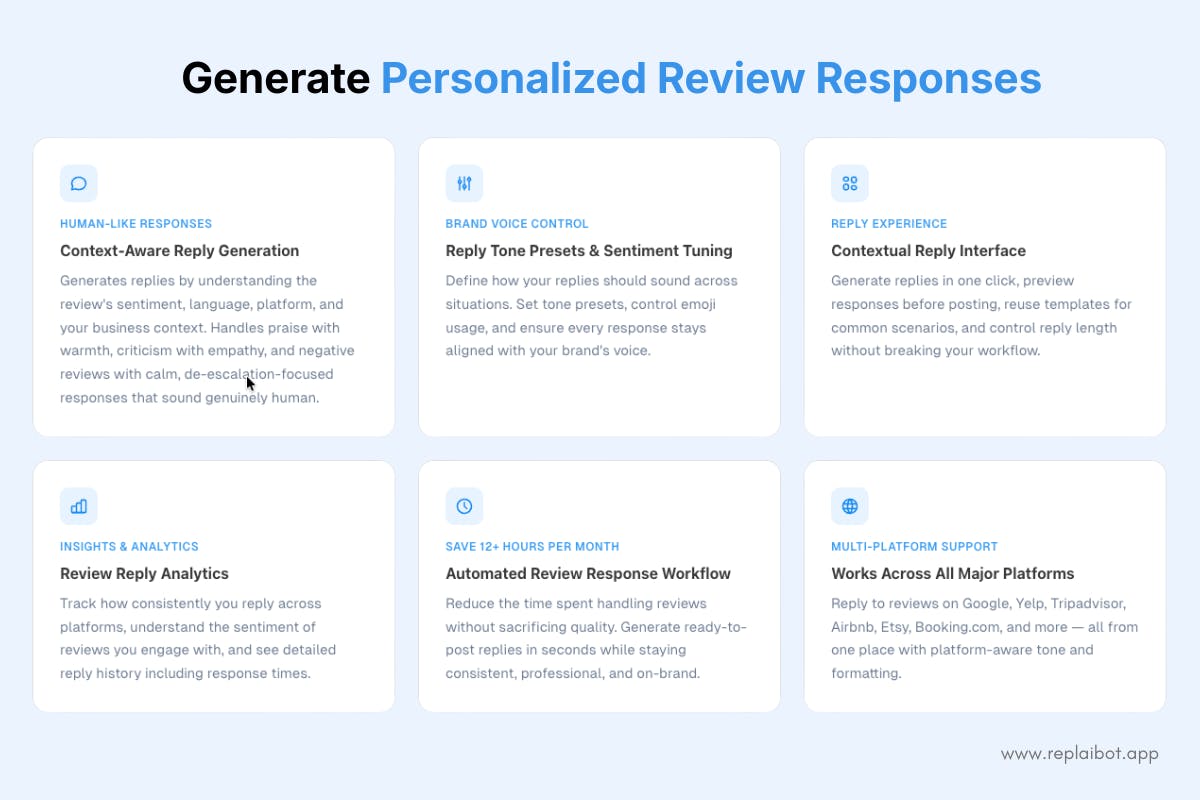
ReplaiBot helps businesses respond to customer reviews across major review platforms with personalized, human-like AI replies. It focuses on three core capabilities:
-
Sentiment Recognition: Determines whether a review is positive, negative, or neutral to decide the tone of the response. Sentiment Analysis is one of the core applications in Natural Language Processing (NLP). Modern sentiment analysis systems are typically based on pre-trained language models with Transformer architectures (such as BERT, GPT series), fine-tuned on large-scale annotated datasets to learn to identify sentiment polarity and more granular emotional dimensions (such as anger, disappointment, satisfaction, surprise, etc.). In the review response scenario, sentiment analysis needs to not only determine overall sentiment direction but also identify specific emotional triggers in the review — for example, whether a customer is dissatisfied with pricing or service attitude — to generate targeted replies.
-
Platform Context Awareness: Adjusts response style based on user habits across different platforms. Google review users expect concise, direct responses; Yelp users may expect more detailed explanations; while Facebook interactions tend to be more social and personable. Platform context awareness means the AI needs to understand these implicit community norms and adjust reply length, tone, and format accordingly.
-
Brand Voice Matching: Ensures generated replies align with the business's own tone, avoiding cookie-cutter robotic responses. Brand voice matching is typically achieved through Prompt Engineering or Fine-tuning techniques. In the Prompt Engineering approach, the system embeds brand style guidelines into the AI model's system prompt, including tone descriptions (e.g., "professional yet friendly," "humorous and lively"), prohibited word lists, and exemplary reply samples. A more advanced implementation uses Few-shot Learning, feeding the business's historical high-quality human replies as reference samples to help the AI learn the brand's unique expression patterns.
According to official claims, businesses can save up to 15 hours per month on review management while improving their online reputation and enhancing customer engagement.
Why Review Responses Deserve AI Automation
Many people question: how hard can it be to reply to a review? But the real challenge isn't in a single reply — it's in consistency at scale.
The Hidden Cost of Time
For a business with steady foot traffic, it might receive several to dozens of reviews daily. Crafting high-quality replies one by one means operations staff must invest substantial fragmented time. ReplaiBot's claimed "15 hours saved per month" translates to roughly half an hour saved per day — which is no small amount for a small team. Considering that small business owners typically wear multiple hats, releasing this half-hour of cognitive load can deliver efficiency gains far beyond the time itself.
Professional Handling of Negative Reviews
Replying to negative reviews is particularly challenging. A poorly worded response can escalate conflicts and may be seen by more potential customers, creating secondary damage. Research shows that approximately 45% of consumers say they're actually more likely to patronize a business if they see it has given a thoughtful reply to a negative review. AI can generate calm, appropriate, and professional reply templates based on sentiment analysis, helping businesses avoid emotional expressions and turning crises into opportunities to showcase service attitude. This "negative review conversion" capability is often the operational skill that small businesses lack most and need most.
Ensuring Brand Consistency
When multiple employees respond to reviews separately, tone and wording often vary significantly. Through unified brand voice settings, AI can output stylistically consistent replies, maintaining brand image coherence across every interaction. In brand management theory, this cross-touchpoint consistency is called "Brand Experience Coherence" and is one of the key elements in building long-term consumer trust.
Product Positioning and Market Competition
Review management and reputation management are not entirely new categories. Online Reputation Management (ORM) is a market projected to reach approximately $550 million by 2025. Market leader Podium, founded in 2014, has raised over $500 million in funding, primarily serving mid-to-large enterprises with an all-in-one platform spanning review management to customer communications. Birdeye covers over 150,000 business customers, emphasizing omnichannel review aggregation and competitive benchmarking. Yext focuses on multi-platform synchronization of business information. These platforms typically charge annual subscriptions ranging from hundreds to thousands of dollars, presenting a high barrier for small businesses with limited monthly revenue.
By comparison, ReplaiBot as an indie developer product differentiates itself through its lightweight and AI-native positioning. For small and medium businesses with limited budgets that don't need heavy SaaS systems, a tool focused on "quickly generating high-quality replies" may be more appealing than feature-bloated enterprise platforms. This explains why lightweight indie tools still have clear survival space in markets where enterprise products are highly mature — they satisfy the long-tail demand of "good enough is enough."
Of course, as an early-stage product, its maturity in multi-platform deep integration, data analytics, and team collaboration still awaits market validation.
A Realistic View of AI Reply Limitations
While AI can dramatically improve review response efficiency, fully relying on machine-generated replies also carries risks. Review responses are fundamentally a form of human-to-human communication, and overly templated replies lacking genuine details may be detected by consumers, undermining trust. Research has shown that consumer satisfaction with obviously AI-generated customer service replies averages 20%-30% lower than human replies, especially in scenarios involving specific complaints or emotional appeals.
A more sensible approach is "Human-in-the-Loop" (HITL) — currently recognized as the best practice model in AI content generation. In this model, AI handles standardized, highly repetitive foundational work (such as generating reply drafts and extracting key information), while humans handle final review, personalized adjustments, and complex decisions. Gartner's research indicates that by 2025, customer service teams adopting human-in-the-loop models will be 25% more efficient than teams relying entirely on humans or entirely on AI.
In the review response scenario, this means AI can compress processing time for 80% of standardized reviews to near zero, while human effort can focus on truly high-value reviews requiring personalized handling (such as detailed complaints or key customer feedback). ReplaiBot's emphasis on "human-like" and "brand voice matching" is precisely an attempt to narrow the gap between machine replies and human replies, but the final quality gate should remain in the business's hands.
Summary
ReplaiBot represents a typical case of AI landing in vertical business scenarios — it focuses on the specific, high-frequency pain point of "review responses," offering small and medium businesses burdened by review management a viable path to reducing costs and improving efficiency.
As a newly launched indie product, its actual effectiveness, platform coverage breadth, and long-term competitiveness still need validation in real business environments. For readers interested in AI application deployment, these "small but specialized" tools are exactly the perfect window for observing how AI integrates into daily business operations. In an era where AI capabilities are increasingly commoditized, the true competitive advantage may lie not in the sophistication of the underlying model, but in the deep understanding and precise resolution of specific business scenario pain points.
Related articles

LangGraph Studio Hidden Features: Practical Tips for Visually Debugging Agent Workflows
Explore LangGraph Studio's hidden features including time travel debugging, interactive state editing, and human-in-the-loop testing to efficiently debug AI Agent workflows.

Mecanum Wheel Motion Simulation Platform: A Detailed Guide to Low-Cost VR Haptic Solutions
A detailed look at a Mecanum wheel-based omnidirectional motion simulation platform using VR trackers for 3-DOF motion simulation and recentering correction — a viable low-cost VR immersion solution.

LangChain Managed DeepAgents: Hosted Agent Infrastructure So You Can Focus on Core Logic
LangChain launches Managed DeepAgents public beta, hosting evals, memory, OAuth, Slack integration, and sandbox infrastructure so developers can focus on Agent core logic.