Replicating Manus for $30: A Practical Breakdown of Building an AI Agent's Minimum Viable Loop

A developer replicates the Manus AI agent platform for $30, monetizing through courses and source code sales.
A developer took on a $30 project to replicate a Manus-like AI agent platform called Figure K AI, achieving a minimum functional closed loop: user inputs task → AI plans → generates results. Technically, it uses Docker containers for isolated task execution, ensuring security and scalability. The business model adopts a "co-creation" approach, monetizing at scale by converting the project into hands-on courses and selling the source code, covering the low project cost through multiple distributions.
Project Background: How Do You Replicate Manus for $30?
I recently came across an interesting case — a developer took on a $30 (200 RMB) project with the goal of replicating an AI agent platform similar to Manus. The price is absurdly low, but the business logic and technical approach behind it are actually worth examining. The project has already achieved a minimum functional closed loop, so let's look at what was actually built.
What is Manus? Manus is an AI agent platform that generated widespread attention in early 2025, developed by the Chinese team Monica. Its core feature is the ability to autonomously complete complex multi-step tasks — not just answering questions, but acting like a true digital employee that independently plans tasks, invokes tools, executes code, browses the web, and ultimately delivers complete work outputs. After launch, Manus quickly triggered a registration frenzy and became one of the benchmark products in the AI Agent space, which is why it became the target of study and replication by countless developers.
The project is called Figure K AI, and both its interface and core functionality are benchmarked against Manus's product form. The developer was quite straightforward: $30 isn't a price for pure custom development — it's a "co-creation model." After completion, the project will be turned into a hands-on course, and the source code will be sold externally, using multiple distributions to cover costs.
Product Interface & Functional Architecture Overview
Overall Layout Design
Figure K AI uses the classic left navigation bar + right workspace layout. The left side houses function entry points; hovering over the Logo expands the sidebar, supporting basic operations like creating new sessions and searching history. The overall style is clean and closely resembles Manus's design language.
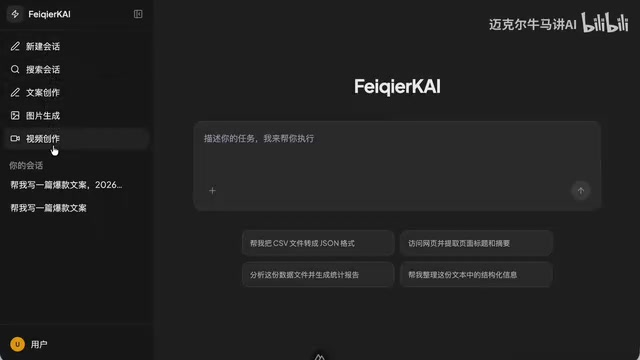
Beyond the core conversation functionality already implemented, the sidebar has reserved entry points for copywriting, image generation, video creation, and more. Although the client didn't request these modules, the developer's thinking is: as an agent project, you can later build different workflows on the existing infrastructure and gradually enrich the platform's capability matrix.
The Complete Task Execution Flow
The core flow that's currently working looks like this: User inputs task → AI performs task planning → Generates response → Delivers results.
How AI Agents Work AI Agents (artificial intelligence agents) represent one of the core paradigms of current large model applications. Unlike traditional single-turn Q&A, Agent systems can decompose complex goals into multiple subtasks and complete them through iterative cycles of "planning → tool invocation → execution → feedback." A typical Agent architecture includes: a large language model as the reasoning core, a tool set (search, code execution, file operations, etc.), a memory module (short-term context + long-term storage), and a task orchestration layer. Currently mainstream Agent frameworks include LangChain, AutoGen, CrewAI, etc., all attempting to solve core challenges like Agent reliability, tool invocation accuracy, and long-task execution stability. What Figure K AI has implemented is precisely the simplest version of this architecture.
The developer demonstrated a real case — having the AI write viral copy. The system first performs task planning and analysis, then generates content and delivers it to the user.
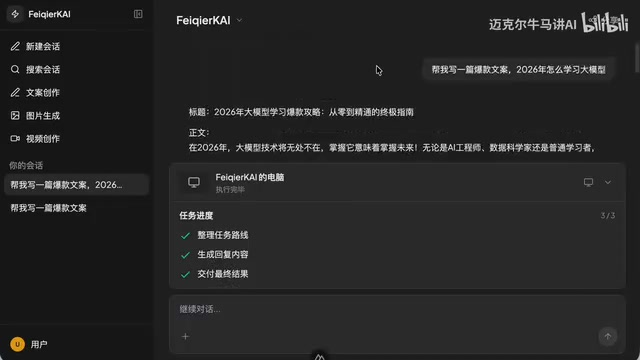
From the results, this flow is consistent with Manus's basic logic. However, it's currently a minimum viable loop, primarily relying on the large model's own capabilities to complete tasks, without integrating more external tools yet. The developer mentioned that research tools and other components will be added later, at which point task completion quality will see noticeable improvement.
Technical Highlight: Docker Containers for Isolated Task Execution
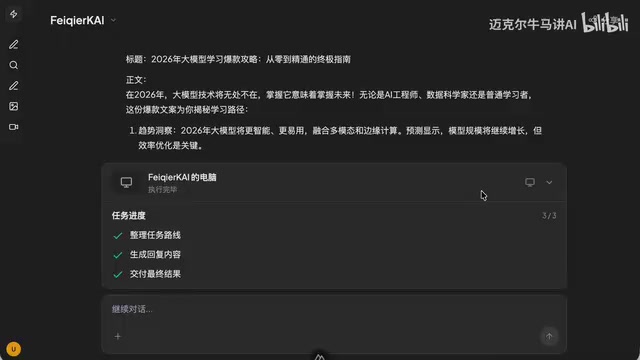
This project has one noteworthy technical detail — task execution is integrated with Docker containers. Tasks submitted by users actually run inside Docker containers. Clicking the "computer" icon on the interface opens a terminal window on the right side, displaying the task execution process in real time.
Why Use Docker Containers? Docker is currently the most mainstream containerization technology, released by Solomon Hykes in 2013. The core idea of container technology is to package an application and all its dependencies into an independent runtime unit, achieving process-level isolation from the host system. Compared to virtual machines, Docker containers share the host kernel, start faster (typically in seconds), and consume fewer resources. In AI Agent scenarios, Docker's value is particularly prominent: tasks submitted by users may include arbitrary code execution, and running them directly on the server poses serious security risks. Through container isolation, each task runs in an independent sandbox environment — even if code behaves abnormally, it won't affect the main system. This is also the architectural approach universally adopted by mainstream AI Agent platforms like Manus and Devin.
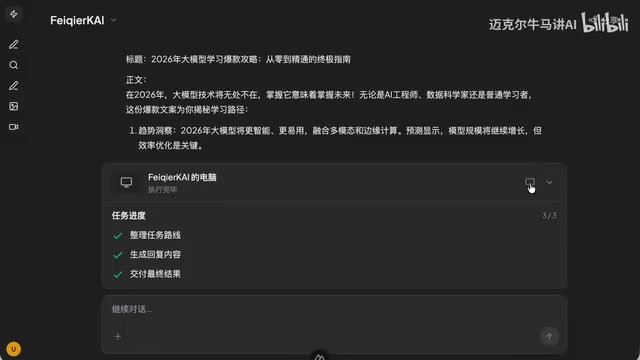
This architectural design has several practical benefits:
- Security isolation: Tasks execute in containers without affecting the host environment
- Scalability: More tools and runtime environments can be integrated into containers later
- Process visualization: Users can intuitively see what the AI is doing, which greatly increases trust
This is also the key difference between agent development and traditional CRUD projects. Traditional projects focus on data creation, reading, updating, and deletion, while agent projects need to handle task orchestration, tool invocation, environment isolation, and a series of more complex problems.
Business Model Breakdown: How Do You Make Money on a $30 Project?
Many people's first reaction is: doesn't taking on this kind of project for $30 lose money? The developer provided a clear monetization path:
- Course monetization: After project completion, organize it into a hands-on tutorial and earn ongoing income through course sales
- Source code sales: Sell the complete source code at $30 per copy, selling one codebase multiple times
- Technical accumulation: Accumulate agent development experience through real projects, building your own technical moat
The Underlying Logic of Course Monetization for Individual Developers The monetization model of converting real projects into course content is already quite mature in both domestic and international indie developer communities. The economic logic of this model is: development costs are one-time, but content can be distributed infinitely with marginal costs approaching zero. In the AI field, due to extremely fast technology iteration and strong learning demand, the market demand for hands-on courses is particularly intense. Similar models have numerous success cases on overseas platforms (like Udemy, Gumroad) and domestic platforms (like Xiaobaotong, Aifadian). For individual developers, this flywheel model of "projects funding courses, courses funding projects" is an effective path to achieving sustainable income with limited resources.
The prerequisite for this model to work is that the client accepts the content being turned into a course and the source code being sold externally. Essentially, it's an open-source co-creation approach — trading extremely low customization costs for the right to publish content publicly, with the developer covering costs and profiting through scaled distribution. For individual developers, this approach actually has significant reference value.
Future Iteration Directions & Takeaways for Developers
Currently, Figure K AI is still in the MVP stage, with the core large model + Docker container infrastructure already running.
The Value of MVP Methodology MVP (Minimum Viable Product) is a core concept in lean startup methodology, systematically articulated by Eric Ries in The Lean Startup. Its core idea is: build a product version that can validate core assumptions with minimal development cost, quickly push it to market to obtain real feedback, then iterate and optimize based on that feedback. In AI Agent development, the MVP approach is especially important — Agent systems are extremely complex, and the more tools and longer processes involved, the higher the probability of errors. First running through the minimum closed loop of "large model + basic execution environment," validating the core experience, then gradually layering on tools and capabilities, is currently the industry's recognized most robust development path.
Future iterations will mainly focus on three directions:
- Tool integration: Connecting search engines, web browsing, code execution, and other external tools so the AI isn't just "pure chat"
Related articles
 Tutorials
ChatGPT Plus Subscription Guide: Are GPT-5.5, image-2, and Codex Worth the Upgrade?
A detailed look at ChatGPT Plus features — GPT-5.5, image-2, and Codex — with a Plus vs Pro comparison and a complete step-by-step subscription guide for users outside the US.
 Tutorials
Harness AI Engineering in Practice: Using Claude Code to Master Enterprise-Level E-Commerce Development
Deep dive into Harness AI Engineering: master enterprise e-commerce development with Claude Code using the Rules, Skills, Wiki, and Changes framework.
 Tutorials
Cursor + Codex Dual-IDE Collaboration: A Practical Methodology for Open-Source Project Customization
A complete methodology for open-source project customization based on real-world experience, detailing the Cursor+Codex dual-IDE workflow, seven-stage process, MVP validation, and AI source code reading techniques.