Replika Founder Returns: Wabi Free AI Assistant Realizes a 12-Year-Old Vision

Replika founder launches Wabi, a free personal AI assistant fulfilling a 12-year-old vision.
Replika founder Eugenia Kuyda has launched Wabi, a new free downloadable AI assistant whose concept dates back to her first presentation at TechCrunch Disrupt 12 years ago. Unlike Replika's focus on emotional companionship, Wabi is positioned as a personal daily task assistance and information management tool, emphasizing downloadable and local/semi-local operation to address privacy concerns. The free strategy is relatively rare in a subscription-dominated AI assistant market, and Kuyda believes falling technology costs can now support free services at scale. Wabi faces competitive pressure from major tech assistants (ChatGPT, Gemini) and high computing costs, but Kuyda's conversational product experience and user psychology insights constitute a differentiated advantage. The founder's IP is both a financing boost and brings连带 scrutiny from Replika's controversies.
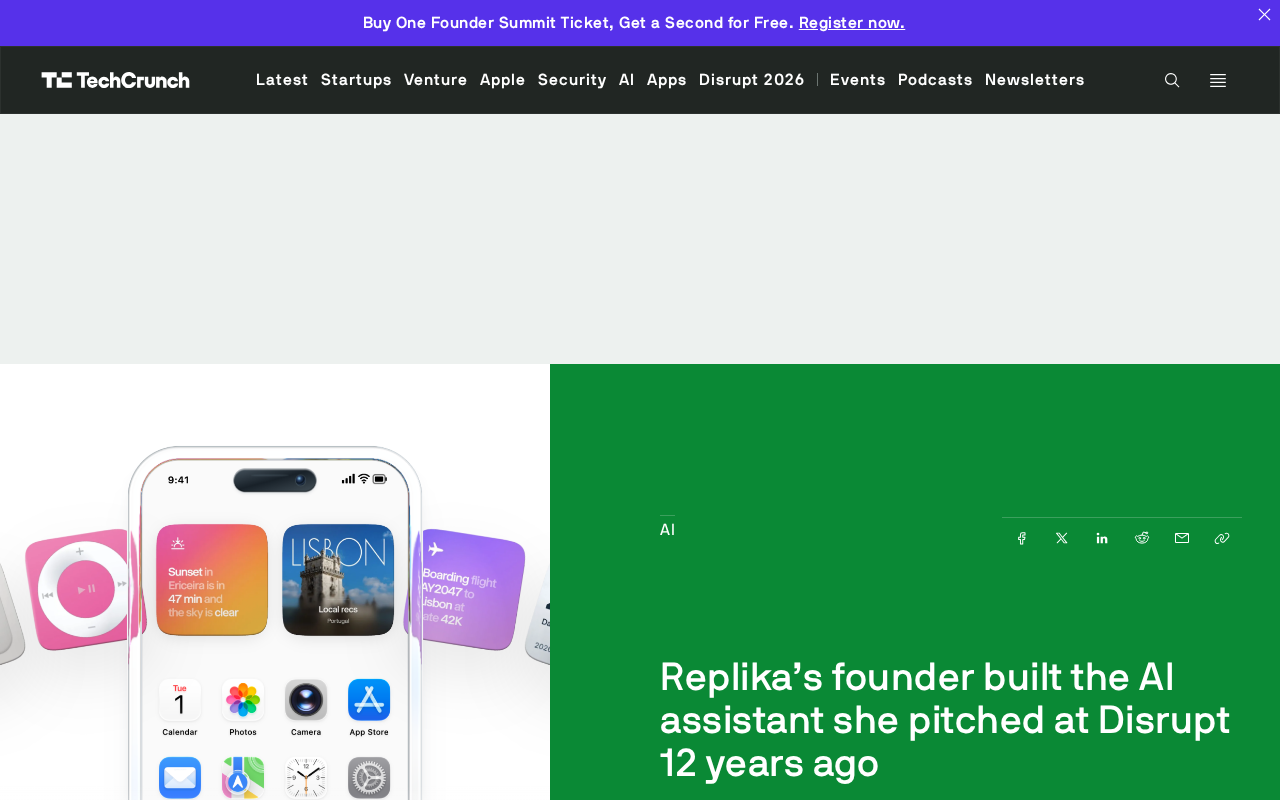
In today's increasingly crowded AI assistant market, Replika founder Eugenia Kuyda is back in the spotlight with a new project called Wabi. This free, downloadable personal AI assistant is essentially the realization of an idea she first presented on the Disrupt stage 12 years ago. According to TechCrunch, Kuyda first showcased the concept that later evolved into Replika at Disrupt, and Wabi carries her earlier vision—a truly personal AI companion.
From Replika to Wabi: A Product Line Spanning Twelve Years
Kuyda's entrepreneurial trajectory has always revolved around "conversational AI." Replika entered the market with emotional companionship, accumulating a massive user base, but also facing commercialization and ethical controversies. Wabi's positioning is different: it emphasizes a "personal AI assistant" and is completely free. This pricing strategy is uncommon today—most AI assistants are either subscription-based or tied to hardware. In an interview, Kuyda stated that Wabi can be free because technology costs have dropped enough to support规模化 free services at scale.
A detail worth noting: Wabi is not a simple replica of Replika. Replika focuses on simulating interpersonal relationships, while Wabi leans more toward daily task assistance and information management. This difference reflects Kuyda's judgment on the evolution of AI assistants: users need not only emotional companionship but also practical value.
Replika is a conversational AI app officially launched by Eugenia Kuyda in 2017. It was initially created as a digital avatar to memorialize her deceased friend and gradually evolved into a virtual companion offering emotional support. Users can build highly personalized conversational relationships with Replika, whose core mechanisms include memory storage, emotional feedback, and character development. Replika has accumulated tens of millions of users worldwide, particularly attracting people experiencing loneliness and social anxiety, but it has also sparked ethical controversies over users potentially developing excessive emotional dependence, data privacy handling, and blurred content boundaries. These experiences directly influenced Wabi's design orientation, making it emphasize tool attributes and privacy protection.
Wabi's Product Logic: The Considerations Behind Free
The free strategy is Wabi's most prominent label. In a context where AI products generally seek monetization, Kuyda chose to scale first and consider the business model later. This approach resembles Replika's early strategy, but Wabi faces a more complex market environment—major tech assistants (such as ChatGPT and Gemini) have already captured user mindshare, and startups must find a differentiated angle.
Wabi's angle may be "downloadable" and "personalized." Unlike purely cloud-based assistants, Wabi emphasizes local or semi-local operation, which addresses users' privacy concerns to some extent. However, the specific technical architecture has not been fully disclosed, and whether its actual experience can support the "personal AI assistant" positioning still needs market validation.
Local and semi-local operation has been an important technical direction in the AI assistant field in recent years. Unlike relying entirely on cloud-based large model inference, local operation deploys part or all of the model on the user's device, thereby reducing data upload, lowering latency, and enhancing privacy and security. Implementation methods typically include using distilled small models, on-device inference frameworks (such as llama.cpp, MLC), and hybrid architectures—simple tasks processed locally, complex tasks falling back to the cloud. The challenge of this architecture lies in device computing power limitations and model capability degradation, but for assistant products emphasizing "personalization" and privacy, it is a key technical path to building a differentiated experience.
The Market Twelve Years Later: Opportunities and Challenges Coexist
The concept Kuyda proposed at Disrupt is not outdated today, but the competitive landscape is entirely different. Twelve years ago, AI assistants were still at the voice command stage; today, large language models have greatly expanded the capability boundaries of conversational assistants. Wabi must face not only technical issues but also the migration cost of user habits.
On the positive side, Kuyda has conversational product experience accumulated from Replika and understands user psychology better than most founders with technical backgrounds. If Wabi can iterate quickly under a free model, it may gain a foothold in niche scenarios. But the risks are equally obvious: free means high computing costs, and if differentiated features are not prominent enough, they can easily be covered by major tech products.
Disrupt is TechCrunch's annual tech startup conference, featuring a "Startup Battlefield" segment where many well-known startups have made their public debut. Twelve years ago, around 2013, the mainstream form of AI assistants was still limited interaction based on rules and voice commands (such as early versions of Siri), and large language models had not yet entered the practical stage. Kuyda's "personal AI companion" concept at the time was far ahead of its era in terms of technical conditions and only became feasible after the maturation of the Transformer architecture and generative AI. This time span also explains why Wabi is seen as a belated fulfillment of an early vision.
The Double-Edged Sword of Founder IP
Kuyda's personal brand is both a boost and a pressure for Wabi. Replika's success makes investors willing to give Wabi a chance, but the controversies Replika once sparked (such as emotional dependence and data privacy) will also be brought into public view. Wabi needs to draw clearer boundaries in product design to avoid repeating past mistakes.
Wabi is currently available for download, but information about team size, financing, and long-term roadmap is limited. For observers following the AI assistant market, Wabi is worth continuous tracking—it is both a validation of Kuyda's vision from twelve years ago and a stress test of the free AI assistant model.
Related articles

Gemini 4 Argon Hands-On: AI Builds Board Games, Constructs Temples, and Trains Robots Autonomously
Gemini 4 Argon hands-on roundup: AI autonomously builds a desk racetrack and temple in Blender, writes a ray tracing engine, trains a humanoid robot to sink 7 shots, plus API pricing and developer access.

The Magic Octagonal Coin: Why Only 9% of People Can Predict Its Flip?
Only 9% of people can correctly predict the Magic Octagon coin flip. This article explains its spatial rotation mechanism, common cognitive pitfalls, and a new hypothesis based on Relevance Theory, exploring the limits of human spatial reasoning.

Sam Altman: AI Is Entering the Era of Scientific Discovery — Math Breakthroughs Will Replicate in Biology and Energy
Sam Altman says AI is entering the era of scientific discovery — math breakthroughs will replicate in biology, materials science, and energy to help develop new drugs and energy sources.