Replit CEO: AI Isn't Here to Replace You — It's Here to Give You More Time to Make Judgment Calls

Replit CEO's "self-driving company" vision: AI agents do the busywork, humans focus on judgment and decisions.
At TechCrunch Disrupt, Replit CEO Amasad presented the "self-driving company" vision: AI agents handle process work like support ticket triage, context summarization, and fix deployment, while humans keep final decision-making authority, focusing on judgment, taste, and deciding what to build next. He stressed that AI's purpose at work isn't to make people do less, but to reallocate time to judgment-heavy tasks. The framework offers three takeaways: identify automatable busywork, preserve human decision points in agent workflows, and measure AI's value by freed-up judgment time rather than headcount savings.
At TechCrunch Disrupt, Replit CEO and co-founder Amasad shared his vision of the "self-driving company." The core of this metaphor: AI agents take on large amounts of tedious work, while humans focus on deciding what's worth doing.
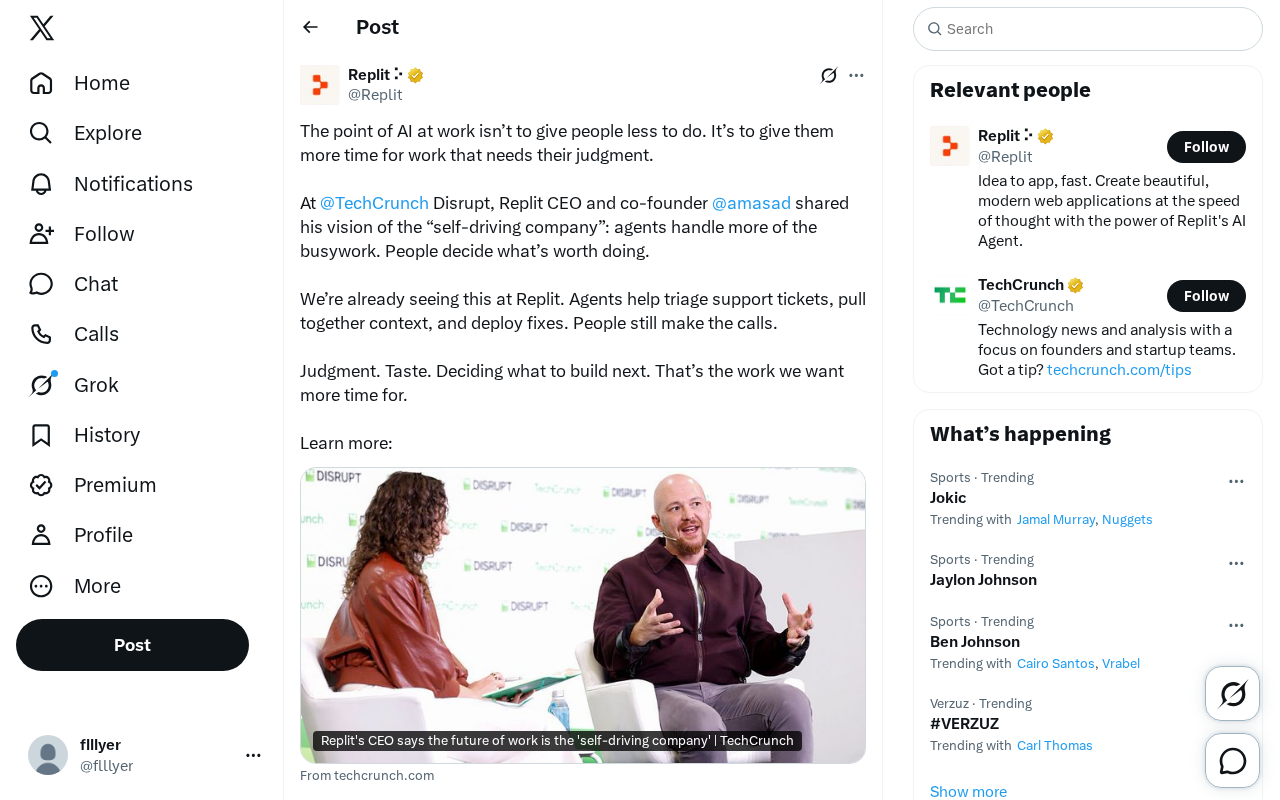
The Real Value of AI: Freeing Up Judgment, Not Replacing People
"The purpose of AI at work isn't to make people do less — it's to give people more time for the work that requires judgment." This was the central point of Amasad's talk.
Traditionally, the narrative around automation has revolved around "reducing headcount," but Replit's practice points in a different direction: AI agents handle repetitive, process-driven busywork, while humans put their energy into higher-level decisions. This shift in thinking means both managers and employees need to redefine "efficiency" — not getting the same work done with fewer people, but enabling the same people to do more valuable work.
According to Amasad's talk, this model is already in place inside Replit.
From Ticket Triage to Fix Deployment: The Agent's Specific Roles
Replit's engineering and support teams are already using AI agents for a range of specific tasks:
- Support ticket triage: Agents help categorize and prioritize user support tickets, reducing the time spent on manual sorting
- Context summarization: Agents automatically gather and organize the background information needed for a given issue
- Fix deployment: Agents participate in executing the deployment process for fixes
The key point: even though agents take on this execution-level work, the final decisions are still made by humans. Amasad emphasized that humans still "make the call" — deciding which problems are worth prioritizing, which fixes are acceptable, and what to build next.
This human-machine division of labor is fundamentally different from "full automation." Agents are the executors; humans are the judges.
AI Agent refers to a software system capable of perceiving its environment, planning autonomously, and calling tools to execute multi-step tasks — distinct from a chatbot that only handles single-turn Q&A. A typical agent has capabilities such as task decomposition, tool invocation (e.g., reading and writing to code repositories, triggering deployment pipelines), memory, and reflection. The "ticket triage" mentioned above falls under an agent's read-and-classify capabilities, while "fix deployment" involves an agent calling external systems to perform write operations — higher risk, and therefore usually requiring a human approval step as a guardrail. Understanding the difference between an "agent" and an "automation script" is crucial: scripts execute according to fixed rules, whereas agents dynamically decide the next action based on context — which is exactly why they're suited to handling unstructured busywork.
"Self-Driving Company": A Metaphor Worth Unpacking
Amasad uses "self-driving company" to summarize this organizational form. In a self-driving car, the system handles the vast majority of routine driving operations, but the driver (or, at higher levels of autonomy, the supervisor) remains responsible for key decisions.
Mapping this metaphor onto company operations means: a large amount of the "driving" work in day-to-day operations is done by AI agents, while humans focus on strategic questions like "where to go" and "why go there."
The practical value of this framework is that it gives companies a clear boundary for adopting AI: not pursuing a headcount-free operation, but maximizing judgment within human-machine collaboration.
Judgment, Taste, and Direction
Amasad specifically mentioned three keywords: Judgment, Taste, and Deciding what to build next.
These three point to capabilities that AI currently struggles to replace. Judgment involves making decisions with incomplete information; taste involves intuition about product quality and direction; and deciding what to build is about strategic trade-offs. Amasad's implication is that once agents take over execution-level busywork, organizations should invest the time saved into these areas.
This also addresses a common worry: will AI make people "dumber" or "idler"? Replit's answer is no — time is reallocated to tasks that demand more distinctively human qualities.
Human-in-the-loop (HITL) is a common design pattern in human-machine collaboration: the system pauses at key points in the process and waits for human confirmation, correction, or rejection before continuing. It stands in contrast to "full automation," emphasizing the embedding of human judgment into agent workflows. In the ticket triage and fix deployment scenarios Replit describes, the human "making the call" is precisely HITL in action. In practice, this typically requires designing approval thresholds (which operations must be manually confirmed and which can be auto-approved), traceable operation logs, and rollback mechanisms for when agents make mistakes. The value of this pattern: it preserves the efficiency agents bring while keeping responsibility for high-risk decisions on the human side.
Implications for Businesses and Developers
Replit's practice offers a reference sample. For teams considering adopting AI agents, Amasad's framework suggests several directions for action:
Identify the boundaries of "busywork." Which tasks are process-driven and can be triaged and summarized by agents? These are the priority targets for automation.
Preserve decision points. Build human approval and judgment steps into agent workflows to ensure key decisions aren't swallowed by automation.
Redefine output. The measure of AI's value shouldn't just be "how much manpower was saved," but also "how much time was freed up for judgment and creation."
Amasad's talk didn't offer a specific implementation roadmap, but the "self-driving company" metaphor itself provides a sufficiently clear thinking framework: AI agents are the execution system behind the wheel, but humans remain the ones setting the destination.
Observability and permission governance for AI agents are engineering problems that tend to be underestimated when adopting agents. When agents participate in write operations like deployment, teams need to know what they did, why they did it, and how to roll back if something fails. Common practices include: assigning agents dedicated service accounts with least privilege, logging every tool call in a structured format, and setting up dual gates of automated testing and human approval before deployment. In addition, an agent's "context summarization" capability depends on the retrieval quality of internal documents and ticketing systems — if the knowledge base itself is messy, the agent's output will be distorted too. So before connecting agents into production workflows, sorting out data and permission boundaries is often more important than choosing a model.
One-line Summary
Replit CEO proposes the "self-driving company" vision: AI agents handle tedious execution while humans focus on judgment and decisions.
Paragraph Summary
At TechCrunch Disrupt, Replit CEO and co-founder Amasad presented the "self-driving company" vision: AI agents take on process work like support ticket triage, context summarization, and fix deployment, while humans retain final decision-making authority, focusing on judgment, taste, and deciding what to build next. He stressed that the purpose of AI at work isn't to make people do less, but to reallocate time to tasks that require judgment. This framework draws a clear boundary for businesses adopting AI — maximizing judgment in human-machine collaboration rather than going headcount-free. The article distills three takeaways: identify automatable busywork, preserve human decision points in agent workflows, and measure AI's value by "how much judgment time was freed up" rather than "how much manpower was saved."
Related articles

A Single Prompt Triggers a Global PHP Security Storm: Is AI a Savior or a Hidden Risk?
A single AI prompt triggered a global PHP security crisis affecting Wikipedia and the Internet Archive. This article reviews the incident, analyzes the OpenAI-Amazon controversy, and explores the security paradox of lowered vulnerability discovery barriers in the AI era and developer response strategies.

When AI Is Taken Away: How Reliance on Shortcuts Undermines Your Problem-Solving Resilience
A study of 1,222 people found that after using AI to answer questions, once AI was removed, people gave up on more problems than a control group that never used AI. The article analyzes the impact of AI reliance on learning resilience and metacognition, and explores design implications for AI learning tools.

Carta and NewView Partner to Let Startup Employees Cash Out Equity Early
Carta and NewView Capital partner to simplify startup tender offers, helping employees sell equity early. Analysis of the mechanism, liquidity pain points, and impact.