Replit Comes to Windows: A New Approach to Local Sandboxed App Building

Replit teams up with Microsoft and NVIDIA to bring AI-powered local sandboxed builds to Windows.
Replit has announced a deep partnership with Microsoft, extending its AI app-building capabilities to local Windows development. Each build runs in an isolated sandbox powered by Microsoft Execution Containers for lightweight isolation and NVIDIA OpenShell for runtime and potential GPU acceleration. This reduces reliance on remote cloud resources while preserving security. The move also signals a new competitive dimension for AI coding tools — shifting focus from code generation quality to the completeness and safety of the full execution environment. The feature is currently in preview, with performance details and availability timelines yet to be confirmed.
Replit Moves Into Windows Local Development
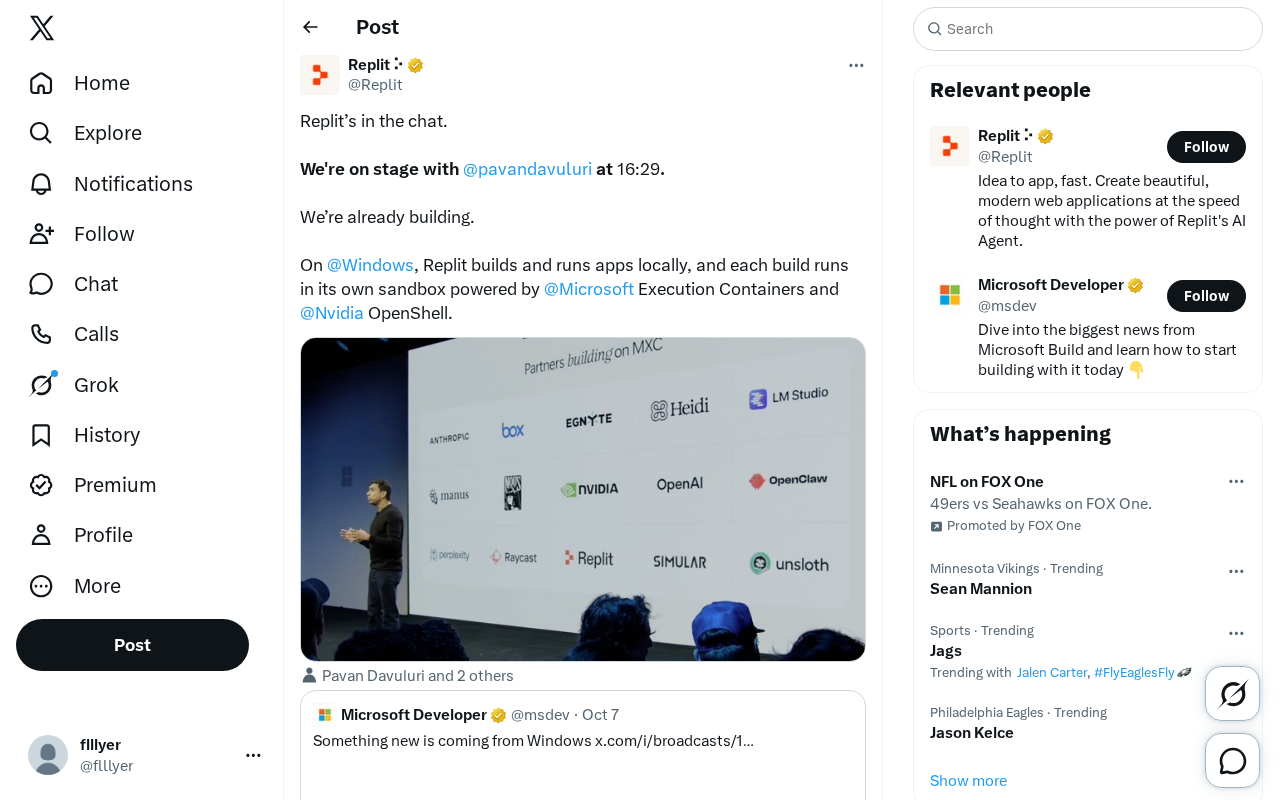
Replit has announced a deep partnership with Microsoft, bringing its app-building capabilities to the Windows platform. According to posts shared on social media, Replit made its debut at a live demo led by Microsoft Windows team head Pavan Davuluri, showcasing a brand-new workflow for building and running apps locally on Windows.
This move marks Replit's expansion from a cloud-based IDE into local development environments. Replit has long been known for its in-browser cloud coding experience, but this integration with the Windows ecosystem means developers can now build and run projects directly on their local machines — without relying entirely on remote cloud resources.
Sandbox Isolation and the Underlying Tech Stack
Based on what's been disclosed, the core of this solution is that every build runs in its own isolated sandbox. Replit is using Microsoft's Execution Containers and NVIDIA's OpenShell as the underlying infrastructure.
Sandbox isolation is a critical design principle for modern AI-assisted development tools. When an AI agent or automated process generates and executes code, an isolated environment effectively limits potential risks, preventing untrusted code from affecting the host system. Each build running in its own sandbox ensures a clean, reproducible environment and lays the groundwork for parallel builds and safe execution.
Microsoft Execution Containers provide lightweight containerized execution, while the inclusion of NVIDIA OpenShell hints at GPU acceleration or deeper runtime-level integration. This "Microsoft + NVIDIA" combination reflects a broader trend: local AI developer toolchains are evolving toward tighter hardware-software co-design.
NVIDIA OpenShell is a relatively new technical term with limited public documentation. Based on its name and context, it likely relates to a low-level runtime or shell execution environment that NVIDIA provides on Windows — possibly a variant of the NVIDIA Container Toolkit adapted for non-Linux environments to enable containerized GPU access. Traditionally, NVIDIA's GPU-accelerated container solutions have been Linux-centric (e.g., CUDA containerization). OpenShell may signal NVIDIA's push to bring similar capabilities to the Windows ecosystem, providing hardware-accelerated support for local AI inference, code execution, or model loading. Since no official technical documentation has been released yet, the specific implementation details remain to be confirmed.
What This Means for Developers
For developers accustomed to cloud-based Replit, Windows local builds bring several immediate changes. Running locally reduces dependence on network latency, which could mean faster build-and-debug feedback loops. At the same time, local sandboxing gives developers greater autonomy while preserving security through isolation.
This also reflects a new competitive frontier for AI coding tools — it's no longer just about the quality of code generation, but about the complete execution environment from generation to runtime. The ability to run safely, quickly, and reproducibly is becoming a key benchmark for the maturity of these tools.
It's worth noting that the current information comes from Replit's live announcement preview and brief descriptions. The company has yet to provide detailed data on performance, specific availability scope, or a general release timeline — all of which will need to be validated once the product officially launches.
Microsoft Execution Containers is a lightweight containerization technology developed by Microsoft for Windows, distinct from traditional Docker or Hyper-V container solutions. It targets use cases that require fast startup and low-overhead isolation, making it particularly suited for short-lived workloads that are frequently created and destroyed — exactly the kind of scenario where AI-assisted coding tools need to immediately execute and validate generated code. Compared to the Linux container ecosystem, Windows containers have historically been limited in developer tooling contexts due to large image sizes and slow startup times. Execution Containers represent Microsoft's attempt to close that gap. Replit's choice of this technology as its foundation also signals a deep engineering collaboration between the two companies, rather than a simple distribution partnership.
Summary
The collaboration between Replit, Microsoft, and NVIDIA brings this cloud-native development platform into the Windows local environment. Sandboxed build execution, container isolation, and hardware ecosystem integration form the technical foundation of this solution. Whether it will genuinely improve day-to-day developer experience remains to be seen — it will take a full product launch and community feedback to find out.
Related articles

Should U.S. College Fraternities Be Banned? A Researcher's Incisive Observations
Why not just ban U.S. college fraternities? A researcher finds the key resistance comes from decision-makers' own fraternity identities and schools' "willful ignorance."

Microsoft Discovery: Accelerating Scientific Discovery with AI Agents
Microsoft's Discovery platform runs specialized AI agents to help researchers screen and prioritize the most promising compounds and experimental paths, reducing experiments and accelerating scientific discovery.

Cambridge Heavy Industries Secretly Develops Desktop-Scale Nuclear Fusion Device
Cambridge Heavy Industries is secretly developing a desktop-scale laser-driven nuclear fusion device, targeting the equipment supply market for fusion power plants. This article analyzes its miniaturization technology path, commercialization logic, and unique positioning in the fusion startup wave.