Replit Launches Government Edition: The Speed and Control of Superintelligence

Replit launches a government-specific edition, entering the public sector AI coding market with a dual focus on speed and control.
Replit announced Replit for Government, a dedicated version for government agencies, positioned as "bringing the power of superintelligence together with speed and control." The article argues that government procurement prioritizes compliance, auditing, data sovereignty, and permission management over efficiency, so the government edition involves product-level adjustments for governance needs. "Superintelligence" refers to Replit's Agent end-to-end automation capabilities, valued for replacing tedious internal tool development rather than model scale. As AI coding platforms shift from individual tools to organization-level infrastructure, Replit uses government as a niche for differentiation. The article also notes that real barriers include data leaving controlled environments, local regulatory compliance, and liability definition—solid control capabilities will determine who wins these customers.
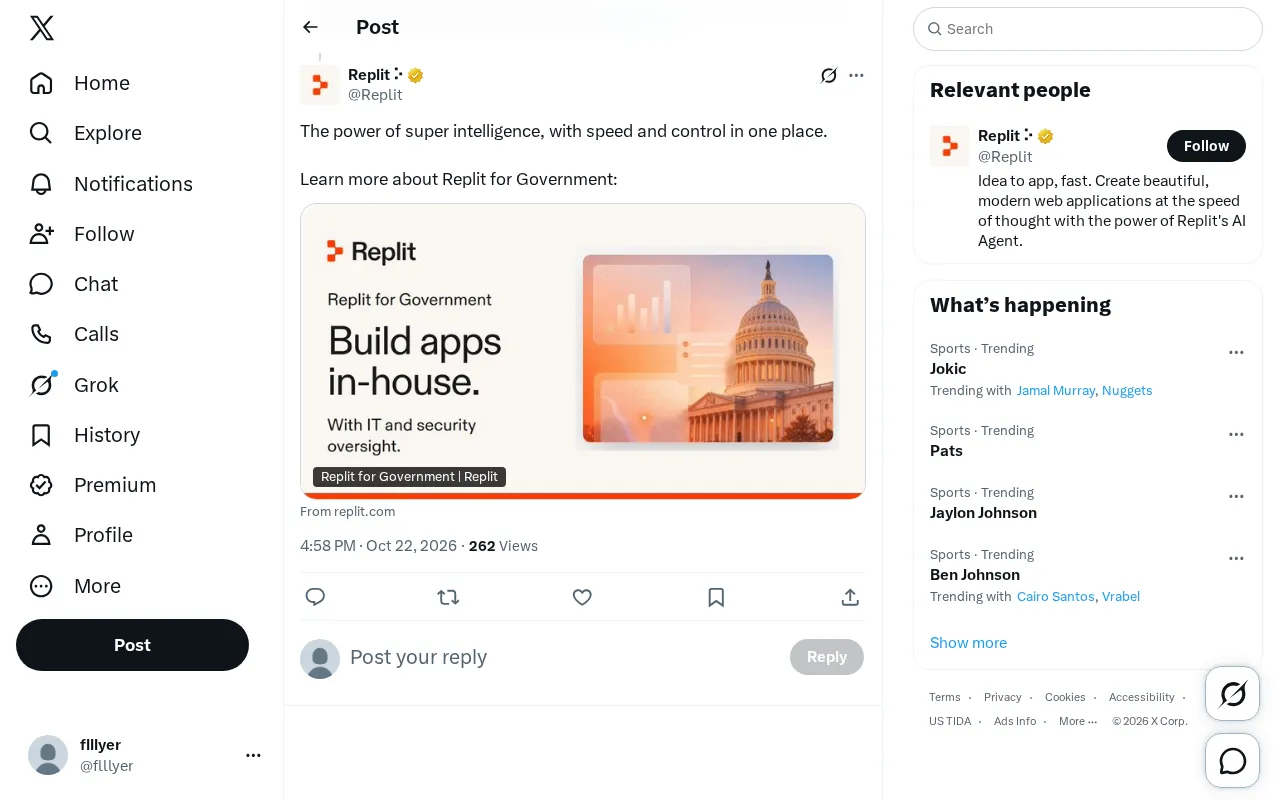
Replit announced on social media the launch of a dedicated version for government agencies—Replit for Government—positioned officially as "bringing the power of superintelligence together with speed and control." This short tweet doesn't elaborate on technical details, but from the product name and wording, several key signals about AI coding platforms extending into the public sector can be discerned.
Why Government Scenarios Need "Control"
The core selling point of consumer-grade AI coding tools is speed: from natural language to a runnable application, prototyping is completed in minutes. But the procurement logic of government agencies is almost the opposite—compliance, auditing, data sovereignty, and permission management rank ahead of efficiency. Replit's tweet places "speed" and "control" side by side, indicating that the government edition is not simply packaging and selling the existing product, but rather making product-level adjustments for the governance needs of the public sector.
Such adjustments typically involve several directions: isolation of deployment environments, traceability of operation logs, tiered management of member permissions, and review mechanisms for generated code. Replit hasn't disclosed the specific implementation, but "control" being placed on equal footing with "super intelligence" suggests it aims to address a real pain point—governments want to use AI to boost efficiency but dare not give up control over their systems.
Data sovereignty refers to data storage, processing, and access being governed by the laws of the country or region where it resides, without flowing out of the controlled environment across borders. For government agencies, this typically means data must remain within the country or a dedicated cloud region, and vendors must not have unilateral access.
Audit trail requires the system to record every access, modification, and code generation action, forming tamper-proof logs for later accountability and compliance checks. In AI coding scenarios, auditing also needs to cover the prompts fed into the model, the generated code versions, and their approval chains.
Role-based access control (RBAC) then controls which projects members can access and which operations they can perform through role division, preventing sensitive systems from being modified without authorization. These three capabilities are the foundation that distinguishes government edition products from consumer-grade tools, and they are also the main product-level focus of the word "control."
What "Superintelligence" Means in Coding Tools
Replit has been continuously ramping up its Agent capabilities in recent years, enabling AI not just to complete code but to autonomously plan, execute, and debug multi-step development tasks. The official use of "super intelligence" is more of a marketing expression, pointing to this end-to-end automated development experience. For government users, the value lies not in model parameter scale, but in whether tedious internal tool development, data report generation, and process automation can be handed off to AI without introducing uncontrollable risks.
From an industry trend perspective, AI coding platforms are transitioning from individual developer tools to organization-level infrastructure. Products like GitHub Copilot and Cursor are all advancing enterprise editions and compliance capabilities, and Replit's choice of "government" as a细分 segment is a way to find differentiated positioning in the competition.
Agent capabilities are the core evolution direction of AI coding tools in recent years. Traditional code completion can only predict the next line based on context; the Agent model allows the model to receive a high-level goal (such as "build an internal expense approval tool"), autonomously break down tasks, invoke the file system and terminal, write and run code, read errors and iterate debugging until delivering a runnable result.
The appeal of this end-to-end automation for government scenarios lies in: a large backlog of internal small-tool demands that IT departments cannot develop one by one, and Agents can compress development cycles from weeks to hours. But autonomous execution also brings risks—AI may modify production data or introduce vulnerabilities, so the government edition must be paired with sandbox isolation, human approval nodes, and code review mechanisms to let "superintelligence" function within controlled boundaries.
The Real Barriers to Public Sector AI Procurement
Government customers' concerns about AI tools center on three points: whether data leaves the controlled environment, whether vendors comply with local regulations, and how liability is defined when problems arise. For Replit for Government to land, it needs to provide clear answers on these issues. The link accompanying the tweet points to a product introduction page, indicating that official communication materials are ready, but public information remains limited.
For those watching AI adoption, what's worth noting about this news is not the wording but the direction it reflects: AI coding tools are entering high-barrier markets that require "explainability, auditability, and controllability." Whoever can first build solid control capabilities is more likely to win these customers.
Government AI procurement is typically constrained by several types of regulations: data localization requirements (such as GDPR restrictions on cross-border transfer of personal data in the EU, and some countries requiring government data to be stored domestically), security certification systems (such as FedRAMP in the US and China's Multi-Level Protection Scheme 2.0), and vendor liability clauses (clarifying liability when AI output errors cause losses).
In addition, public sector procurement often uses framework agreements and long-cycle tenders, with requirements on vendors' continuous service capability, source code escrow, and exit mechanisms. This means that for Replit for Government to truly enter the government market, it needs not only product feature adjustments but also certification, localized deployment solutions, and adaptation of contract terms—work that is long-cycle and high-cost, challenges that consumer-grade products have never faced.
Conclusion
The release of Replit for Government is an attempt by AI coding platforms to penetrate the public sector. "Superintelligence" provides the appeal, "control" provides the persuasion—whether the two can truly combine depends on the actual investment in compliance and security, not on the adjectives in a tweet.
One-line Summary
Replit launches a government-specific edition, entering the public sector AI coding market with a dual focus on speed and control.
Paragraph Summary
Replit announced on social media the launch of a dedicated version for government agencies, Replit for Government, officially positioned as "bringing the power of superintelligence together with speed and control." The article argues that government agencies' procurement logic is opposite to the consumer market—compliance, auditing, data sovereignty, and permission management take priority over efficiency—so the government edition is not simply packaging the existing product but making product-level adjustments for governance needs. "Superintelligence" points to Replit's recently ramped-up Agent end-to-end automated development capabilities, whose value lies in replacing tedious internal tool development rather than model scale. AI coding platforms are transitioning from individual tools to organization-level infrastructure, and Replit is seeking differentiation with government as a niche segment. The article also notes that the real barriers to government AI procurement include whether data leaves the controlled environment, whether vendors comply with local regulations, and how liability is defined; whether control capabilities are solid will determine who wins these customers.
Related articles

The Touchscreen MacBook and Apple's Delightful Mess: A Deliberate Gamble
The Vergecast unpacks the touchscreen MacBook Pro's launch logic, the ProLed naming controversy, the iPad squeezed between iPhone and Mac, and how Apple stays competitive with premium hardware in the AI era.

Fifty Years Studying Power: Robert Caro's Writing and Insights on Power
Robert Caro reflects on 50 years studying power: Lyndon Johnson's persuasion and leverage, Robert Moses's transformation from idealist to ruthless builder, the dilemmas of large-scale construction, and his methods of compressing themes and solitary focus in biography writing.

Can a $20,000 Robot Do Your Chores? The Test Results Are Surprising
A YouTube test video shows how a $20,000 robot responds to commands like washing dishes, turning off lights, taking out trash, and feeding the dog. This article analyzes its real capability boundaries, the state of voice interaction technology, and how far household robots are from mainstream adoption.