Replit Launches Monitoring Agent: An Autonomous On-Call Engineer in Your Pocket

Replit launches Monitoring Agent, using AI to achieve an autonomous operations loop of monitoring, repair, and deployment.
Replit releases Monitoring Agent, positioned as "an on-call engineer in your pocket," targeting individual AI application developers and small teams lacking operations experience. The tool attempts to complete the loop of "monitoring to detect anomalies—locating and repairing—automatic deployment," filling the gap in the post-launch maintenance stage of AI programming tools. The article calmly points out that the official wording is restrained, and the actual capability is closer to an automation assistant than fully autonomous operations; the repair scope, the ability to handle business-logic bugs, and the confirmation mechanism for automatic deployment are all unclear. If it can meet expectations, it will lower the launch barrier for independent developers and change debugging habits, but it also requires the platform to be transparent about changes. This move reflects that the platform layer is absorbing more SRE work, and competition is extending from "helping you write" to "helping you maintain"; success depends on repair accuracy and user trust.
Replit recently released a new tool called Monitoring Agent, positioning it officially as "an on-call engineer in your pocket." For AI application developers without a dedicated ops team, this may mean the last link in the chain—from "writing code" to "fixing problems"—is being automated.
From Assisted Programming to Autonomous Operations
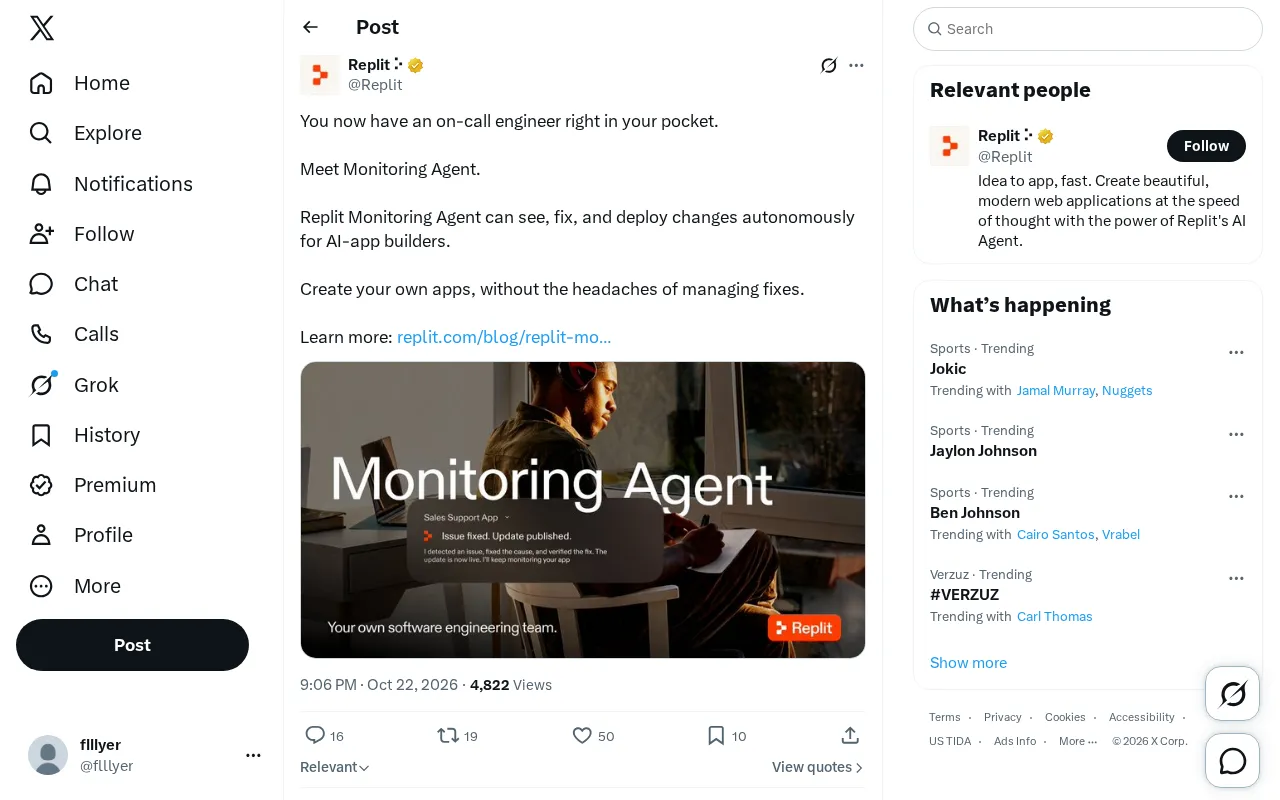
Replit's tweet doesn't contain much information, but the keywords are clear: see, fix, and deploy changes autonomously. These three actions form a complete operations loop—monitoring for anomalies, locating and fixing problems, and automatically deploying changes.
Over the past year, the main battlefield for AI programming tools has centered on code generation and completion, and Replit itself has enabled users to build applications with natural language through its Agent feature. But maintenance after an application goes live has always been a different matter: error logs, performance regressions, dependency conflicts—these issues often require manual intervention from developers. Monitoring Agent's positioning is precisely to fill this gap.
According to the official description, the tool targets AI-app builders, i.e., individual developers or small teams who use the Replit platform to quickly build AI applications. Such users typically lack systematic operations experience, yet face ongoing stability pressure after their applications go live.
On-call engineer is a core role in internet operations culture, referring to engineers who are on duty to respond to system alerts and handle production incidents at any time. Traditionally, on-call requires 7×24 availability; once the monitoring system triggers an alert (such as a spike in error rates or service unavailability), the on-call person must intervene within minutes to investigate. This model places extremely high demands on human resources, and the fatigue caused by late-night alerts significantly affects the quality of fixes. By calling Monitoring Agent "an on-call engineer in your pocket," Replit is essentially using an AI agent to replace part of the responsibilities of human on-call duty—continuous monitoring, rapid response, and automatic repair—thereby freeing small teams from the burden of maintaining on-call rotations.
SRE (Site Reliability Engineering) was proposed by Google and is a discipline that uses software engineering methods to solve operations problems, covering practices such as service level objectives (SLOs), error budgets, and automated operations. The core idea of SRE is to engineer and program operations work, reducing manual repetitive operations. The trend of "the platform absorbing SRE work" represented by Replit Monitoring Agent is precisely an extension of the automation direction in SRE philosophy: encapsulating anomaly detection, fault repair, and change deployment as built-in platform capabilities, so that small developers without an SRE team can also obtain stability guarantees close to professional operations.
Where Are the Boundaries of Autonomous Repair?
"Autonomous repair" sounds radical, but its capability boundaries need to be viewed calmly. Judging from the wording of the tweet, Monitoring Agent's working mode is most likely: monitor the application's running status, and when an anomaly is detected, attempt to automatically generate a repair plan and deploy it.
There are several details worth asking about: Is the repair scope limited to common faults such as configuration errors and dependency issues? Is it equally effective against bugs at the business logic level? Is there a confirmation step before automatic deployment? Neither the tweet nor the linked page provides answers.
Replit's official wording is "create your own apps, without the headaches of managing fixes," emphasizing reducing the mental burden of managing fixes rather than completely replacing developer judgment. This restrained wording suggests that the tool's actual positioning is closer to an "automation assistant" than "fully autonomous operations."
Auto-deploy refers to code changes being automatically released to the production environment through a pipeline, without manual approval or manual operation. In CI/CD practice, automatic deployment can greatly shorten the cycle from fix to release, but it also brings risks: if the change itself is wrong, the fault will spread immediately. Therefore, mature automatic deployment usually comes with mechanisms such as gray release, canary release, and automatic rollback. Monitoring Agent claims it can "deploy changes autonomously"; whether its automatic deployment step includes these safety nets directly determines whether users dare to let it repair on its own—this is also the technical background of the "confirmation step" question mentioned in the article.
Impact on the AI Application Development Workflow
If Monitoring Agent can reach the level officially implied, its impact on the AI application development workflow will be reflected at two levels.
Lowering the launch barrier. One of the biggest concerns for independent developers and small teams is "what if something goes wrong after the application goes live." When monitoring and repair are taken over by the platform, the psychological barrier between prototype and production will be significantly lowered. This is consistent with Replit's direction in recent years of promoting "anyone can build software."
Changing debugging habits. In the traditional workflow, developers locate problems through logs and error messages. If the Agent takes over this step, the developer's role will shift toward "reviewing repair plans." The efficiency gains of this shift are obvious, but it also requires the platform to be transparent—users need to clearly know what the Agent changed and why.
Competitive Signals of Platform-Level Operations Automation
Looking more broadly, Replit's move is not an isolated event. Cloud platforms and low-code tools are all encapsulating operations capabilities as built-in services, from automatic scaling to anomaly alerts, and now to autonomous repair; the platform layer is absorbing more and more work that originally belonged to SRE.
For Replit, Monitoring Agent is an extension of its Agent product matrix: the build Agent is responsible for writing code, and Monitoring Agent is responsible for maintaining stability. Combined, Replit attempts to cover the entire lifecycle of AI applications from creation to operation. Whether this strategy works depends on the accuracy of autonomous repair and users' trust in automatic deployment—and there is currently no public data to support either point.
At this stage, Monitoring Agent is more like a signal with a clear direction: competition among AI programming tools is extending from "helping you write" to "helping you maintain."
One-line Summary
Replit launches Monitoring Agent, using AI to achieve an autonomous operations loop of monitoring, repair, and deployment.
Paragraph Summary
Replit releases Monitoring Agent, positioned as "an on-call engineer in your pocket," targeting individual AI application developers and small teams lacking operations experience. The tool attempts to complete the loop of "monitoring to detect anomalies—locating and repairing—automatic deployment," filling the gap in the post-launch maintenance stage of AI programming tools. The article calmly points out that the official wording is restrained, and the actual capability is closer to an automation assistant than fully autonomous operations; the repair scope, the ability to handle business-logic bugs, and the confirmation mechanism for automatic deployment are all unclear. If it can meet expectations, it will lower the launch barrier for independent developers and change debugging habits, but it also requires the platform to be transparent about changes. This move reflects that the platform layer is absorbing more SRE work, and competition is extending from "helping you write" to "helping you maintain"; success depends on repair accuracy and user trust.
Related articles

Will GitHub Die? Open Source Maintainer Burnout and the Collaboration Crisis in the AI Era
Lex Fridman podcast discussion on open source maintainer burnout and GitHub's predicament: massive pull requests overwhelm core maintainers, and AI worsens code bloat. Using math journal peer review and Poincaré conjecture verification as analogies, the article analyzes why verification in knowledge production must be deliberately slow, and how open source communities can avoid the failure mode of maintainers exiting.

Stop Building Cookie-Cutter AI Websites: 3 Tools That Transform Your Coding Agent
Three tools that boost AI coding agents: FFmpeg skill for local video editing in Claude Code and Cursor, Hallmark's 50 design themes to fix cookie-cutter AI sites, and Jailbreaks' 25+ model prompts.

How America's Gerontocracy Squeezes the Younger Generation
Americans over 55 hold nearly three-quarters of national wealth, alongside an 80-year-old president and elderly congressional leaders. The Atlantic's Idrees Kahloon explains how gerontocracy drives up housing costs, squeezes opportunities for the young, and explores zoning reform and child poverty reduction as practical fixes.