Replit Partners with Meta: Describe It in Plain Language, Get a VR App

Replit announced at Meta Connect that natural language descriptions can now generate VR apps for Meta devices.
At Meta Connect, Replit announced that developers can describe an app in natural language and have it built for Meta VR devices — extending "vibe coding" from web and mobile into spatial computing. Traditional VR development demands Unity/Unreal expertise, 3D modeling skills, and SDK knowledge, but Replit aims to compress that complexity into simply describing your idea. While this could significantly lower the barrier for indie developers, educators, and rapid prototypers, key details — including output quality, supported devices, extensibility, and cost — remain undisclosed and require real-world testing to evaluate.
Replit Brings AI-Powered Coding to VR
At Meta Connect, AI coding platform Replit announced a compelling new capability: developers can simply describe an app in natural language, and Replit will build the corresponding VR application for Meta devices. This could dramatically lower the barrier to creating VR experiences — reducing the requirement from mastering complex 3D engines and SDKs down to just "clearly describing your idea."
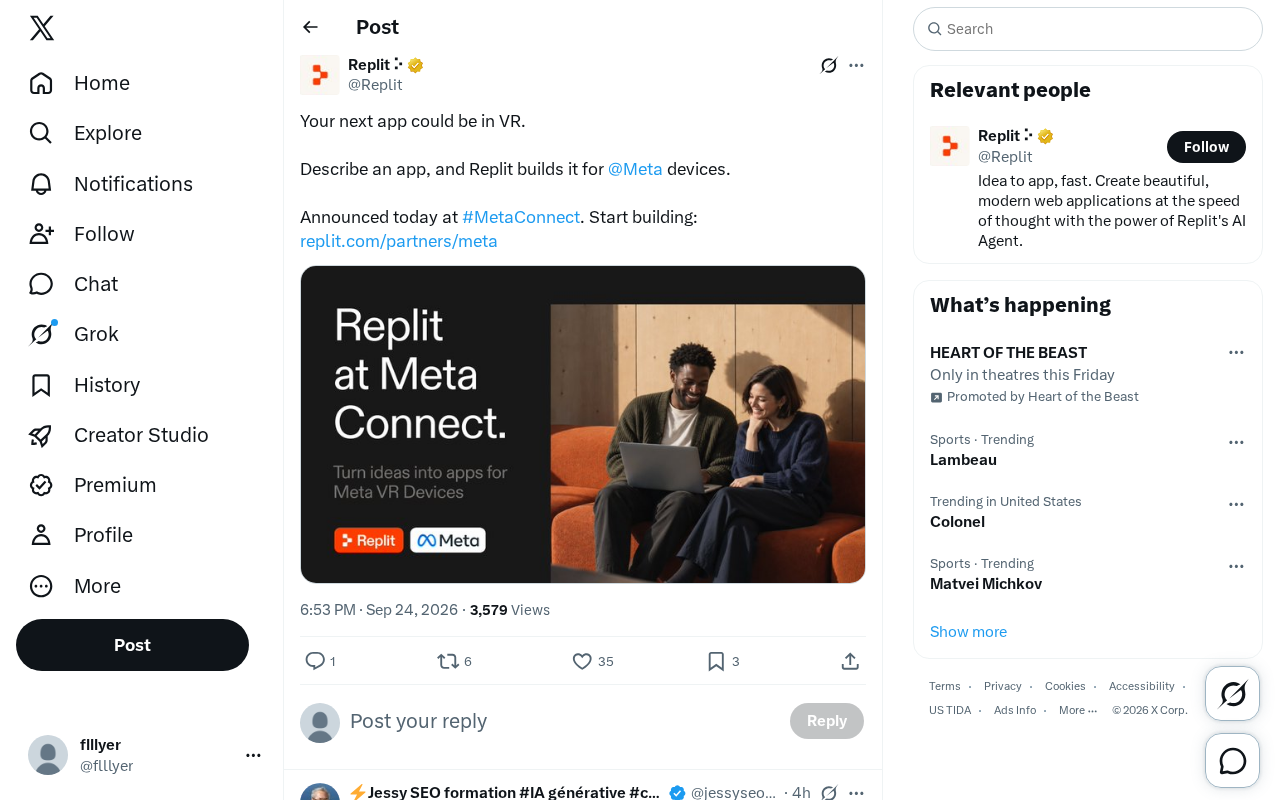
What makes this announcement worth paying attention to is that it brings two technology curves together: the "vibe coding" wave represented by Replit, where AI generates working code directly from intent; and Meta's long-running bet on its VR/MR hardware ecosystem. When natural language generation meets head-mounted displays, the way applications are created could undergo a structural shift.
"Vibe coding" is a concept coined by OpenAI co-founder Andrej Karpathy in early 2025 that quickly went viral. It refers to relying entirely on AI to understand intent and generate code — developers barely need to read or write code themselves, only describe goals in natural language and verify the results. This is fundamentally different from traditional "AI-assisted coding" (like GitHub Copilot completing code snippets), where the developer remains in control. Vibe coding hands that control almost entirely to the AI. Replit is one of the core practitioners of this paradigm, allowing users to generate fully working web or mobile apps with a single sentence in the browser, no local environment setup required. This model dramatically lowers the entry cost for non-professional developers, but also raises questions about code maintainability, security, and suitability for complex scenarios.
What "Description to Working App" Actually Means
Replit's positioning in recent years has been centered on lowering the barrier to software development. Users describe their needs in the browser, and the platform handles code writing, dependency configuration, and deployment automatically. Extending this capability to Meta devices is essentially bringing the same "intent-driven" paradigm into the spatial computing space.
For developers, traditional VR development typically requires engines like Unity or Unreal, 3D modeling skills, and familiarity with device SDKs. If Replit can handle the full pipeline from description to build, creators can focus on experience design and creativity rather than getting bogged down by toolchains. This is especially valuable for indie developers, educational contexts, and rapid prototyping.
That said, it's worth staying grounded: the official announcement only delivers on the core promise of "describe an app → Replit builds it for Meta devices." It doesn't disclose the complexity ceiling of generated apps, which specific device models are supported, performance characteristics, or what types of apps can be delivered. These details will directly determine whether this feature is a toy-level demo or a genuine productivity tool.
The VR development ecosystem for Meta devices currently relies primarily on two paths: integrating Meta XR SDK with Unity or Unreal Engine (suited for developers with game engine experience), or using Meta's own Horizon Worlds platform (with scripting capabilities, lower barrier but limited expressiveness). Traditional paths require developers to understand 3D spatial coordinate systems, gesture/controller interaction events, rendering performance optimization, and other VR-specific knowledge — a steep learning curve that is one of the main reasons VR content ecosystems have remained relatively sparse. If Replit can bypass this layer of toolchain complexity and translate natural language intent directly into runnable code conforming to Meta SDK specifications, the significance goes beyond speed — it expands the potential developer pool from "engineers who know 3D engines" to "everyday people with creative ideas."
Where AI Coding and Spatial Computing Intersect
Viewed against a broader industry backdrop, this partnership reflects the convergence of two trends. On one hand, natural language code generation is spreading from web and mobile to more platforms; VR, with its complex interactions and high development costs, is precisely where AI assistance can deliver the most value. On the other hand, Meta needs a richer content ecosystem to support hardware sales, and lowering the development barrier is a direct way to stimulate content supply.
For Meta, attracting more creators to VR depends largely on how much friction exists between "having an idea" and "shipping it." If tools like Replit can actually deliver on their promise, they effectively open a much wider developer on-ramp for Meta devices.
Questions Worth Asking
Before getting hands-on, several things still need to be verified through real-world testing:
- Output quality: Can naturally language-generated VR apps reach a usable, interactive standard, or do they remain simple demos?
- Device compatibility: Which specific Meta headsets are supported, and how does performance vary across devices?
- Extensibility: Can generated apps be edited further, integrated with external services, and published to the store?
- Cost and limitations: What are the resource requirements and usage thresholds for AI-powered VR app generation?
The official announcement includes a link to start building, encouraging developers to try it hands-on. For practitioners interested in the intersection of AI coding and VR, this is an opportunity worth experiencing firsthand — rather than judging solely based on the marketing.
Takeaway
Replit's VR app generation capability announced at Meta Connect marks a significant step in AI-assisted coding expanding into spatial computing. It brings the "describe it, get an app" philosophy into the high-barrier world of VR, with the potential to reshape how VR content is created. That said, what's publicly available right now is mostly vision and entry points — the true capability boundaries still need real-world use and more technical details to be properly assessed.
Related articles

Gemini 4 Argon Hands-On: AI Builds Board Games, Constructs Temples, and Trains Robots Autonomously
Gemini 4 Argon hands-on roundup: AI autonomously builds a desk racetrack and temple in Blender, writes a ray tracing engine, trains a humanoid robot to sink 7 shots, plus API pricing and developer access.

The Magic Octagonal Coin: Why Only 9% of People Can Predict Its Flip?
Only 9% of people can correctly predict the Magic Octagon coin flip. This article explains its spatial rotation mechanism, common cognitive pitfalls, and a new hypothesis based on Relevance Theory, exploring the limits of human spatial reasoning.

Sam Altman: AI Is Entering the Era of Scientific Discovery — Math Breakthroughs Will Replicate in Biology and Energy
Sam Altman says AI is entering the era of scientific discovery — math breakthroughs will replicate in biology, materials science, and energy to help develop new drugs and energy sources.