Replit's Free Mobile App Conversion Feature: Import Your Project, Get a Native App

Replit launches free Web-to-mobile-app conversion for imported projects, intensifying AI coding tool competition.
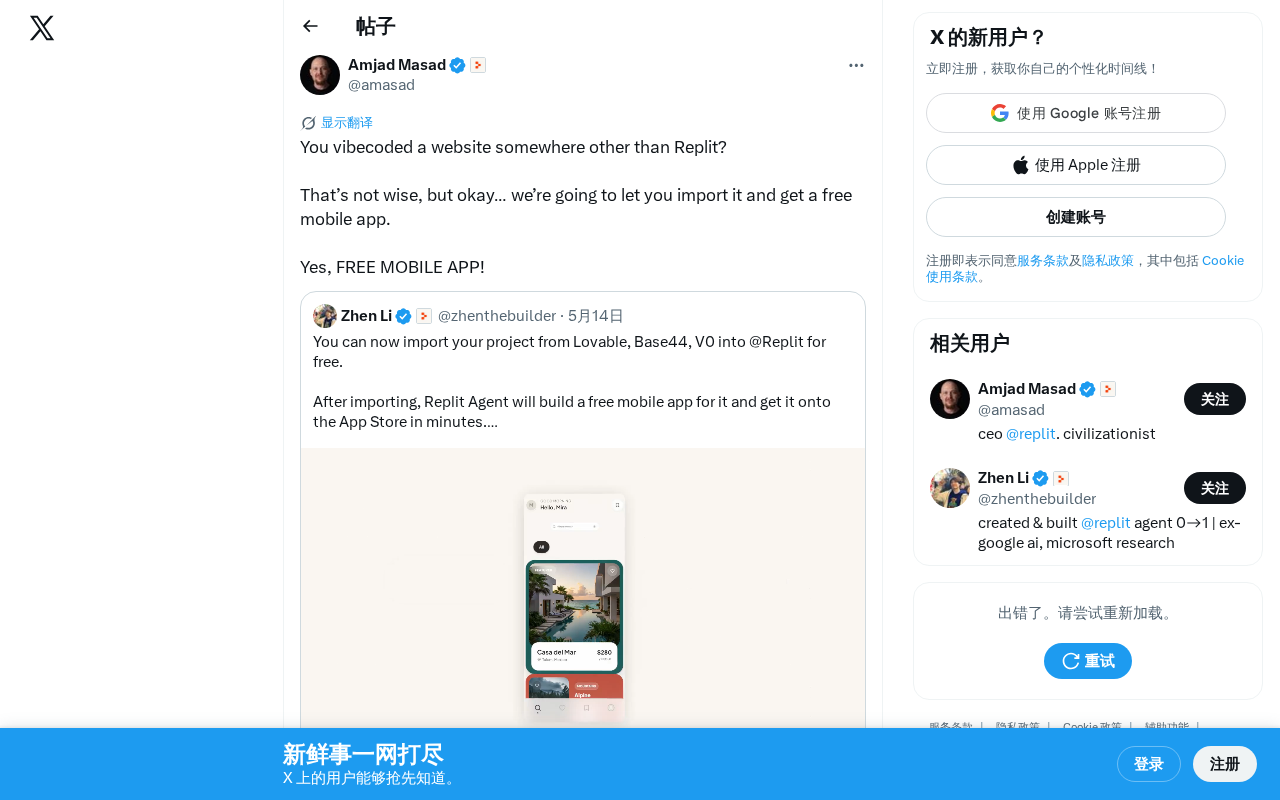
Replit announced that users can import Web projects created on other platforms (such as Cursor, Bolt, Lovable) via vibe coding and convert them into mobile apps for free. This differentiation strategy aims to lower migration costs, provide incremental value, and build user stickiness. The feature most likely uses WebView or PWA technology paths, with conversion quality and the boundaries of "free" still to be verified. This move reflects how AI coding platform competition has expanded from code generation to full-stack services including deployment, hosting, and multi-platform adaptation.
Replit's New Feature: Import Web Projects, Get a Free Mobile App
Replit recently announced an attractive new feature on social media: users can import Web projects created on other platforms via vibe coding into Replit and receive a free mobile app version. This move directly targets users of competing products like Cursor, Bolt, and Lovable.
What Is Vibe Coding?
Vibe coding is an emerging development approach in the AI programming space — users describe their requirements in natural language, and AI automatically generates code and builds complete applications. This approach dramatically lowers the barrier to programming, enabling non-technical users to quickly build websites and apps.
From a technical perspective, vibe coding fundamentally relies on the code generation capabilities of large language models (LLMs), combined with interactive development environments. Its technical pipeline typically includes: natural language intent understanding, code skeleton generation, automated dependency management, and real-time preview and debugging. Since 2023, as models like GPT-4 and Claude have significantly improved their code task capabilities, this development paradigm has evolved from experimental tools into commercially viable products. Notably, the term "vibe coding" was formally coined by AI researcher Andrej Karpathy in early 2025 and quickly gained popularity, precisely describing this "vibe-driven, AI-handles-the-implementation" programming experience.
Platforms currently offering vibe coding capabilities include Replit, Cursor, Bolt, Lovable, and others — making the competitive landscape quite intense. Replit's project import feature is essentially a targeted user acquisition strategy aimed at competitors' user bases.
Free Mobile App: Replit's Differentiating Weapon
The core selling point of this feature is free Web-to-mobile-app conversion. For users who rapidly build websites with AI tools, converting Web projects into native mobile apps has always been a pain point — typically requiring additional development work and significant costs. Replit directly offers this capability and labels it free, making the appeal obvious.
To understand the value of this feature, you need to know the technical background of Web-to-mobile conversion. The industry currently has three main technical approaches: WebView wrapping (e.g., Capacitor/Cordova, packaging a webpage into an App shell), responsive PWA packaging (Progressive Web App, leveraging browser standards for app-like experiences), and cross-platform framework rewriting (e.g., React Native/Flutter, migrating Web logic to a native rendering layer). WebView solutions have the lowest cost but inferior performance and native experience; PWA solutions have limited support in the iOS ecosystem; framework rewrites produce the best results but require substantial engineering effort. Replit's automatic conversion is most likely based on the WebView or PWA path, enabling fast, low-cost conversion — but this is also the fundamental reason why conversion quality remains uncertain.
From a product strategy perspective, this move achieves at least three objectives:
- Lowering migration costs: Users don't need to start from scratch — they can directly import existing projects
- Providing incremental value: Free mobile App conversion is a capability competitors haven't broadly offered yet
- Building user stickiness: Once a project is migrated and a mobile App is generated, subsequent maintenance and iteration naturally stays within the Replit ecosystem
Competition in the AI Coding Tools Space Intensifies
Replit used a slightly playful tone in their tweet — "Vibe coding somewhere other than Replit? That's not very wise" — this confident marketing language reflects the increasingly fierce competition in the AI coding tools space.
To understand why Replit has the confidence to say this, you need to appreciate its product ecosystem. Founded in 2016, Replit was initially positioned as an online IDE for educational scenarios, supporting browser-based runtime environments for 50+ programming languages. After 2022, it pivoted with the AI wave, launching the Ghostwriter code assistant and gradually building a comprehensive development platform encompassing cloud development, AI generation, one-click deployment, and database hosting. Its core technical advantage lies in its containerized cloud runtime — each project runs in an independent cloud environment, which is the infrastructure foundation enabling its end-to-end service from code generation to app deployment. This is a moat that pure frontend code generation tools (like Bolt and Lovable) cannot easily replicate in the short term.
The competition between platforms has expanded from pure code generation capabilities to full-stack services including deployment, hosting, and multi-platform adaptation. Replit had already established a fairly complete product matrix across cloud IDE, AI code assistant, and one-click deployment — the addition of mobile App conversion further completes its closed-loop experience from "idea to launch."
This also means the competitive focus among AI coding platforms is shifting from "who can generate better code" to "who can provide a more complete productization pipeline."
Key Questions Worth Considering Before Importing
"Free mobile App" sounds enticing, but there are several questions worth noting before actual use:
- What's the conversion quality like? Web-to-mobile adaptation involves many details including responsive layout and native interactions. As mentioned, if a WebView wrapping approach is used, the experience in scenarios like scroll performance, gesture interactions, and keyboard pop-ups often noticeably differs from native apps — the actual results of automatic conversion remain to be verified
- Where are the boundaries of "free"? Generating the App is free, but whether subsequent App Store publishing (Apple Developer account alone costs $99/year), hosting, and version updates will incur charges remains unclear. There may be an important distinction between "free to generate" and "free to use"
- How's the tech stack compatibility? Projects generated on different platforms use varying frameworks — Bolt leans toward Vite+React, Lovable is based on the Supabase ecosystem, and Cursor is nearly framework-agnostic. How many tech stacks Replit's import function can accommodate, and how it handles backend logic and database connections, requires further investigation
For developers and creators who have already built Web projects on other platforms, Replit's feature is worth trying. However, it's recommended to first test the import and conversion with a small project, confirm the quality meets expectations, and then consider large-scale migration.
Key Takeaways
- Replit launched a project import feature allowing users to migrate website projects created on other platforms
- Imported projects receive a free mobile app version — this is their differentiated competitive strategy
- Web-to-App conversion technically relies mostly on WebView wrapping or PWA approaches, with inherent limitations in automatic conversion quality
- This move reflects how competition in the AI coding tools space has expanded from code generation to full-stack services
- Replit's infrastructure built on containerized cloud runtime is its core advantage distinguishing it from pure frontend code generation tools
- The automatic conversion quality from Web to mobile and the specific boundaries of "free" remain to be observed
Related articles
 Tech Frontiers
A Rare Quiet Day in AI: Recursive Self-Improvement Stirs Beneath the Surface
A rare quiet day in AI sees multiple sources go silent simultaneously. Behind the calm, Recursive Self-Improvement (RSI) research continues. What this means for the industry.
 Tech Frontiers
Reve 2 vs. Ideogram 4: A Deep Dive into Layout Control in AI Image Generation
A deep comparison of Reve 2 and Ideogram 4's layout control capabilities, covering technical approaches, real-world use cases, and industry trends for designers and creators.
 Tech Frontiers
In the Weights: Check Your Influence Score in the AI World
In the Weights is an AI influence search engine that quantifies your presence in the AI world with a score. Explore how it evaluates practitioners and what it means for digital identity.