Repository Intelligence: How AI Coding Agents Truly Understand an Entire Codebase

Repository Intelligence uses vector embeddings, AST, and knowledge graphs so AI agents truly understand a whole codebase, not just one file.
The article explains repository intelligence: a set of technologies that lets AI coding agents understand an entire codebase's structure, dependencies, and relationships, not just the open file. It argues that simply enlarging the context window fails because holding text is not the same as understanding calls and dependencies — a structural problem. The answer combines three complementary techniques: vector embeddings for semantic retrieval, AST parsing for syntax, and knowledge graphs for cross-file dependency tracing. Research shows graph-based indexing cuts token use by roughly 10x versus file-by-file exploration, indexing the Linux kernel's ~2.1M nodes in about three minutes. When evaluating tools, check whether they index text chunks or syntactic units and whether they trace call chains across files.
Ask an AI coding agent to fix a bug in a file, and most tools can handle it. But if you ask it to trace this: why would changing a single function in the payments service cause a module three microservices away to crash? Many tools quietly fall apart. Being able to read code is one thing; understanding how an entire codebase fits together — call relationships, dependency chains, the reason behind that strange workaround buried three layers deep — is another matter entirely, and far harder. The industry has started using a single term to name the technical system that solves this problem: Repository Intelligence.
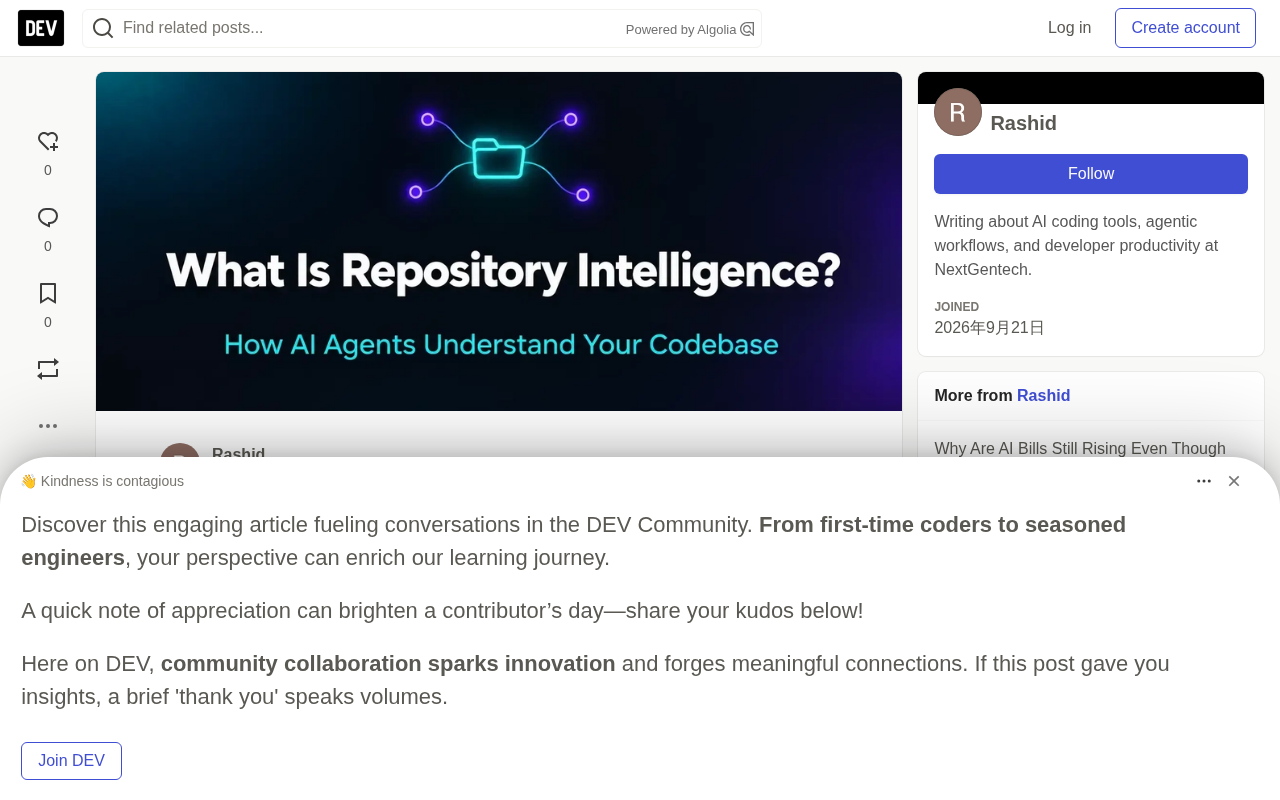
Core definition: Repository Intelligence is a set of technologies — including vector embeddings, AST (Abstract Syntax Tree) parsing, and knowledge graphs — whose goal is to let AI coding agents understand the structure, dependencies, and relationships of an entire codebase, not just the file currently open. By 2026, most tools taking this seriously will combine at least two of these approaches, and research shows that graph-based indexing can reduce token consumption by roughly 10x compared to having an agent explore a codebase file by file.
Why "just make the context window bigger" doesn't solve the problem
The most intuitive-sounding fix — cramming the entire codebase into the model's context window — runs into the same old problem. As discussed in the article on Context Engineering: more raw text does not equal better understanding. A context window can indeed hold the text of a large codebase, but holding the text and understanding "which function calls which," "what breaks if I change a shared type," or "why does this odd-looking piece of code exist" are two different things.
This is a structural problem, not a capacity problem, and therefore requires a structural answer. Piling on context only lets the model see more characters; it doesn't reveal the semantic skeleton connecting those characters.
Three paths tools actually take to build understanding
Most repository intelligence systems in 2026 rely on some combination of three techniques, each capturing something the other two miss.
Vector embeddings: finding semantically similar code
Vector embeddings convert code chunks into numerical representations and retrieve the parts most semantically similar to the agent's current task. This is the oldest and most common approach, essentially moving retrieval-augmented generation (RAG) from documents to source code, and it excels at finding conceptually related code even when the wording differs.
Its weakness is that embeddings measure "similarity," not "connection." Two pieces of code being semantically similar doesn't mean a real call or dependency relationship exists between them.
The underlying mechanism of vector embeddings: At its core, vector embeddings take a code chunk (a function, class, comment, or arbitrary fragment) as input to an encoding model trained specifically for code, which outputs a fixed-length high-dimensional floating-point vector. Individual dimensions of the vector don't correspond to readable semantic labels, but the training process brings semantically similar code closer together in vector space. During retrieval, the agent encodes the current task description or context into a vector in the same space, then uses cosine similarity or approximate nearest-neighbor algorithms to fetch the closest fragments from the index. This "encode first, compare later" pipeline lets it find conceptually related code even when wording, naming, or even language differs, making it especially good at answering questions like "how is this feature implemented elsewhere" — but it offers no guarantee about determining calls and dependencies.
AST parsing: understanding code structure
AST parsing takes a different approach. Instead of treating code as text to be searched, it parses it into actual syntactic structure — functions, classes, calls, inheritance — so the tool knows a piece of code is a complete function rather than an arbitrary text slice.
A simple example makes the difference clear: suppose a function calls getUser(), checks a verified flag, and then calls stripe.charge(). An AST-aware tool knows these three calls structurally belong to the same unit; pure text search just sees three lines that happen to sit next to each other.
The relationship between AST and concrete syntax tree: An AST is a tree representation of source code syntax that omits details with no semantic impact, such as parentheses and semicolons, keeping only meaningful nodes like functions, classes, calls, parameters, and conditional branches. In contrast, a concrete syntax tree (CST) preserves all lexical details, including whitespace and comments. Repository intelligence systems typically choose AST because it is more compact and better suited to connecting with downstream graph structures. The parsing process is generally handled by each language's built-in compiler front end or an incremental parsing library like tree-sitter, producing a tree with node types. Range information on nodes (start and end rows and columns) lets tools map any AST node back to the original text, allowing precise localization during retrieval or rewriting rather than crude character-window chunking.
Knowledge graphs: turning structure into an explicit map
Knowledge graphs go one level further, turning the structural output of AST into an explicit map — files, functions, and classes as nodes; calls, imports, and references as edges — so the agent can trace dependency chains across multiple files without re-reading all of them every time.
One research system indexed 31 real repositories this way: the graph built for Django had roughly 49,000 nodes and 196,000 edges, while indexing the entire Linux kernel (about 2.1 million nodes) took only about three minutes. This scale shows that the cost of graph indexing does not explode linearly with codebase size.
How nodes and edges are modeled: In a code knowledge graph, nodes typically include entities like files, modules, classes, functions, methods, variables, and types, while edges describe relationships between them, such as calls, imports, inheritance, implementation, references, and reads/writes. Graph databases (like Neo4j, NebulaGraph) or in-memory graph structures persist these relationships, letting the agent use graph query languages or traversal algorithms to answer questions like "who calls this function" or "which files are affected if I change this type." Compared to crawling file by file, graph indexing materializes relationships in advance, so the agent only needs to walk along edges instead of repeatedly reading entire files, thereby significantly compressing token consumption. Graph quality depends on the accuracy of edge extraction; false-positive calls or missed dynamic dispatch can skew dependency analysis, which is why production systems need to continuously maintain extraction rules.
The key differences among the three approaches
The three techniques are not substitutes for one another but complement each other: vector embeddings handle "can it be found," AST parsing handles "can the structure be understood," and knowledge graphs handle "can relationships be traced." A tool that only does vector retrieval will still fail when troubleshooting cross-service dependencies; a tool that only does AST will be helpless when facing questions like "how is this concept implemented elsewhere."
So judging whether a tool truly has repository intelligence isn't about how many indexing methods it claims to support, but whether it can connect structure and semantics in real tasks.
Questions worth verifying before use
Before trusting a tool's repository intelligence marketing, several questions are worth asking first: does it index text chunks or syntactic units? Can it trace call chains across files? How long does it take to index a large repository, and how many tokens does it consume? For the key conclusion mentioned above — that graph indexing can save roughly 10x tokens compared to file-by-file exploration — it's advisable to test against the scale of your own codebase rather than simply trusting vendor benchmark data.
The popularity of the term repository intelligence itself reflects that the industry has realized: the bottleneck for AI coding agents is shifting from "can the model write code" to "can the model understand the relationships between pieces of code." Whoever gets this right will be able to handle the truly thorny cross-module problems.
One-line Summary
Repository Intelligence uses vector embeddings, AST, and knowledge graphs to let AI agents truly understand an entire codebase, not just a single file.
Paragraph Summary
The article explains the concept of repository intelligence: a set of technologies that lets AI coding agents understand the structure, dependencies, and relationships of an entire codebase, rather than only the file currently open. The author points out that simply expanding the context window cannot solve the problem, because holding text is not the same as understanding function calls and dependencies — this is a structural problem. The real answer is combining three techniques: vector embeddings for semantic retrieval, AST parsing for syntactic structure, and knowledge graphs for cross-file dependency tracing, which complement rather than replace one another. Research shows that graph-based indexing can reduce token consumption by about 10x compared to file-by-file exploration, and indexing the Linux kernel's roughly 2.1 million nodes takes only about three minutes. When evaluating tools, focus on whether they index text chunks or syntactic units and whether they can trace call chains across files, rather than on how many indexing methods they claim to support.
Related articles

OpenAI Partners with Shield: How the Astra Agent Revolutionizes IT Troubleshooting
OpenAI and Shield launch the Astra agent, which autonomously logs into computers and legacy systems to fix IT issues in real time, 35-40% faster than traditional models, with humans involved only when judgment is needed.

iPhone Duo Battery Life Tested: One Charge a Day Is Unavoidable, and the Large Screen Is the Culprit
iPhone Duo battery test: heavy use needs at least one charge a day, and about 30% remains after 6.5 hours of screen-on time. How often the large screen is unfolded is key; a MagSafe battery pack helps, and long-term degradation is also worth watching.

Kimi K3.1 Pro Open-Sourced: 2.8 Trillion Parameters Close In on Opus
Moonshot releases the open-source MoE model Kimi K3.1 Pro, with 2.8T total parameters and 104B activated, trailing Opus 5.5 by under 1 point on Terminal Bench 4.0.