ReproBridge: Closing the Reproducibility Gap in Machine Learning Research

ReproBridge uses agents to solidify reproduction knowledge, boosting success to 92.6% while cutting costs by nearly 20%.
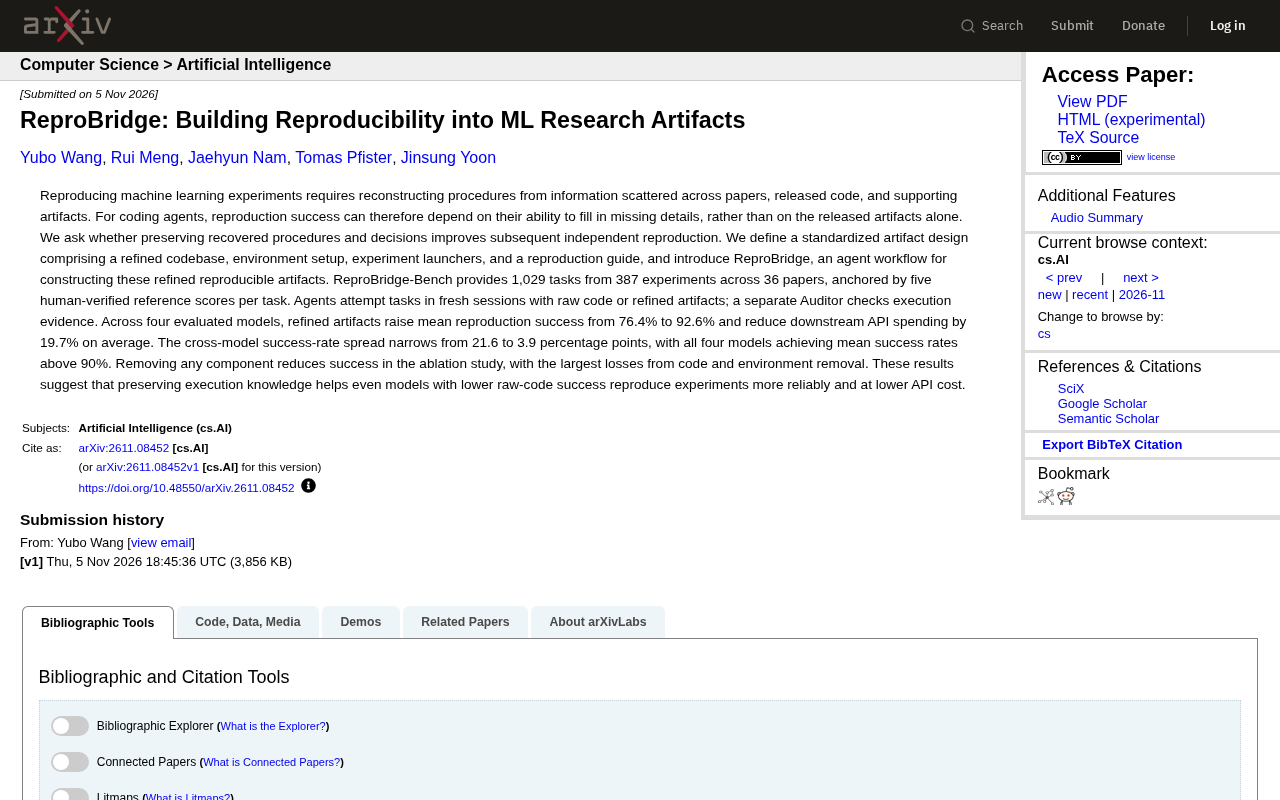
ReproBridge tackles the loss of execution knowledge in reproducing ML papers by proposing "refined reproducible artifacts"—a curated codebase, environment config, experiment launcher, and reproduction guide—plus an agent workflow that captures implicit steps and key decisions from an initial reproduction. Its ReproBridge-Bench covers 1,029 tasks from 36 papers with dual-condition comparison and an independent Auditor. Average success rises from 76.4% to 92.6%, API costs fall 19.7%, and the inter-model gap narrows from 21.6 to 3.9 points.
Machine learning paper reproducibility has long been a pain point for the research community: reproducing an experiment often requires piecing together a complete execution pipeline from the paper, code repository, and various supplementary materials. For coding agents, whether reproduction succeeds depends largely on whether they can fill in those scattered missing details, rather than relying solely on the published artifacts.
A new work from the research community, ReproBridge, is centered on exactly this question: if the pipelines and decisions that an agent recovers during reproduction could be preserved, could that make subsequent independent reproductions better?
Standardized Artifact Design: Keeping Reproduction Knowledge from Being Lost
ReproBridge proposes a standardized artifact design with four core components: a curated codebase, environment configuration, an experiment launcher, and a reproduction guide. Together these four form what is called "refined reproducible artifacts."
Building on this, the research team introduces ReproBridge, an agent workflow for constructing such refined artifacts. Its approach is not complicated: let an agent complete a reproduction once, then solidify the implicit steps and key decisions it recovered during the process into the artifacts, thereby lowering the reproduction barrier for those who come after.
The value of this design lies in turning "execution knowledge"—which previously depended on personal experience and word of mouth—into a transferable, reusable asset. For teams that need to repeatedly validate experiments, this kind of knowledge is often harder to obtain than the code itself.
ReproBridge-Bench: A Reproduction Benchmark Covering 36 Papers
To validate the approach, the team built ReproBridge-Bench, containing 1,029 tasks drawn from 387 experiments across 36 papers, with each task anchored by five human-verified reference scores.
The evaluation design is fairly rigorous: agents attempt tasks in fresh sessions under one of two conditions—original code or refined artifacts—and an independent Auditor checks the execution evidence, preventing agents from "marking their own homework."
This dual-condition comparison plus independent auditing setup makes the conclusions more convincing. After all, judging the success or failure of a reproduction task is inherently subjective, so introducing an independent audit step is a necessary measure.
Ablation study is a common control method in empirical machine learning research: components or modules are removed from the full system one at a time to observe changes in performance metrics, thereby determining whether a component genuinely contributes to the effect. It answers "which part is doing the work" rather than "whether the whole works," and is therefore often used alongside the main experiment. In the context of ReproBridge, the ablation study separately removes the codebase, environment configuration, experiment launcher, and reproduction guide; if success rates drop, it indicates that the component carries irreplaceable execution knowledge—such a design effectively rules out the criticism that "the four components are merely bundled together to look complete."
Experimental Results: Dual Improvements in Success Rate and Cost
Across the four evaluated models, the refined artifacts raised the average reproduction success rate from 76.4% to 92.6%, while reducing downstream API costs by an average of 19.7%.
More noteworthy is the narrowing of the gap between models: the success rate span shrank from 21.6 percentage points to 3.9 percentage points, and the average success rate of all four models exceeded 90%. This shows that refined artifacts help weaker models more—they originally performed poorly under the original-code condition, but with structured reproduction knowledge they can also complete tasks reliably.
The ablation study further shows that removing any one component leads to a drop in success rate, with the removal of the code and environment components causing the largest losses. This means the four components are not optional decorations but each plays a substantive role.
Downstream API cost refers to the token consumption and corresponding fees incurred when an agent calls large model interfaces during task completion. Reproduction tasks typically require multiple rounds of reading files, executing commands, and troubleshooting errors; the more calls and the longer the context, the higher the cost. Refined artifacts reduce this cost because structured information reduces the agent's trial-and-error rounds: environment dependencies, launch commands, and key parameters are explicitly provided, so the model does not need to repeatedly guess and verify. Thus, the increase in success rate and the decrease in cost are not two independent metrics but two sides of the same mechanism—less ineffective exploration simultaneously brings a higher completion rate and lower call volume.
Implications for Research Practice
ReproBridge's conclusions point to a pragmatic judgment: preserving execution knowledge helps even models with weaker original-code reproduction ability reproduce experiments more reliably and at lower cost.
The significance for the research community goes beyond the tooling level. For a long time, the code repositories accompanying papers have been regarded as the primary vehicle of reproducibility, but in practice a large amount of reproduction time is spent on environment configuration, dependency conflicts, and launch parameters. Standardizing and solidifying these steps is equivalent to making the hidden costs of reproduction explicit and reusable.
Of course, refined artifacts themselves also carry maintenance costs, especially when codebases continue to evolve. Whether ReproBridge's agent workflow can keep artifacts current through real research iterations remains to be further observed. But judging from the benchmark results, this path has already demonstrated clear benefits.
One-line Summary
ReproBridge uses agents to solidify reproduction knowledge, raising success rates to 92.6% while cutting costs by nearly a fifth.
Paragraph Summary
ReproBridge addresses the loss of execution knowledge in reproducing machine learning papers. It proposes "refined reproducible artifacts" consisting of four parts—a curated codebase, environment configuration, an experiment launcher, and a reproduction guide—and designs an agent workflow that first completes a reproduction, then solidifies the implicit steps and key decisions recovered during the process. The team built ReproBridge-Bench, covering 1,029 tasks from 387 experiments across 36 papers, using a dual-condition comparison between original code and refined artifacts, with an independent Auditor checking execution evidence. Results show the average success rate across four models rose from 76.4% to 92.6%, downstream API costs fell by an average of 19.7%, and the success rate span between models narrowed from 21.6 to 3.9 percentage points; ablation studies show all four components contribute substantively.
Related articles
 Tech Frontiers
GitHub Daily · November 8: Agent Infrastructure Blooms Across the Board
GitHub Daily Nov 8: agent infrastructure dominates Trending—browser automation, design systems, skill libraries, VM runtimes, and context compression—while veteran tools warm up.
 Tech Frontiers
Comparing Routing Mechanisms of 10 Open-Source MoE Models: DeepSeek, Qwen, Mixtral, Llama 4, gpt-oss
A configuration-based comparison of routing mechanisms in 10 open-source MoE models, analyzing DeepSeek, Qwen, Mixtral, Llama 4, and gpt-oss on expert count, top-k, shared experts, gating, and load balancing.
 Tech Frontiers
Vibe Coding Step-by-Step Guide: Learn to Build Products with AI in Six Steps
Breaking down the six-step methodology of Bilibili's 748-episode Vibe Coding course, analyzing the usage boundaries and prompt techniques of Codex, Claude Code, and Cursor, and discussing who this AI coding course suits, who it doesn't, and how to avoid the trap of watching without acting.