Republican Politicians Embracing Anti-Indian Racism Are Losing Votes

The Republican Party's embrace of anti-Indian rhetoric is pushing Indian American volunteers and voters toward the Democrats, with far-reaching costs.
Using University of Houston student Vasant Bhatt's shift from an active Republican volunteer to a Democratic voter as a starting point, the article reveals a widening rift within the GOP. Indian Americans are one of the fastest-growing voter groups in the U.S. and carry real electoral weight in key swing states. However, some politicians and commentators openly embracing anti-Indian racist rhetoric—from xenophobic social media attacks to inflammatory language on immigration—is eroding the party's minority volunteer networks, fundraising channels, and voter base. The article notes that this loss has a generational effect: once young Indian American voters' political positions solidify, they could shape the electoral landscape for years. Internal divisions between broadening the coalition and stirring xenophobia have blurred the party's image, and silence is read as tacit approval. The article also briefly touches on indirect impacts on tech industry talent strategies and immigration policy.
Two years ago, University of Houston student Vasant Bhatt was fully committed to helping Republicans regain power. He went door-to-door canvassing for Senator Ted Cruz's reelection campaign and helped organize community outreach for Donald Trump. Like many Republicans, he saw those victories as his own. But this week, Bhatt did something unexpected: he cast his vote for the Democrats.
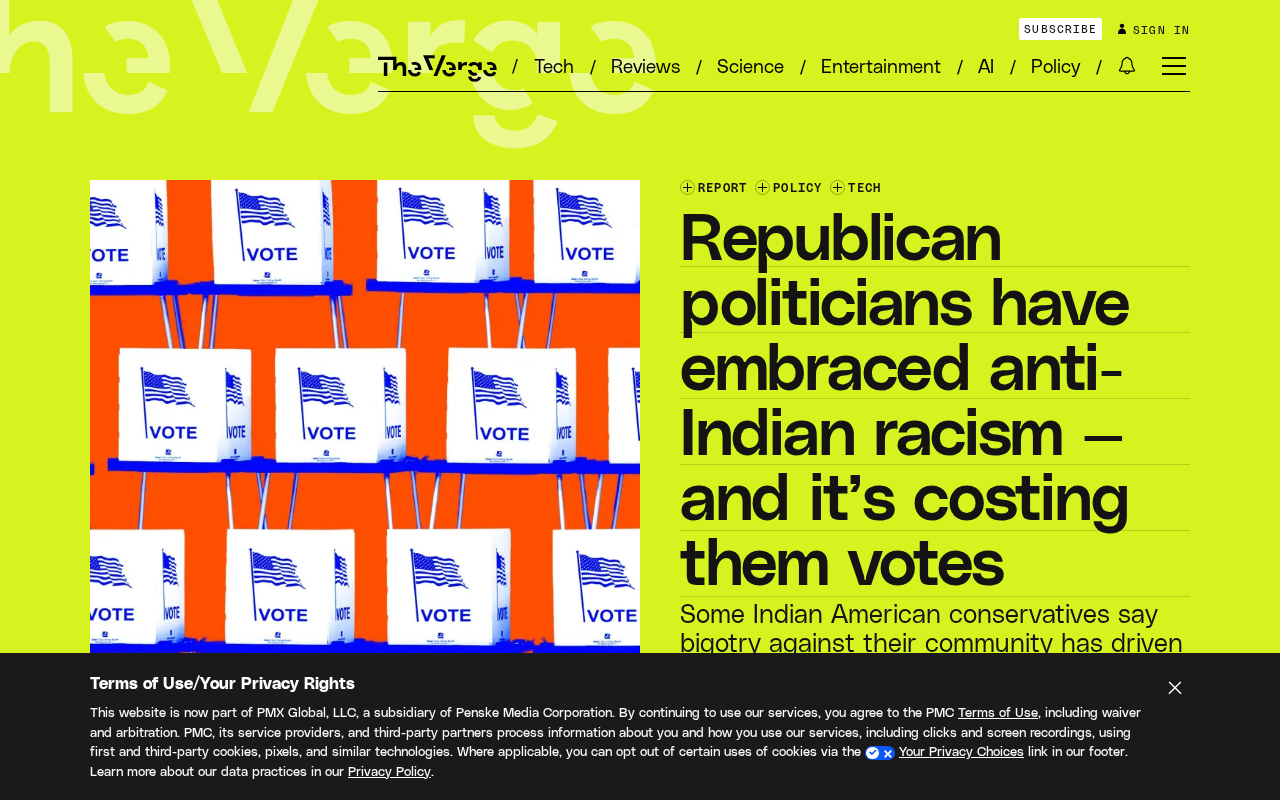
A Landmark Shift
Bhatt's story is not an isolated case—it reflects a widening rift within the Republican Party. Indian Americans are one of the fastest-growing voter groups in the United States. Long relatively low-profile politically, they have become increasingly engaged in electoral politics in recent years. The Republican Party relies on this group's support in certain districts, especially in swing states. However, some politicians and commentators within the party have openly embraced anti-Indian rhetoric, pushing active volunteers like Bhatt to the opposite side.
The cost of this shift is concrete: volunteer attrition, the collapse of community mobilization networks, narrowing fundraising channels, and lost votes. Bhatt himself is the best illustration—a young man who once went door-to-door for Republican candidates now chooses to express his discontent through the ballot.
How Anti-Indian Rhetoric Entered the Mainstream
Over the past few years, anti-Indian racism has moved from the fringe to the mainstream in some Republican circles. Xenophobic rhetoric targeting Indian immigrants on social media, stereotypical attacks on Indian Americans in the tech industry, and inflammatory language used by some politicians on immigration issues have together created an increasingly hostile political environment for Indian Americans.
Those who spread such rhetoric often believe that attacking minority groups can consolidate support among white working-class voters. But this calculation overlooks a fact: Indian Americans are not only voters but also donors, volunteers, and community organizers. When political rhetoric crosses a certain line, these people do not respond with silence—they turn and walk away.
Bhatt's experience illustrates the psychological mechanism of this shift. He once believed in the Republican Party's policy agenda and was willing to devote his time to it. But when racist rhetoric within the party was directed at his own community, the conflict between political identity and personal dignity became irreconcilable.
Indian Americans refer to U.S. citizens or residents of Indian descent and are one of the largest Asian American populations in the United States. According to Pew Research Center data, Indian Americans are also one of the fastest-growing voter groups in the country, with educational attainment and median household income significantly above the national average. This group has long leaned Democratic politically, but historically has also included a substantial proportion of Republican supporters, particularly business owners and believers in small-government principles. In recent years, as second- and third-generation Indian immigrants have reached voting age, their political participation has increased significantly, and they have begun to play a key role in elections in swing states such as Pennsylvania, Michigan, and Georgia.
The Electoral Math: How Big Is the Cost?
The weight of Indian Americans in U.S. politics is rising. They are concentrated in key districts, their turnout is increasing year by year, and they show a high willingness to participate in both local and national elections. For the Republican Party, losing this group's support means losing an important piece of the puzzle in already fiercely contested races.
More critically, this loss has a generational effect. Young Indian American voters like Bhatt are in the formative period of their political positions, and once their voting habits solidify, they could shape the electoral landscape for years to come. If the Republican Party continues to tolerate or even encourage anti-Indian rhetoric, it may curry favor with some voters in the short term but will overdraft its voter base in the long run.
From a campaign operations perspective, the collapse of volunteer networks is equally devastating. Community organizers like Bhatt are the bridge between candidates and minority communities. Once the bridge is broken, the cost and difficulty for campaign teams to re-enter these communities will rise substantially.
Generational effect in political science refers to the phenomenon whereby voting habits and political identities formed early in life continue to influence an individual's subsequent electoral behavior and may be passed on to the next generation through family and socialization processes. Research shows that partisan leanings formed between ages 18 and 25 tend to be highly stable. Therefore, if a political party loses support among the younger generation of a minority group, that loss could last for decades rather than affecting just one or two elections. For the Republican Party, the current alienation of young Indian American voters could mean a systematic loss of this group's votes for the next decade or even longer.
The Republican Party's Dilemma
The Republican Party's predicament lies in the fact that different factions within the party hold inconsistent attitudes toward minority voters. Some advocate broadening the coalition and courting immigrant communities; others use inflammatory xenophobia as a mobilization tool. The effects of these two approaches cancel each other out in elections, blurring the party's overall image.
For Indian Americans, this ambiguity is itself a signal. When party leaders fail to clearly distance themselves from racist rhetoric, silence is interpreted as tacit approval. Bhatt's shift is precisely a response to that tacit approval.
It remains unclear whether the Republican Party will adjust its strategy. But what is certain is that volunteers like Bhatt, who once gave their all, did not leave on impulse but made a calculated choice. Vote loss often begins with trust loss, and once trust is broken, the cost of repair far exceeds the cost of maintenance.
Indirect Impact on the Tech Industry
Indian Americans occupy important positions in the tech industry, and this group's political shift deserves attention from tech professionals as well. The tech industry has long relied on immigrant talent, and the friendliness of the political environment toward immigrant communities directly affects talent flows and corporate talent strategies. When some tech professionals feel excluded by a particular political party, their political donations, voting behavior, and public advocacy will adjust accordingly, and this change will ultimately be reflected in the balance of power in policy debates.
For those following AI and tech policy, the political trajectory of Indian American voters is a variable worth tracking. The direction of immigration policy, high-skilled visas, and tech regulation are all closely tied to this group's political participation.
The H-1B visa is the United States' primary high-skilled nonimmigrant work visa, allowing tens of thousands of foreign professionals each year—of whom Indian nationals consistently account for over 70%—to work at American tech companies. This visa program has long been a focal point of congressional immigration debates, and the Republican Party is internally divided on it: the business faction advocates expanding the visa program to meet tech industry demand, while immigration hardliners advocate tightening or even eliminating it. The political shift of Indian Americans is therefore not only about votes but also indirectly affects policy directions surrounding H-1B, green card backlogs, and tech immigration reform. Tech companies' talent strategies and lobbying priorities often need to be adjusted based on this group's political participation.
Conclusion
Bhatt's transformation from an active Republican volunteer to a Democratic voter is a micro-level sample that points to a macro-level trend: in a diverse American electorate, the political cost of racist rhetoric is rising. If the Republican Party continues to waver on this issue, what it loses will not just be a few votes but the trust of an entire generation of minority voters.
Related articles

OpenAI Partners with Shield: How the Astra Agent Revolutionizes IT Troubleshooting
OpenAI and Shield launch the Astra agent, which autonomously logs into computers and legacy systems to fix IT issues in real time, 35-40% faster than traditional models, with humans involved only when judgment is needed.

iPhone Duo Battery Life Tested: One Charge a Day Is Unavoidable, and the Large Screen Is the Culprit
iPhone Duo battery test: heavy use needs at least one charge a day, and about 30% remains after 6.5 hours of screen-on time. How often the large screen is unfolded is key; a MagSafe battery pack helps, and long-term degradation is also worth watching.

Kimi K3.1 Pro Open-Sourced: 2.8 Trillion Parameters Close In on Opus
Moonshot releases the open-source MoE model Kimi K3.1 Pro, with 2.8T total parameters and 104B activated, trailing Opus 5.5 by under 1 point on Terminal Bench 4.0.