Research Firm Says Anthropic IPO Will Test Investor Gullibility

Research firm calls Anthropic IPO the 'most absurd of the year,' sparking fierce debate over AI valuations detached from fundamentals.
According to CNBC, a research firm called Anthropic's upcoming IPO the 'most absurd of the year,' seeing it as an unprecedented test of investor gullibility, sparking 224 points and 179 comments on Hacker News. The core controversy is the gap between AI company valuations and verifiable business fundamentals: rapid AI revenue growth comes with staggering losses, and high private market valuation anchors may spill into the public market. Community reactions are polarized, with one side viewing it as a bubble signal and the other stressing Anthropic's real enterprise customers and API revenue. The IPO outcome could have chain effects on AI industry financing, and investors should watch metrics such as revenue growth, customer acquisition cost, renewal rates, and marginal inference costs.
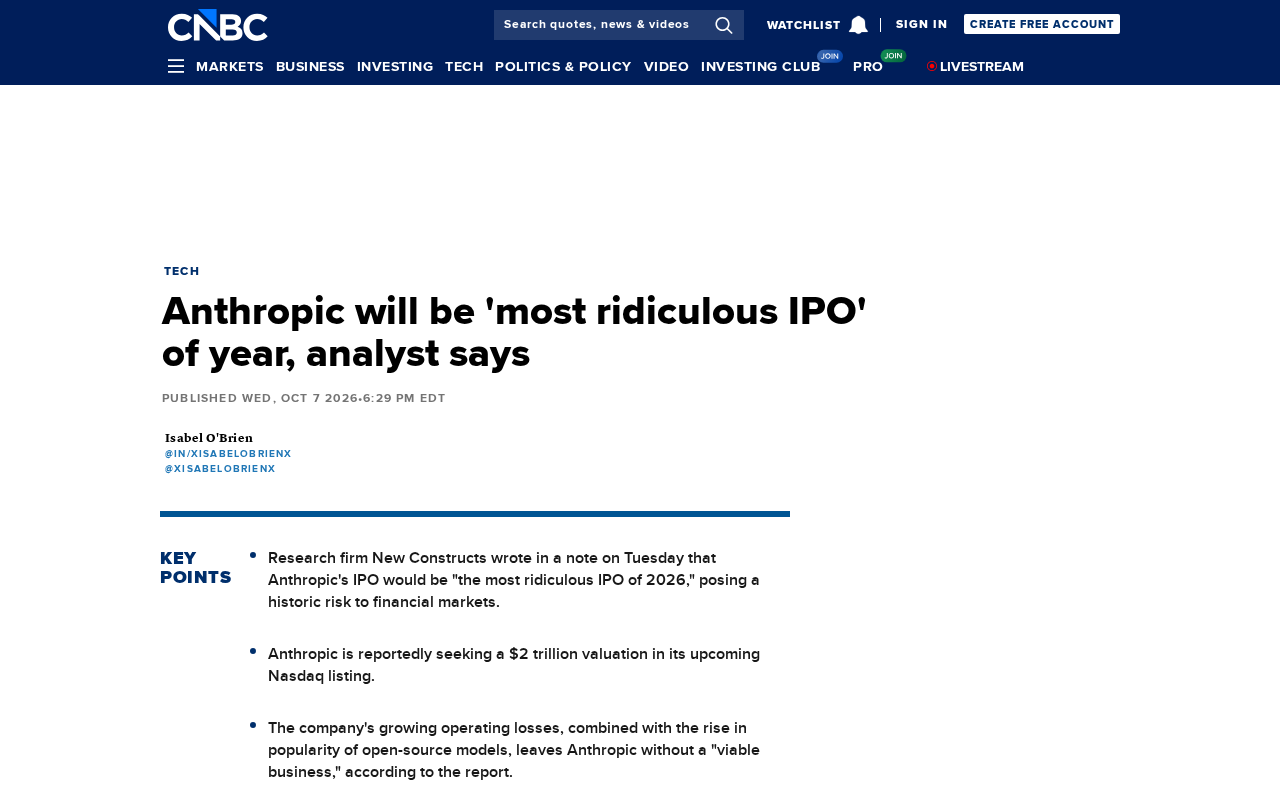
According to CNBC, a research firm has given an extremely sharp assessment of Anthropic's upcoming IPO, calling it the "most absurd IPO of the year" and describing it as an "unprecedented test" of investor gullibility. This view sparked a heated discussion on Hacker News with 224 points and 179 comments.
The Core Controversy: The Gap Between Valuation and Fundamentals
The analyst's criticism is not unfounded. As one of OpenAI's most direct competitors, Anthropic has secured a position in the enterprise AI market with its Claude series of models. However, the research firm's core challenge is this: has the market's current valuation logic for AI companies already detached from verifiable business fundamentals?
This concern is not directed at Anthropic alone. The entire generative AI sector has experienced valuation inflation over the past two years, with investment logic often built on "future possibilities" rather than "current revenue." When a research firm uses a word like "gullibility" to describe investors, it is effectively questioning the credibility of the entire AI investment narrative.
What Are IPOs and Private Market Valuation Anchors
An IPO (Initial Public Offering) refers to a company selling its shares to the public for the first time and listing them for trading on a stock exchange. The financing stages before this are called the private market, primarily involving venture capital, hedge funds, and sovereign wealth funds. Private market valuations are typically determined by the terms of the most recent funding round rather than public bidding, making them susceptible to liquidity premiums, FOMO sentiment, and the willingness of strategic investors. When a company moves from private to public markets, investment banks use private valuations as a reference to set the offering price range. If the private valuation itself is already elevated, IPO pricing cannot truly reflect the company's fundamentals—this is one of the core reasons analysts question Anthropic: public market investors may be forced to pay for the premium of the previous private round.
It is important to distinguish that IPO pricing does not equal the opening price on the first day of trading, which is determined by supply and demand in the public market and may see significant premiums or break below the offer price, further amplifying valuation uncertainty.
Why Analysts Used the Word "Absurd"
According to CNBC's report, the research firm's wording was unusually direct—calling Anthropic's IPO the "most absurd of the year." This phrasing carries several implicit judgments:
First, while AI companies' revenue growth is rapid, their losses are equally staggering. The cost of training frontier models, spending on talent wars, and investment in computing infrastructure all make the profit outlook unclear.
Second, IPO pricing is often based on high private market valuation anchors, and private valuations themselves may already contain substantial irrational premiums. Whether retail investors should pay for this premium when it is brought into the public market is a question that deserves serious consideration.
Third, analysts may believe that current market sentiment is overly optimistic and lacks critical scrutiny of the sustainability of AI business models.
The Cost Structure of Frontier AI Companies
Understanding analysts' doubts about AI companies' profit prospects requires understanding the cost composition of frontier model companies. The single cost of training a top-tier large model (such as Claude or the GPT series) can reach tens of millions to hundreds of millions of dollars, mainly including GPU computing rental, data center energy consumption, and engineering team expenses. In addition, inference costs—the computing power consumed each time a user calls the model—rise linearly or even super-linearly with user scale. Talent costs are equally staggering, with top AI researchers often earning annual salaries plus equity packages exceeding one million dollars. The combination of these three expenses means that even with rapid revenue growth, companies may continue to incur large losses. Therefore, revenue growth alone is insufficient to judge health; it must be assessed alongside gross margin (the ratio after subtracting inference costs from revenue) and cash burn rate. This also explains why investors need to pay attention to the metric of "changes in the marginal cost of model inference."
Divisions in the Hacker News Community
With 179 comments, this topic is far from reaching consensus. Judging from the discussion atmosphere on Hacker News, community reactions show clear polarization.
Some commenters agree with the research firm's judgment, believing that signs of an AI bubble are already obvious enough, and that Anthropic's IPO could become a touchstone for testing market rationality. They point out that every technological boom in history has been accompanied by excessive investment and subsequent corrections.
Others believe this criticism is too harsh. Anthropic has real enterprise customers, stable API revenue, and a top-tier research team. Simply categorizing it as a "bubble" ignores its actual accumulation in AI safety and technical capabilities. For these people, the IPO is simply a natural stage of company development, not speculation.
Historical References for AI Bubble Theories
The "technological booms accompanied by excessive investment" mentioned by commenters have multiple historical precedents. In the internet bubble around 2000, a large number of companies without clear profit models went public at extremely high valuations, after which the Nasdaq index fell about 78% from its peak. The clean energy and 3D printing booms of the 2010s also showed similar patterns: real technological prospects, but short-term valuations that overdrew future years of growth. However, there are counterexamples to bubble theories—Amazon went public in 1997 and lost money for a long time, yet proved to be a reasonable investment. Therefore, the key to judging whether AI companies are bubbling is distinguishing between "temporarily losing money but with a healthy unit economic model" and "losses that intensify as scale expands." Anthropic's enterprise positioning and API revenue model bring it closer to the former than consumer AI applications, but uncertainty around training costs remains the biggest variable.
Potential Impact on the AI Industry's Financing Environment
Regardless of the final pricing of Anthropic's IPO, this debate itself has revealed a deeper question: how much patience does the public market still have for AI companies?
If Anthropic's IPO performs below expectations, it could have a chain reaction on the financing pace of the entire AI sector. Subsequent AI companies preparing to go public will have to face stricter scrutiny, and private market valuation logic may also be forced to adjust.
Conversely, if the IPO is oversubscribed and performs strongly, it could further reinforce the "AI premium" narrative and attract more capital inflows.
The Chain Reaction Mechanism of IPOs
The IPO performance of a landmark company can affect the entire industry through multiple channels. First is the pricing benchmark effect: if Anthropic lists at a price below its private valuation, investment banks for subsequent AI companies must lower their reference anchors when pricing. Second is investor sentiment transmission: public market funds and retail investors will reassess the risk-return ratio of the AI sector, potentially causing capital to flow from high-valuation AI stocks to tech sectors with clearer profitability. Third is the lagging adjustment of the private market: venture capital funds will demand lower valuations or stricter terms in the next funding round, making financing more difficult for startups. Conversely, if the IPO is oversubscribed, it could create a positive cycle, attracting more AI companies to accelerate their listing processes. This "bellwether effect" has appeared in the biotech and cloud computing industries, and the AI sector will likely follow similar patterns.
What Investors Need to Watch
For investors following this IPO, several key indicators are worth tracking: the ratio of revenue growth to customer acquisition cost, enterprise customer renewal rates, changes in the marginal cost of model inference, and whether the company's investment in safety research conflicts with commercial goals.
The research firm's sharp assessment may contain exaggeration, but the question it raises—what should the public market valuation of AI companies be based on—is one that every participant cannot avoid.
One-line Summary
A research firm calls Anthropic's IPO the "most absurd of the year," sparking fierce debate over the disconnect between AI valuations and fundamentals.
Paragraph Summary
According to CNBC, a research firm called Anthropic's upcoming IPO the "most absurd of the year," describing it as an unprecedented test of investor gullibility. The view sparked 224 points and 179 comments on Hacker News. The core controversy is the gap between AI company valuations and verifiable business fundamentals: AI revenue is growing rapidly but losses are equally staggering, and high private market valuation anchors may be carried into the public market. Community reactions are polarized, with one side seeing it as a bubble signal and the other emphasizing Anthropic's real enterprise customers and API revenue. The IPO outcome could have chain effects on the AI industry's financing pace, and investors should watch indicators such as revenue growth, customer acquisition cost, renewal rates, and marginal inference costs.
Related articles

A Single Prompt Triggers a Global PHP Security Storm: Is AI a Savior or a Hidden Risk?
A single AI prompt triggered a global PHP security crisis affecting Wikipedia and the Internet Archive. This article reviews the incident, analyzes the OpenAI-Amazon controversy, and explores the security paradox of lowered vulnerability discovery barriers in the AI era and developer response strategies.

When AI Is Taken Away: How Reliance on Shortcuts Undermines Your Problem-Solving Resilience
A study of 1,222 people found that after using AI to answer questions, once AI was removed, people gave up on more problems than a control group that never used AI. The article analyzes the impact of AI reliance on learning resilience and metacognition, and explores design implications for AI learning tools.

Carta and NewView Partner to Let Startup Employees Cash Out Equity Early
Carta and NewView Capital partner to simplify startup tender offers, helping employees sell equity early. Analysis of the mechanism, liquidity pain points, and impact.