Resend Launches Shared Inboxes: Letting AI Agents Take Over Email Workflows

Resend launches Inboxes, letting AI agents participate in shared inboxes and build email workflows.
Resend launched Inboxes on Product Hunt, extending from email sending API to the inbox side, supporting creation of shared inboxes, connecting AI agents, and building automated workflows. The core idea is to make AI agents first-class participants in the inbox, turning email from a breakpoint in the automation chain into a trigger for AI workflows. The product received 90 upvotes and ranked #10 daily—moderate attention—but key details such as agent integration methods, model support, and workflow visualization are not yet public. Resend's advantages lie in developer trust and API reputation, while challenges come from vertical players like Front and Missive, as well as Google/Microsoft ecosystems, and the accumulation of enterprise-grade permissions, compliance, and auditing capabilities.
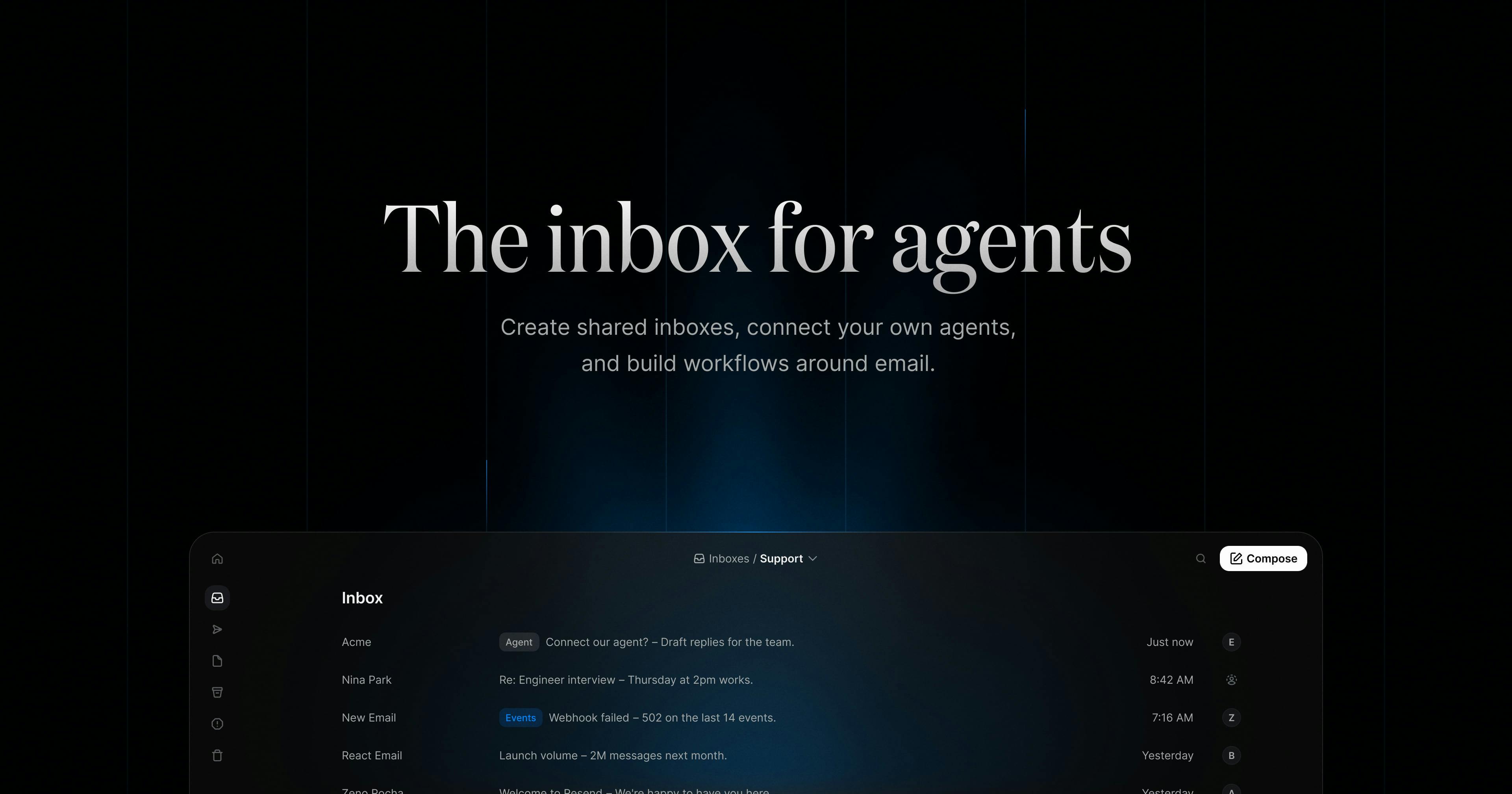
Resend has launched a new product called Inboxes on Product Hunt, positioned as "create shared inboxes, connect your agents, build workflows." The product attempts to solve an increasingly prominent contradiction: as AI agents begin handling tasks on our behalf, email—the most traditional communication channel—has become the breakpoint in the automation chain.
From Sending Tool to Receiving Infrastructure
Resend was previously known for its transactional and marketing email sending API, with the tagline "reach humans, not the spam folder" emphasizing deliverability. The launch of Inboxes means Resend is extending toward the receiving side—not just helping you send emails out, but also helping you manage incoming emails, in a way that AI agents can participate in.
This direction is worth noting. The email sending market is already quite mature, with competition centered on deliverability, templates, and API ease of use; while automation on the inbox side has long remained at the level of rule filtering and tag classification. Shared inbox products (like Front and Missive) solve team collaboration problems, but their automation capabilities are mostly based on manually preset rules. Resend Inboxes' differentiator is treating "connecting agents" as a first-class citizen, making AI agents direct participants in the inbox.
Transactional Email refers to emails automatically triggered by user actions or system events and sent to specific individuals, such as password resets, order confirmations, and billing notifications. Unlike marketing emails, it doesn't pursue bulk reach and large-scale conversion, but emphasizes immediacy, reliability, and high deliverability. Resend initially entered this scenario, providing an API for developers to send transactional emails programmatically, with its core competitiveness lying in the stability of delivery infrastructure and developer-friendly interface design.
Shared Inbox + Agents: A New Piece of the Workflow Puzzle
According to the Product Hunt page, Inboxes supports three core actions: creating shared inboxes, connecting agents, and building workflows. Combined, these three point to a new collaboration paradigm—human team members and AI agents share the same email entry point, with agents handling classification, drafting replies, or triggering subsequent actions.
For developers, this means email can become a trigger for AI workflows rather than an endpoint. When a customer inquiry comes in, the agent reads the content, queries the knowledge base, generates a draft, and assigns it to the corresponding member—all without leaving the inbox interface. As a developer tool by origin, Resend will likely provide API-level orchestration capabilities to connect Inboxes with existing systems.
However, it should be noted that currently public information does not detail the specific agent integration methods, which models are supported, or the degree of visualization in workflow building. These details will determine whether the product is a true automation platform or just another shared inbox with an AI label.
Shared Inbox is a product form that allows multiple team members to jointly access and manage the same email address, commonly seen in customer service and sales scenarios. Typical products like Front and Missive support email assignment, internal notes, status tracking, and basic automation rules. Traditional shared inbox automation relies on manually preset "if-then" rules, whereas with AI agents, agents can understand email semantics, make autonomous decisions, and execute multi-step actions, upgrading automation from rule-driven to intent-driven.
Market Positioning and Potential Challenges
With 90 upvotes, 4 comments, and a #10 daily ranking, the product has gained some attention in the Product Hunt community, though discussion heat isn't particularly prominent. The email inbox space itself is highly competitive: there are giant ecosystems like Google Workspace and Microsoft 365, vertical players focused on shared inboxes like Front and Missive, and products like Superhuman that emphasize AI email experiences.
Resend's advantage lies in developer trust and its reputation for API design. If Inboxes can connect sending and receiving to form a closed loop of "send-receive-agent processing-resend," it will have natural migration appeal for teams already using Resend for sending. The challenge is that inbox products involve enterprise-grade requirements such as permission management, compliance auditing, and data security—capabilities that take time to accumulate and cannot be quickly filled in just by elegant APIs.
Another observation point is the actual value of "agent connection." If agents only automatically tag or generate summaries, the increment is limited; if they can reliably execute multi-step tasks (such as updating CRM based on email content, scheduling meetings, or initiating refund processes), that would be a qualitative change at the workflow level. The former is easy to achieve; the latter requires solid engineering investment.
Permission management and compliance auditing are unavoidable foundational capabilities for enterprise-grade inbox products, involving fine-grained role controls (such as who can view, reply, and assign emails), operation log retention, data residency and encryption, and meeting compliance requirements like SOC 2 and GDPR. These capabilities often require long-term engineering investment and third-party audit certification—a key threshold for teams starting as API tool providers to enter the enterprise market.
Signals Worth Watching
The idea of email as an entry point for AI agents is gaining more recognition. Resend's path from the sending side into the receiving side is clear and reasonable. For development teams building AI automation workflows, Inboxes is worth adding to the watch list—especially after the product opens up more agent capabilities and workflow details, when evaluation will be more accurate.
One-line Summary
Resend launches Inboxes, letting AI agents participate in shared inboxes and build email workflows.
Paragraph Summary
Resend launched Inboxes on Product Hunt, extending from email sending API to the inbox side, supporting creation of shared inboxes, connecting AI agents, and building automated workflows. The core idea is to make AI agents first-class participants in the inbox, turning email from a breakpoint in the automation chain into a trigger for AI workflows. The product received 90 upvotes and ranked #10 daily—moderate attention—but key details such as agent integration methods, model support, and workflow visualization are not yet public. Resend's advantages lie in developer trust and API reputation, while challenges come from vertical players like Front and Missive, as well as Google/Microsoft ecosystems, and the accumulation of enterprise-grade permissions, compliance, and auditing capabilities.
Related articles

Will GitHub Die? Open Source Maintainer Burnout and the Collaboration Crisis in the AI Era
Lex Fridman podcast discussion on open source maintainer burnout and GitHub's predicament: massive pull requests overwhelm core maintainers, and AI worsens code bloat. Using math journal peer review and Poincaré conjecture verification as analogies, the article analyzes why verification in knowledge production must be deliberately slow, and how open source communities can avoid the failure mode of maintainers exiting.

Stop Building Cookie-Cutter AI Websites: 3 Tools That Transform Your Coding Agent
Three tools that boost AI coding agents: FFmpeg skill for local video editing in Claude Code and Cursor, Hallmark's 50 design themes to fix cookie-cutter AI sites, and Jailbreaks' 25+ model prompts.

How America's Gerontocracy Squeezes the Younger Generation
Americans over 55 hold nearly three-quarters of national wealth, alongside an 80-year-old president and elderly congressional leaders. The Atlantic's Idrees Kahloon explains how gerontocracy drives up housing costs, squeezes opportunities for the young, and explores zoning reform and child poverty reduction as practical fixes.