Restate Raises $20M: AI Agents Are Supercharging Demand for Durable Execution Infrastructure

Restate raises $20M, leveraging Flink expertise to challenge Temporal in the AI agent durable execution market.
As AI agents move from experiments into production, "durable execution infrastructure" — which ensures reliable completion of long-running, multi-step tasks — is becoming a hot investment category. Restate, founded by Apache Flink veterans, applies battle-tested state management and fault-tolerance concepts from stream processing to agent workflow orchestration, and has raised $20M to challenge industry leader Temporal. The core value of durable execution frameworks is recording workflow state at every step so that execution can resume precisely after failures like network outages or service crashes — a hard requirement for agent tasks running minutes or hours. Restate's raise also reflects a broader capital trend: investment is flowing from the model layer down into foundational execution infrastructure.
The Age of AI Agents Makes Durable Infrastructure a Must-Have
As AI agents move from concept to large-scale production deployment, the foundational infrastructure that supports their long-running, reliable execution is becoming a major investment focus. Startup Restate recently announced a $20 million funding round, taking direct aim at workflow orchestration heavyweight Temporal in a market that's heating up fast.
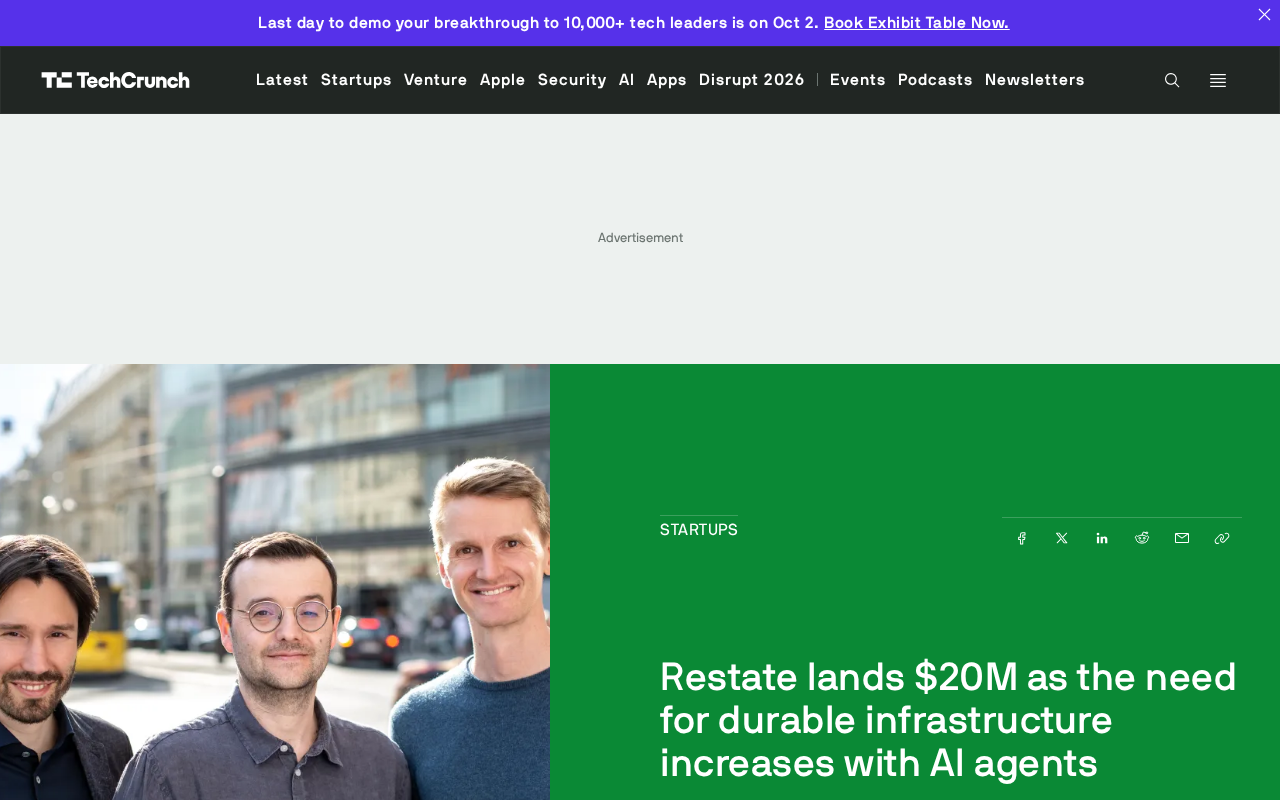
Restate was founded by veteran engineers behind Apache Flink — one of the industry's most widely used stream data processing engines. That background gives the team deep expertise in distributed systems and state management, which they're now applying to the emerging need for "durable execution."
Why AI Agents Need "Durable" Infrastructure
AI agents are fundamentally different from traditional one-off API calls. An agent might need to execute dozens or even hundreds of sequential steps, invoke multiple external tools, wait for human approval, or handle long-running tasks. At any point in this process, a network interruption, service restart, or process crash could wipe out the entire task chain.
This is precisely where durable execution frameworks deliver value — they record the state of every step in a workflow, enabling precise recovery from the point of failure rather than starting over from scratch. For agent tasks that can run for minutes or even hours at a time, this kind of reliability guarantee is no longer a nice-to-have. It's a hard requirement.
From Data Streaming to Agent Orchestration
Restate's founding team brings deep Flink DNA, meaning they have a near-obsessive understanding of state consistency and fault tolerance. Applying mature state management concepts from stream processing to the orchestration of agent workflows is the technical foundation that sets Restate apart from purely application-layer solutions.
Apache Flink is an open-source stream processing framework originally initiated at TU Berlin and later donated to the Apache Software Foundation. It has become one of the industry standards for large-scale real-time data processing. Its core design revolves around "stateful stream computation": each operator can maintain state locally, and the system periodically generates "checkpoints" that persist state snapshots to distributed storage. When a node fails, a job can recover precisely from the most recent checkpoint without losing any already-processed data. This "checkpoint + state backend" mechanism is deeply aligned with Restate's durable execution philosophy — at their core, both approaches are about "making long-running computations fault-tolerant." The real-world experience Flink engineers have accumulated in designing distributed state consistency, exactly-once semantics, and related problems is precisely the differentiated technical moat that Restate's team brings to workflow orchestration.
Head-to-Head Competition with Temporal
Temporal is the recognized leader in durable workflow orchestration, widely used by enterprises for mission-critical business process management. Restate's decision to directly target this incumbent signals strong confidence in its own technical approach.
The competition between the two ultimately comes down to developer experience, performance overhead, and how well each adapts to AI agent use cases. As agent applications grow explosively, the workflow infrastructure market is expanding rapidly — creating an opening for a challenger like Restate. The $20 million raise will provide critical firepower for product refinement and market expansion.
Temporal grew out of Cadence, an internal workflow engine built at Uber, and was spun out as an independent company in 2019. It has since raised over $120 million and counts Netflix, Stripe, Snap, and other major tech companies among its customers. Its core concept is "Durable Functions": developers write business logic as ordinary code, and the framework handles persisting the execution history of every step to a database, enabling resume-from-anywhere on failure. Temporal's strengths lie in its mature ecosystem and enterprise-grade reliability, but some developers criticize it for complex deployment and high operational overhead. One of Restate's key angles is lowering that barrier — attracting smaller teams and emerging agent application developers with a more lightweight deployment model and native support for AI agent scenarios.
Sector Trends: A Revaluation of Infrastructure
Restate's funding round is a signal: amid the AI application boom, capital is flowing beyond the model layer and deeper into foundational infrastructure. As more enterprises try to deploy agents in production, the question is shifting from "can we get this running?" to "can we keep this running reliably and continuously?"
Whoever can provide a stable, recoverable, and easy-to-integrate execution foundation will hold a critical key to scaling AI applications in the real world. The rising temperature of the durable infrastructure sector is a direct reflection of that logic.
Note: This article is based on limited publicly available information. Restate's specific product capabilities, funding details, and comparative data with Temporal await further verification from additional sources.
Related articles

Should U.S. College Fraternities Be Banned? A Researcher's Incisive Observations
Why not just ban U.S. college fraternities? A researcher finds the key resistance comes from decision-makers' own fraternity identities and schools' "willful ignorance."

Microsoft Discovery: Accelerating Scientific Discovery with AI Agents
Microsoft's Discovery platform runs specialized AI agents to help researchers screen and prioritize the most promising compounds and experimental paths, reducing experiments and accelerating scientific discovery.

Cambridge Heavy Industries Secretly Develops Desktop-Scale Nuclear Fusion Device
Cambridge Heavy Industries is secretly developing a desktop-scale laser-driven nuclear fusion device, targeting the equipment supply market for fusion power plants. This article analyzes its miniaturization technology path, commercialization logic, and unique positioning in the fusion startup wave.