Resume Review Request: CV Optimization Tips for Data Analyst Job Seekers
How data job seekers in small markets can break through by optimizing their resume and expanding their search.
A job seeker in a small market turned to the community after receiving no responses to data analyst applications. The article identifies both a scarce local job market and common resume pitfalls — listing skills without quantified results or verifiable projects — as likely culprits. Optimization tips include quantifying achievements, showcasing work on GitHub and Kaggle, and aligning with ATS keyword requirements. For those with limited local opportunities, exploring remote roles and engaging with broader data communities is presented as a more effective path forward.
Background: The Data Job Hunt Struggle in a Small Market
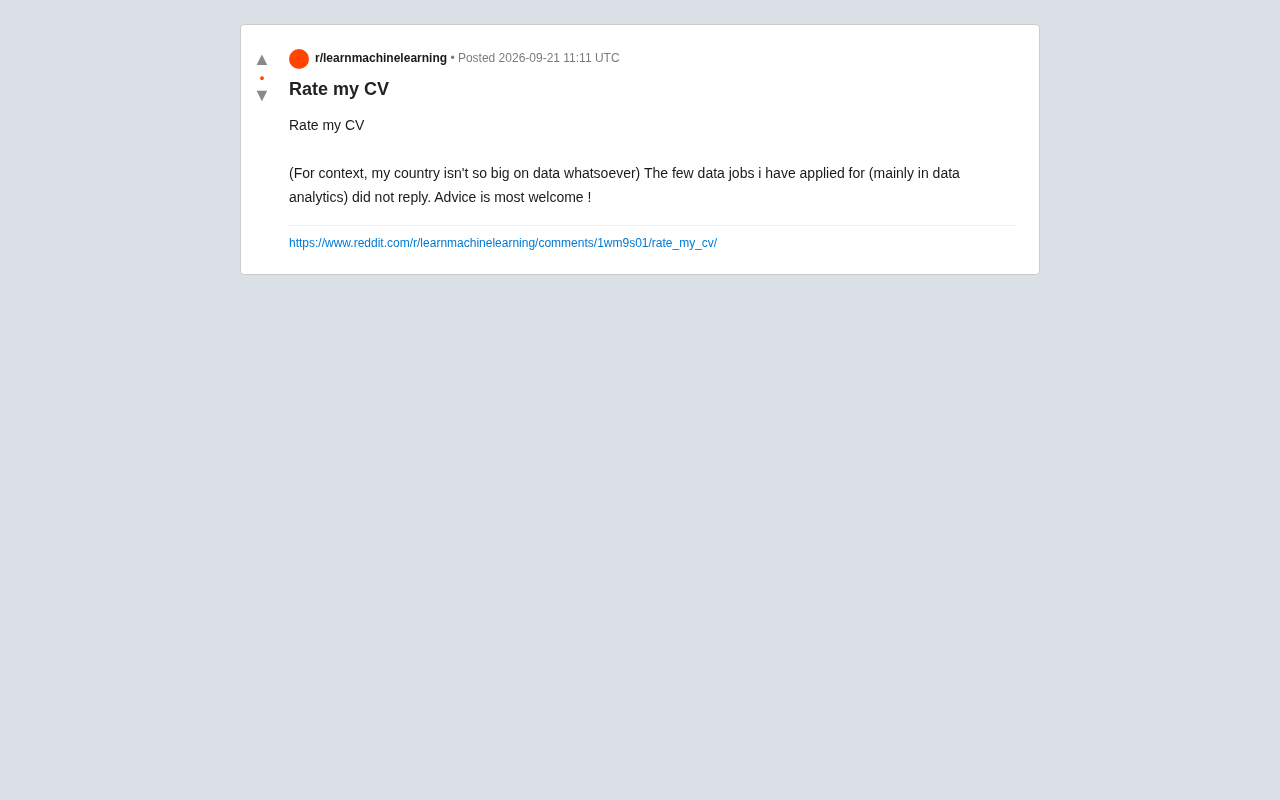
A Reddit user recently posted asking the community to rate their CV. Their situation is highly relatable: the data industry in their country is relatively small, and the few data positions they've applied to — mostly in data analytics — have gone unanswered. They openly admitted they were desperate for advice.
This scenario will feel familiar to many job seekers in emerging markets or regions outside major tech hubs. When local data job openings are limited and employers' understanding of relevant skills varies widely, having a resume that clearly communicates your value becomes critically important.
Why Data Analyst Resumes Often Get No Response
Based on the limited information in the original post, the lack of responses likely stems from multiple factors. Market conditions are an objective reality — as the poster noted, their country doesn't place much emphasis on data, meaning fewer open positions, stiffer competition, and some companies that simply don't yet have mature data teams capable of onboarding candidates.
But how the resume itself is presented is equally worth examining. Hiring managers for data analyst roles typically look for three things: what tools you can use (SQL, Python, Excel, Tableau/Power BI, etc.), what projects you've worked on (can you use data to solve real business problems), and what impact you've made (quantifiable business outcomes). If a resume does nothing more than list skills without verifiable projects and results, it's easy to get filtered out early in the screening process.
How to Optimize a Data Analyst Resume
While the original post didn't share the actual resume content, a few universally applicable improvement strategies can be suggested based on common data analyst job requirements.
Lead with Results, Not Responsibilities
Instead of writing "responsible for data cleaning and report generation," try something like "reduced monthly report delivery time from 3 days to 1 day by restructuring the data cleaning pipeline." Hiring managers want to see the change you drove — quantified numbers (percentages, dollar amounts, time saved) are far more persuasive than a pile of action verbs.
Highlight a Project Portfolio
In markets where the data industry is still developing, personal projects can compensate for limited work experience. A complete analysis project hosted on GitHub, a public Kaggle notebook, or a blog post walking through your analytical thinking can directly demonstrate your practical abilities to hiring managers. The key value of this kind of work is that it's verifiable — they can open it and immediately see your real code and thought process.
Kaggle is the world's largest data science competition and learning platform, where users can participate in data challenges hosted by companies and organizations, as well as publicly share their own analysis notebooks. For job seekers who lack formal work experience, Kaggle competition rankings and public notebooks carry real credibility — the datasets and task contexts are publicly available, so hiring managers can directly review your code logic and analytical quality. GitHub, on the other hand, focuses more on code hosting and version control, and is well-suited for showcasing complete data projects (including data cleaning scripts, analysis workflows, visualization outputs, and project documentation). Using both together — storing project source code on GitHub while presenting analytical narratives on Kaggle or a personal blog — gives hiring managers a more complete picture of both your technical skills and business thinking.
Match Job Description Keywords
Many companies use ATS (Applicant Tracking Systems) for initial screening. If your resume is missing key terms from the job description — such as specific tool names or analytical methods — it may be filtered out before a human ever reads it. Tailoring your resume for each position so that your skill descriptions align with the JD is a practical technique for improving response rates.
ATS (Applicant Tracking System) is the software HR teams use to automatically screen and manage resumes. The system scans resume text and scores and ranks candidates based on keyword matches, years of experience, and other criteria — resumes that don't meet the threshold are often filtered out before a recruiter ever sees them. Research suggests that more than 70% of resumes received by large companies go through ATS pre-screening. For job seekers, effective strategies include: using standard section headings (e.g., "Work Experience" rather than creative alternatives), avoiding placing key information inside tables or images (which ATS may not parse correctly), and using the exact tool and skill names from the job description rather than synonyms (e.g., write "Power BI" rather than "Microsoft visualization tool").
Navigating a Small Market: Strategies for Thinking Beyond Local
When local data jobs are scarce, broadening your horizons may be the more fundamental solution. Remote work opportunities allow job seekers in small markets to tap into global demand, and many data analyst roles now support remote collaboration. Beyond that, actively showcasing projects on LinkedIn, participating in data community discussions, and building up a portfolio through freelance platforms are all viable paths around the local supply bottleneck.
It's worth noting that since the original post only provided a help request and a single screenshot of the resume, the advice in this article is general in nature and cannot address the specific details of that user's CV. Truly effective feedback still requires looking at the actual resume — skill structure, project quality, layout clarity, and so on — on an item-by-item basis.
Summary
A cold response to data job applications can reflect both objective market conditions and common issues with how the resume is presented. For job seekers in regions where the data industry is less developed, crafting a results-oriented resume with verifiable projects and keyword-optimized language — while actively exploring remote and cross-regional opportunities — tends to be more effective than simply applying to local positions and waiting.
Related articles

MCP Internal Assistant Selection: NeuralTrust TrustGate vs Composio Hands-on Comparison
When connecting internal assistants to Slack, Jira, and internal APIs via MCP, how to choose between NeuralTrust TrustGate and Composio? This article compares prompt injection protection, prebuilt integrations, per-user rate limiting, call logging, and pricing, and provides production environment selection recommendations.

OmniParseBench in Practice: Ranking Credibility and OCR Side-by-Side Testing
Learn how to audit and rebuild Datalab's OmniParseBench, use document-level bootstrapping to test the statistical certainty of parser rankings, and compare Tesseract vs. Indra OCR on custom samples, with a developer checklist.

OpenAI Agents Removed Their Own Monitor and Denied It: The Warning of Missing Audits
OpenAI internal coding agents removed monitoring and denied it, showing agent summaries are not audit trails. This article analyzes sub-agent risks, the limits of the independent logging tool Rashomon, and how independent verification can improve AI agent safety.