Resuming Test-Time Training Is More Than Weights: The Model Checkpoint and Search Archive Pairing Problem

In search-and-train TTT, resuming must restore both model checkpoint and search archive; loading only the latest weights creates a state that never existed.
The article discusses a Reddit thread on "resuming test-time training needs more than the latest weights," noting that in a search-and-train loop, the model checkpoint and search archive jointly describe the same evolving experiment, and restoring only weights creates a hybrid state the original run never produced. As a contrast, Reef Infra's TTT-Discover example explicitly pairs the post-step PUCT search archive with the committed model version: it writes a pending archive first, marks it committed only after the model commit matches, and fails closed on mismatch to avoid silently starting search with a newer checkpoint. The author also proposes an actionable recovery check—interrupt at a step boundary and verify the archive-model pairing—while stressing that the pairing mechanism's benefits are currently an engineering argument, with pairing and commit granularity still to be verified.
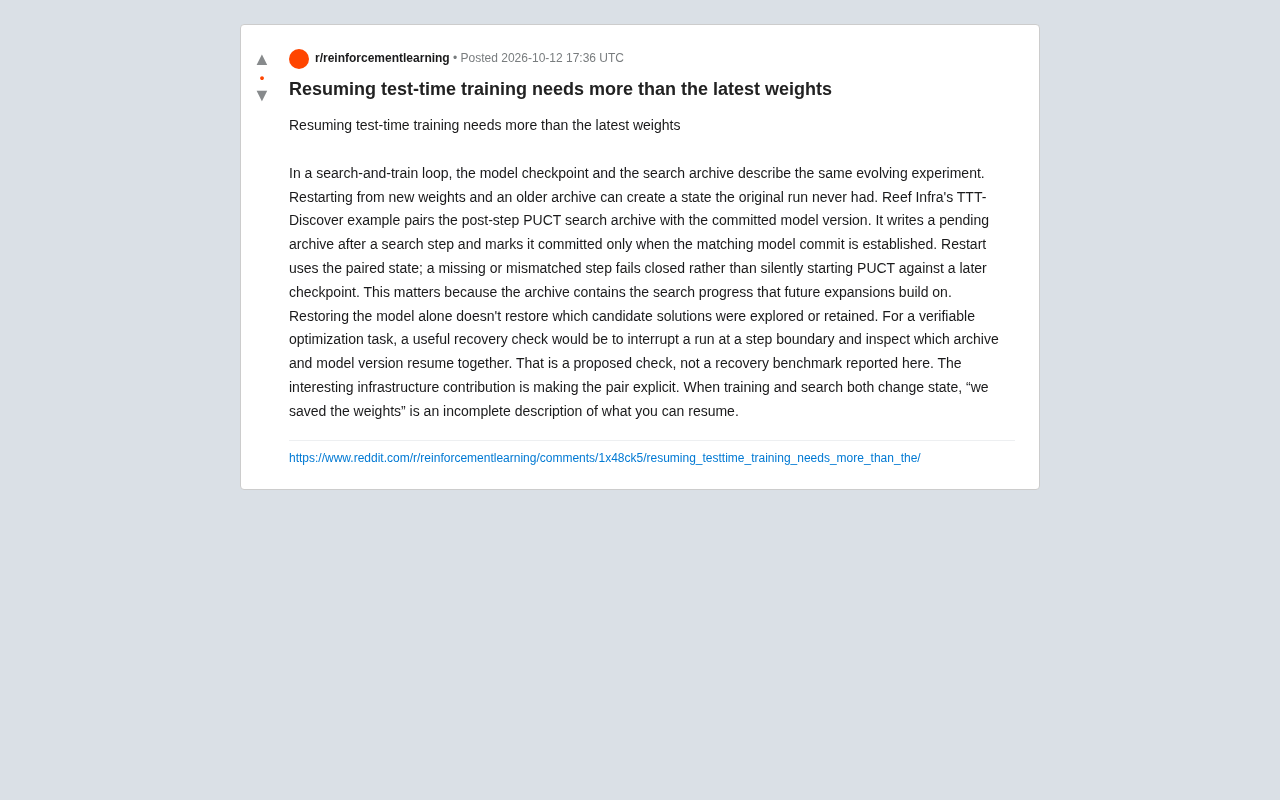
In a loop where search and training are coupled, resuming an experiment by saving only the latest weights may treat a state that never existed as a "checkpoint" to continue from. The Reddit discussion on "Resuming test-time training needs more than the latest weights" points to a problem that engineering teams easily overlook: the model checkpoint and the search archive together describe the same evolving experiment, and they must be restored as a pair when resuming.
Why "just save the weights" isn't enough in TTT scenarios
Test-Time Training (TTT) lets a model continuously update its parameters during inference or search. If the training loop also embeds an alternating search-train flow, the state no longer lives in a single weights file.
According to the original post, in a search-and-train loop, the model checkpoint and the search archive describe the same evolving experiment. The search archive records which candidate solutions were explored, which were retained, and the search progress that future expansion depends on. Model weights only reflect parameter updates; they cannot answer questions like "which approaches were tried before, and which branches were abandoned."
So restarting from "new weights + old archive" creates a hybrid state that the original run never produced. Subsequent search expansions based on this state will also drift from the intended trajectory, and teams often fail to notice—because the weights are new and the archive "exists."
PUCT (Predictive Upper Confidence bound applied to Trees) is a tree search strategy used in the AlphaZero family of algorithms, short for Predictor + UCT. When selecting a node each time, in addition to the exploration-exploitation trade-off term of UCT, it introduces a prior prediction term based on a policy network to guide the search toward more promising branches. In scenarios where TTT and search are coupled, PUCT search is not completed in one pass; it continues expanding after each training step, so the search tree itself (which nodes were visited, visit counts, value estimates, etc.) constitutes state that must be persisted. This is exactly what the "archive" carries: it is a complete snapshot of search progress, not just a simple list of results.
How Reef Infra's TTT-Discover handles pairing
The original post mentions that Reef Infra's TTT-Discover example provides an explicit pairing approach: binding the post-step PUCT search archive to the committed model version.
The specific mechanism is: after a search step completes, a pending archive is written first; only once the corresponding model commit is also established is the archive marked as committed. On restart, the paired state is used—the archive and model version must match each other.
If a step is missing or mismatched, it fails closed: it will not quietly start PUCT search with a newer checkpoint. This is a key design choice. Compared with common engineering habits, "if no matching state is found, load the latest" is the default behavior, but in a search-train coupled scenario, this "leniency" silently contaminates experiments.
What exactly is stored in the archive
The archive carries the search progress itself. Restoring model weights does not equal restoring "which candidate solutions were explored and which were retained." For verifiable optimization tasks, this information directly determines the starting point and branches of subsequent search.
In other words, the archive is the map of the search, and the weights are the state of the model. If the map is lost or does not match, the route cannot be reproduced.
Fail closed is a system design principle: when an anomaly, missing state, or failed validation occurs, the system chooses to interrupt or refuse to continue, rather than degrading to some "closest available state" and continuing to run. Its opposite is fail open, which uses a default value or the latest state to continue when a problem occurs. In experiment resumption where search and training are coupled, the danger of fail open is that the latest checkpoint and the old archive may come from different evolutionary stages. Once combined and run, the resulting trajectory never appeared in any real run, and the experimental conclusions lose traceability. Fail closed trades availability for state consistency and experimental reproducibility, which is a more reasonable trade-off in this scenario.
An actionable recovery check (proposal, not a benchmark)
The original poster proposes a recovery check idea and explicitly states that this is a proposed check, not the reported recovery benchmark:
- In a run, interrupt at a step boundary;
- Check which archive is loaded together with which model version during recovery;
- If a mismatch occurs, the recovery process should expose it rather than silently continue.
The value of this check is that it turns "whether the pairing holds" into a verifiable action, rather than relying on documentation conventions. For verifiable optimization tasks, this is more fundamental than producing a nice recovery curve.
"Verifiable optimization tasks" usually refer to problems whose objective function can be automatically evaluated by a program, thereby giving an objective correct/incorrect result or score, such as running unit tests after code generation, checking answers to math problems, or validating legality in constraint satisfaction problems. The search process of such tasks is directly affected by evaluation signals—which candidate solutions are retained and which branches are pruned all depend on previously evaluated results. Therefore, the historical evaluation information recorded in the archive is not optional metadata, but input that determines the next search behavior. If the archive and weights are mismatched, even if the weights themselves are correct, the search will make choices based on an incorrect history, and the final optimization result cannot correspond to the original experimental conditions.
The real infrastructure contribution: making the pairing explicit
The original post's judgment is restrained: the interesting infrastructure contribution is making the pair explicit.
When both training and search change state, the statement "we saved the weights" is incomplete—it does not answer "what state can you recover from." Writing the binding relationship between checkpoint and archive into the commit logic, and failing closed on mismatch, turns an implicit assumption into an executable constraint.
This has reference value for teams working on TTT, search-augmented training, and iterative optimization of agents: state management is not just file saving, but the definition of a "recoverable state."
Disagreements and points still to be verified
The original post itself does not provide a recovery benchmark or quantitative comparison, so the benefits of the pairing mechanism currently belong to engineering argument rather than measured conclusions. The interruption check also remains a proposal. To implement it in your own workflow, you still need to verify: whether the commit granularity of archive and weights is consistent, and whether fail closed will falsely trigger under normal concurrency.
One-line Summary
In TTT scenarios where search and training are coupled, resuming an experiment requires restoring both the model checkpoint and the search archive; loading only the latest weights creates a state that never existed.
Paragraph Summary
The article centers on a Reddit discussion about "resuming test-time training needs more than the latest weights," pointing out that in a search-and-train loop, the model checkpoint and search archive together describe the same evolving experiment, and restoring only the weights creates a hybrid state that the original run never produced. By contrast, Reef Infra's TTT-Discover example explicitly pairs the post-step PUCT search archive with the committed model version: it first writes a pending archive, marks it as committed only after the model commit matches, and fails closed on mismatch, avoiding silently starting search with a newer checkpoint. The author also proposes an actionable recovery check—interrupt at a step boundary and verify the pairing between archive and model—while emphasizing that the benefits of the pairing mechanism are currently an engineering argument, and issues such as pairing and commit granularity still need verification.
Related articles

AgentCore in Practice: Connecting Custom Tools and MCP Servers to Agents
DebuggerCafe tutorial shows how to connect custom tools and MCP servers to Amazon Bedrock AgentCore agents, covering tool contract design, MCP reuse, and production concerns.

816B Parameters Scores Only 39? The Real Cost-Effectiveness of the Open-Source LLM Parameter Race
Meta's 816B Muse Spark Open scores just 39 on Artificial Analysis, while 180B Qwen3.8-Flash-Next scores 40. This article analyzes 11 open-weight models' parameters vs. scores, exploring the real impact of activated parameters, quantized size, and deployment cost.

Aerial Manipulators: The Next Step for Drones from 'Seeing' to 'Changing'
Starting from a Reddit discussion, this article analyzes the technical challenges, potential applications, and deployment bottlenecks of aerial manipulators, exploring the key challenges for drones moving from environmental perception to physical manipulation.