ResumizeAI Review: AI-Powered Resume Customization for Smarter Job Hunting

ResumizeAI uses AI to instantly generate tailored resumes and cover letters from any job posting.
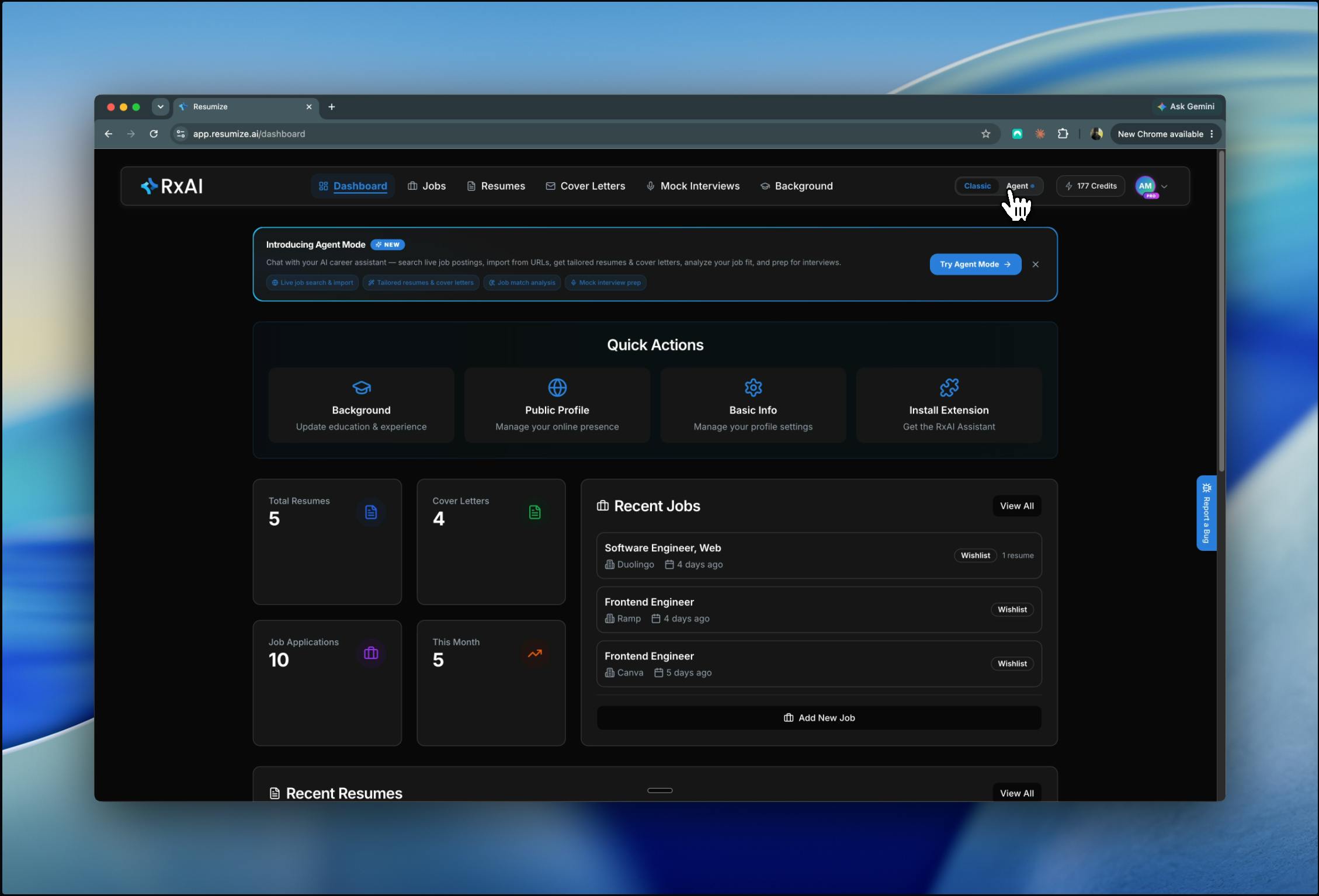
ResumizeAI is an AI-powered tool that automatically customizes resumes and cover letters by matching users' real work experience to specific job postings in seconds. It features built-in job search, PDF export with ATS compatibility, and shareable online profiles. While competing in a crowded market alongside Rezi, Kickresume, and Teal, its integrated workflow approach aims to eliminate the repetitive busywork of job applications.
A New Job Search Tool: Let AI Handle Resume Customization
In today's fiercely competitive job market, every application requires a tailored resume and cover letter—a time-consuming and repetitive grind. According to Glassdoor statistics, a popular job posting receives an average of about 250 applications, of which only 4-6 candidates get interview invitations, and ultimately just one person is hired. Facing these brutal odds, targeted resume customization is no longer a "nice-to-have"—it's a "must-have."
Recently launched on Product Hunt, ResumizeAI aims to revolutionize this process with artificial intelligence. With the tagline "Take full control of your job hunt," it focuses on automating tedious application tasks so job seekers can invest their energy where it truly matters.
The product was built by Maker Hamza Hassan. After launch, it received 46 upvotes and 3 comments, ranking #17 on that day's leaderboard, categorized under Hiring, Productivity, and Artificial Intelligence.
ResumizeAI Core Features Breakdown
One-Click Job Matching with Instant Custom Resume Generation
ResumizeAI's core logic is remarkably straightforward: users paste any job posting, or search for live open positions directly within the platform, and the AI generates a customized resume and cover letter based on that job description within seconds.
From a technical perspective, tools like this rely on Large Language Models (LLMs) for natural language understanding and generation. When users input a job description along with their personal experience, the model identifies key skills, qualifications, and experience requirements in the job posting, then extracts the most relevant information from the user's career data and reorganizes it in industry-standard language. The core advantage of this technology lies in semantic understanding—it doesn't simply swap keywords, but can comprehend the semantic connection between "team management experience" and "led a 5-person cross-departmental project team," intelligently performing deep matching between user experience and job requirements.
Unlike some tools on the market that fabricate experience out of thin air, ResumizeAI emphasizes matching based on users' real work experience (matching your real experience). This means the AI's role is to "reorganize and highlight"—extracting the parts of your existing resume that best fit the target position, rather than inventing content. This design strikes a balance between efficiency and authenticity, reducing the job search risks associated with resume fraud.
Flexible Resume Output and Presentation Options
For deliverables, ResumizeAI offers two formats:
-
Export polished PDFs: Suitable for traditional email submissions and recruitment system uploads, ensuring professional formatting that helps pass ATS screening. It's worth noting that ATS (Applicant Tracking System) is automated software widely used in corporate recruitment processes—statistics show that over 98% of Fortune 500 companies and approximately 75% of mid-to-large enterprises use them. These systems use keyword matching, format parsing, and scoring algorithms for initial resume screening, meaning your resume must pass machine review before a human recruiter ever sees it. Common ATS systems include Workday, Taleo, Greenhouse, and Lever, all of which have strict formatting requirements—complex tables, embedded images, and special fonts should be avoided, as they may prevent resume content from being parsed correctly. Therefore, ResumizeAI's generated PDFs need to balance visual appeal with ATS compatibility.
-
Publish shareable online profiles: Users can publish a personal job-seeking homepage at a dedicated URL, making it easy to share directly with recruiters or on social networks via link.
This "file + link" dual-track approach covers multiple job search scenarios from formal applications to lightweight social sharing, giving job seekers greater agency.
What Job Search Pain Points Does ResumizeAI Solve?
The product page features one standout line: "Built to kill the busywork of applying, one job at a time."
This statement precisely targets job seekers' core pain point. Based on common job search experience, an active job seeker typically needs to submit dozens or even hundreds of applications, and each one should theoretically be customized to match the position's keywords and requirements. Research from Jobvite shows that targeted, customized resumes receive interview callbacks at roughly 40% higher rates than generic ones. However, a successful job search typically requires 100-200 applications, meaning manual completion faces enormous challenges:
- Repetitive labor—repeatedly adjusting the same resume's wording and ordering;
- High time cost—a single high-quality customization often takes 30-60 minutes, meaning resume customization alone could consume 50-200 hours of pure labor, equivalent to over a month of full-time work;
- Fatigue and burnout—later in the process, job seekers often abandon customization and mass-send generic resumes, causing hit rates to decline.
ResumizeAI compresses this process to "seconds," theoretically enabling a significant increase in both application volume and quality, thereby improving the probability of landing interviews.
Product Positioning and Competitive Analysis
From a positioning perspective, ResumizeAI represents a typical vertical use case in the current AI application wave—using LLMs to solve "document customization," a high-frequency essential need. Its value lies not in technical complexity, but in precisely embedding AI capabilities into the specific workflow of job searching.
Several dimensions worth noting:
- Differentiation advantage: The built-in job search function integrates "finding jobs" and "editing resumes" into a single platform, reducing tool-switching costs. This is a clear highlight compared to standalone resume polishing tools.
- Potential challenges: How AI-generated resumes avoid homogenization, how they pass corporate ATS keyword screening, and the accuracy of generated content will all directly impact real-world effectiveness. As more job seekers use similar AI tools, recruiters may receive large volumes of resumes with similar language styles, which could actually reduce the distinctiveness of individual resumes.
- Market competition: The AI resume space is already quite crowded. Rezi focuses on ATS optimization, using AI to analyze resume-to-job-description match rates and provide scores; Kickresume excels in design templates with AI-assisted writing features; Teal positions itself as a complete job search management platform, integrating resume generation, job tracking, and networking management. Additionally, plugins and prompt engineering solutions based on general-purpose models like ChatGPT have proliferated, creating a multi-layered competitive landscape from specialized tools to general solutions. The core moat in this space isn't the AI technology itself, but rather deep understanding of job search workflows, template design quality, ATS compatibility testing, and real job search success rate data. For ResumizeAI to stand out, polished product experience and real conversion rates will be key.
Conclusion: The Value and Limitations of AI Resume Tools
ResumizeAI represents a clear example of AI landing in everyday life scenarios: not pursuing flashy technology, but practically helping users save time. For job seekers actively mass-applying, it offers a possible path to "winning through volume without sacrificing quality."
Of course, tools are ultimately just aids. Whether an AI-customized resume impresses recruiters still depends on the job seeker's real abilities and experience. It's worth noting that as AI tools become prevalent in job searching, recruiters' screening standards are evolving in parallel—increasingly, companies are adding deeper capability verification in interview stages, such as live coding tests, case study presentations, or structured behavioral interviews, to confirm that candidates' actual skill levels match their resume descriptions.
The significance of ResumizeAI perhaps lies in liberating people from mechanical labor, allowing them to invest their limited energy into interview preparation, skill development, and other areas that truly determine success or failure. In the AI-empowered job search era, tools solve efficiency problems, but the core of personal competitiveness—unique experiences, deep professional expertise, and genuine career attitude—remains irreplaceable by any technology.
Related articles

Gemini 3.7 Flash Spotted in Google Cloud Console — Launch Countdown Begins
Developers spot Gemini 3.7 Flash in Google Cloud Console, sparking discussion about its relationship to Pro and Google's model distillation strategy.

AI-Memory: Building a Cross-Tool Long-Term Memory System for Coding AIs
AI-Memory is a Rust-based open-source project providing long-term memory for Claude Code, Cursor, Aider and other Agent coding CLIs, enabling seamless handoff between vendors.

Bullet Enters the Stage: YC Newcomer Bets on a Faster Coding Agent
YC S26 startup Bullet launches a speed-focused coding Agent targeting developer latency pain points. Analysis of its differentiation, acceleration techniques, and market opportunity against Cursor and Claude Code.