Retooling in Minutes: Industrial Next Redefines Factory Robot Flexibility

Industrial Next cuts factory robot retooling from weeks to minutes, targeting small-batch flexible manufacturing.
Industrial Next seeks to solve manufacturing's long-standing retooling pain point: traditional industrial robots rely on manual teaching, and line changeovers often mean days to weeks of downtime and debugging, making it hard to adapt to small-batch, high-variety flexible manufacturing. The company focuses on automating complex, delicate tasks that previously relied on human labor, aiming to compress robot retooling time to minutes. If mature, this capability could improve capacity utilization, reduce dependence on dedicated fixtures, and shift production from rigid lines to flexible cells. The key lies in generalization and yield stability after retooling; large-scale validation remains to be seen.
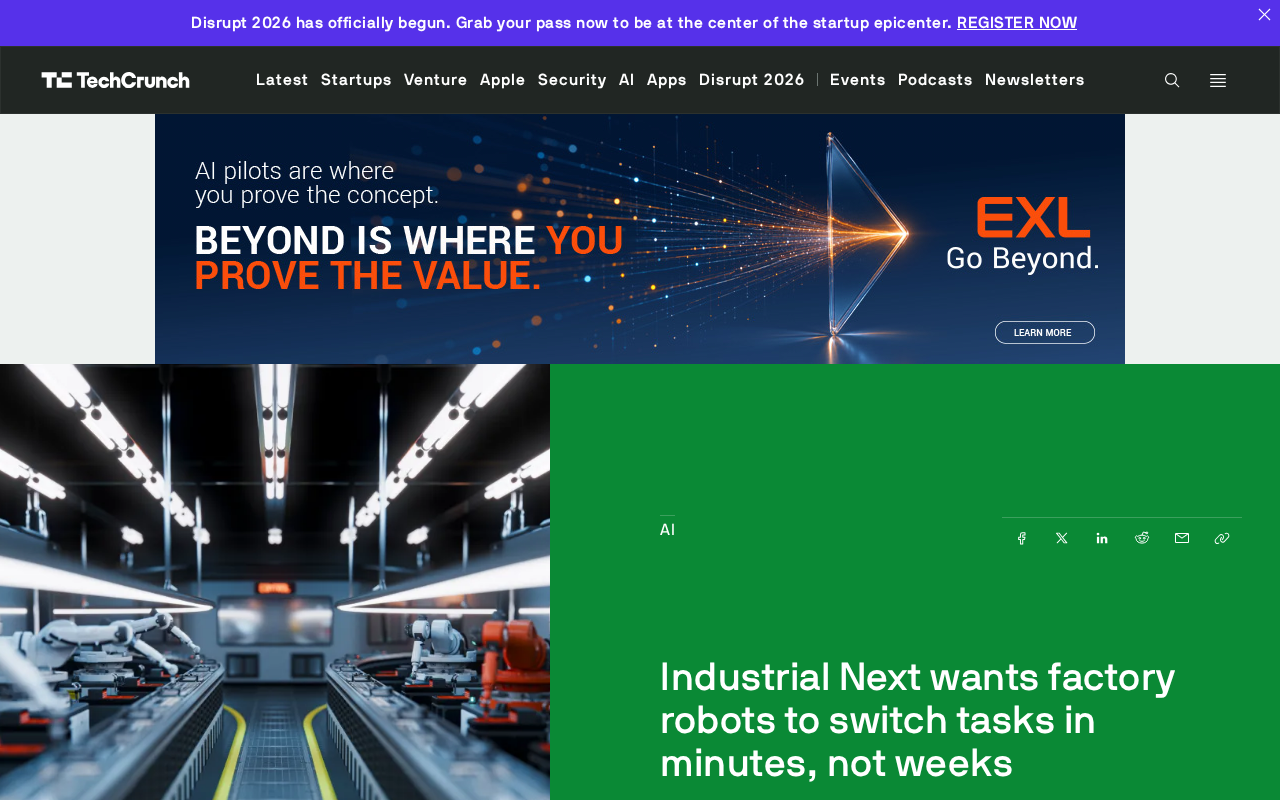
In manufacturing, retooling a robot often means days or even weeks of downtime, reprogramming, and production line adjustments. Startup Industrial Next is trying to break that pattern — letting factory robots switch tasks in minutes rather than weeks.
The Pain of Retooling in Manufacturing
Traditional industrial robots excel at repeating a single motion. Once a production line needs to switch product models or adjust processes, engineers must re-teach, modify code, and debug repeatedly. For the flexible manufacturing demands of small batches and high variety, this model is nearly unbearable. Industrial Next is targeting exactly this pain point: focusing on automating the complex, delicate tasks that traditionally rely on human labor.
Robot teaching is a key concept for understanding retooling costs. Traditional industrial robots do not work by writing abstract programs; instead, engineers use a teach pendant to guide the robotic arm point by point to target positions, recording each joint angle, speed, and wait time as a series of trajectory points. A process containing dozens of actions often requires hundreds of teaching points and takes hours to days. More troublesome is that the teaching results are strongly bound to specific workstations, fixtures, and part placement positions. Once the production line layout is slightly adjusted or part batches differ, the trajectory may fail and must be re-taught. This is precisely the source of costs that small-batch, high-variety production cannot afford, and it is also the essence of so-called "rigid automation": the robot's intelligence is固化 in manually recorded action sequences rather than reusable task models.
Why "Minute-Level Retooling" Is a Paradigm Shift
Fast retooling capability directly determines a factory's capacity utilization and response speed. When robots can be quickly reconfigured like software, manufacturers can take on small-batch orders at lower cost and reduce dependence on dedicated fixtures and fixed workstations. This is not just an efficiency improvement; it means a change in the organization of production — from rigid assembly lines to dynamically orchestrated flexible cells.
Industrial Next's entry point is not general-purpose humanoid robots, but rather the delicate operational needs that truly exist in industrial scenarios, making its path to deployment more pragmatic.
Flexible Manufacturing refers to the ability of the same production line to adapt to changes in product models, batch sizes, and processes without significant efficiency loss. Common metrics for measuring flexibility include retooling time, minimum economic batch size, and equipment reconfigurability. Its opposite is rigid manufacturing, represented by Ford's assembly line, whose efficiency is built on products remaining unchanged for long periods. Flexible manufacturing is not a new concept, but in the past it was mainly achieved through manual workstations and adjustable fixtures; the higher the degree of automation, the worse the flexibility often became. Giving robots themselves the ability to be quickly reconfigured is equivalent to transferring flexibility from "people" to the "machine system," which will change the factory's economies of scale curve: small-batch orders may also become cost-competitive on automated production lines.
Technical Challenges and Industry Significance
Making robots quickly adapt to new tasks involves coordination across perception, motion planning, task orchestration, and other links. The real difficulty is not in any single technology, but in whether the system can generalize stably in unstructured environments. If this capability matures, the sectors most affected will be those highly dependent on human flexibility, such as electronics assembly and precision assembly.
A detail worth noting: this direction is not an isolated case. Multiple companies are exploring industrial automation solutions that are easier to configure, but the quantitative goal of "minute-level" still carries landmark significance.
Generalization refers to a system's ability to correctly complete tasks in scenarios it has not precisely seen during training or configuration. For industrial robots, generalization means being able to stably grasp and assemble despite part position shifts, lighting changes, incoming material differences, or even task order adjustments, rather than erroring out and stopping once conditions deviate from preset ones. Traditional solutions avoid generalization problems through high-precision tooling and structured environments, at the cost of custom fixtures and calibration for every production line. Vision perception and learning-based methods attempt to directly handle these changes in unstructured environments, but industrial scenarios have reliability requirements far higher than laboratories: one misgrasp can halt the line or damage expensive workpieces. Therefore, generalization capability and yield stability constitute the core threshold for whether such solutions can truly be deployed.
Outlook and Observations
Industrial Next's value proposition is clear, but large-scale deployment still needs to verify its reliability and cost-effectiveness in actual production lines. For manufacturers, when evaluating such solutions, the focus should be on yield stability after retooling and maintenance complexity, not just switching speed.
Yield refers to the proportion of qualified products in total input during production, and is one of the most core economic indicators in manufacturing. No matter how fast the retooling speed is, if hundreds of products after switching are largely scrapped because parameters have not converged, or if engineers need long manual tuning to restore stability, then the actual benefits of "minute-level retooling" will be greatly reduced. When evaluating rapid retooling solutions, the industry usually focuses on several hidden costs: the ramp-up time needed to reach stable yield after retooling, the complexity of daily maintenance and troubleshooting, and whether highly skilled engineers must remain on site. Together, these factors determine the total cost of ownership of an automation solution, and they are often the most underestimated part when new technologies move from demonstration to large-scale deployment.
One-line Summary
Industrial Next shortens factory robot retooling from weeks to minutes, targeting small-batch flexible manufacturing.
Paragraph Summary
Industrial Next aims to solve the long-standing retooling pain point in manufacturing: traditional industrial robots rely on manual teaching, and line changeovers often mean days to weeks of downtime and debugging, making it hard to adapt to small-batch, high-variety flexible manufacturing needs. The company focuses on automating complex, delicate tasks that previously relied on human labor, with the goal of compressing robot retooling time to minutes. If this capability matures, it will improve capacity utilization, reduce dependence on dedicated fixtures, and push production organization from rigid assembly lines to dynamically orchestrated flexible cells. The key to deployment lies not in any single technology, but in the system's generalization ability in unstructured environments and yield stability after retooling; large-scale validation remains to be seen.
Related articles

Gemini 4 Argon Hands-On: AI Builds Board Games, Constructs Temples, and Trains Robots Autonomously
Gemini 4 Argon hands-on roundup: AI autonomously builds a desk racetrack and temple in Blender, writes a ray tracing engine, trains a humanoid robot to sink 7 shots, plus API pricing and developer access.

The Magic Octagonal Coin: Why Only 9% of People Can Predict Its Flip?
Only 9% of people can correctly predict the Magic Octagon coin flip. This article explains its spatial rotation mechanism, common cognitive pitfalls, and a new hypothesis based on Relevance Theory, exploring the limits of human spatial reasoning.

Sam Altman: AI Is Entering the Era of Scientific Discovery — Math Breakthroughs Will Replicate in Biology and Energy
Sam Altman says AI is entering the era of scientific discovery — math breakthroughs will replicate in biology, materials science, and energy to help develop new drugs and energy sources.