Reviving a 1983 Classic Computer Game with Claude AI: A Cross-Generational Rebirth from BASIC to JavaScript

Claude AI converts a 1983 BASIC game into a modern web version with just two prompts
Developer Simon Willison uploaded a PDF of Usborne's 1983 children's programming book to Claude AI and transformed the BASIC game "Mad House" into a browser-ready JavaScript version using just two prompts, preserving retro terminal aesthetics with mobile support. This case demonstrates AI's real capabilities in multimodal document understanding, cross-language code translation, and historical software "code archaeology."
A Code Rebirth Spanning 40 Years
Recently, well-known developer Simon Willison shared a project that truly catches the eye: he used Claude AI to transform the classic game "Mad House" from a 1983 children's programming book into a JavaScript version that runs directly in modern browsers. This small experiment not only evokes nostalgia for retro computing but also demonstrates AI's real capabilities in code translation and historical software recreation.
Usborne's Free Programming Book Treasure Trove
British publisher Usborne released a series of children's computer programming books in the 1980s, renowned for their beautiful illustrations and entertaining programming projects. It was the golden age of home computer enlightenment—machines like the Commodore 64, ZX Spectrum, and BBC Micro entered ordinary households at prices of a few hundred dollars, and BASIC (Beginner's All-purpose Symbolic Instruction Code) became the universal programming language of that era. Designed at Dartmouth College in 1964 specifically for educational purposes, BASIC's line-by-line interpreted execution and interactive input made it the standard language for home computers. Children of that era could type the BASIC code from these books line by line into their home computers and run the games and programs themselves—the books even provided dialect versions for different machine models. This "type to learn" approach seems primitive today, but it was the most direct form of computer education at the time.
Notably, Usborne has now made these classic 1980s programming books freely available as PDFs that anyone can download from their official website. For computer history enthusiasts and the retro programming community, this is an invaluable digital heritage.
From PDF to Playable Game: Claude AI's Translation Process
Two Prompts to Complete All the Work
Simon Willison's workflow was surprisingly simple. He uploaded the PDF of the 1983 book Creepy Computer Games directly to Claude, then completed the entire conversion with just two prompts:
"Build a vanilla JS artifact that exactly recreates the game Mad House from this book, make sure it's mobile friendly and has a suitable retro aesthetic"
"Credit the book title and link to https://usborne.com/us/books/computer-and-coding-books"
That was it. However, the work Claude needed to accomplish was actually quite complex—its difficulty far exceeds what appears to be mere "language translation" on the surface. BASIC is imperative and procedural, relying on line number jumps (GOTO statements) and global variables; JavaScript is event-driven, supporting closures and asynchronous operations as a modern language. BASIC programs typically run in single-threaded bare-metal environments, directly manipulating screen buffers; while web games need to handle DOM rendering, event listeners, and responsive layouts. The AI model needs to understand the "intent" of the original code rather than merely converting syntax—including which variables represent player position, which conditions trigger win/loss determinations—this is the most technically demanding part of the experiment.
Multimodal Understanding: From Scanned Book Pages to Executable Logic
Claude's ability to directly process PDF files relies on multimodal large language model technology. Unlike earlier language models that could only process plain text, multimodal models are trained on text, images, code, tables, and other data forms simultaneously, enabling them to understand code blocks, illustration descriptions, and game rule text mixed together on scanned book pages. For a PDF of a 1983 printed book, the model must also handle OCR recognition errors, non-standard fonts, and layout noise. More critically, the model must infer the game's complete state machine logic from context, requiring cross-paragraph semantic understanding rather than simple character recognition.
The Final Result: A Fusion of Retro Aesthetics and Modern Experience
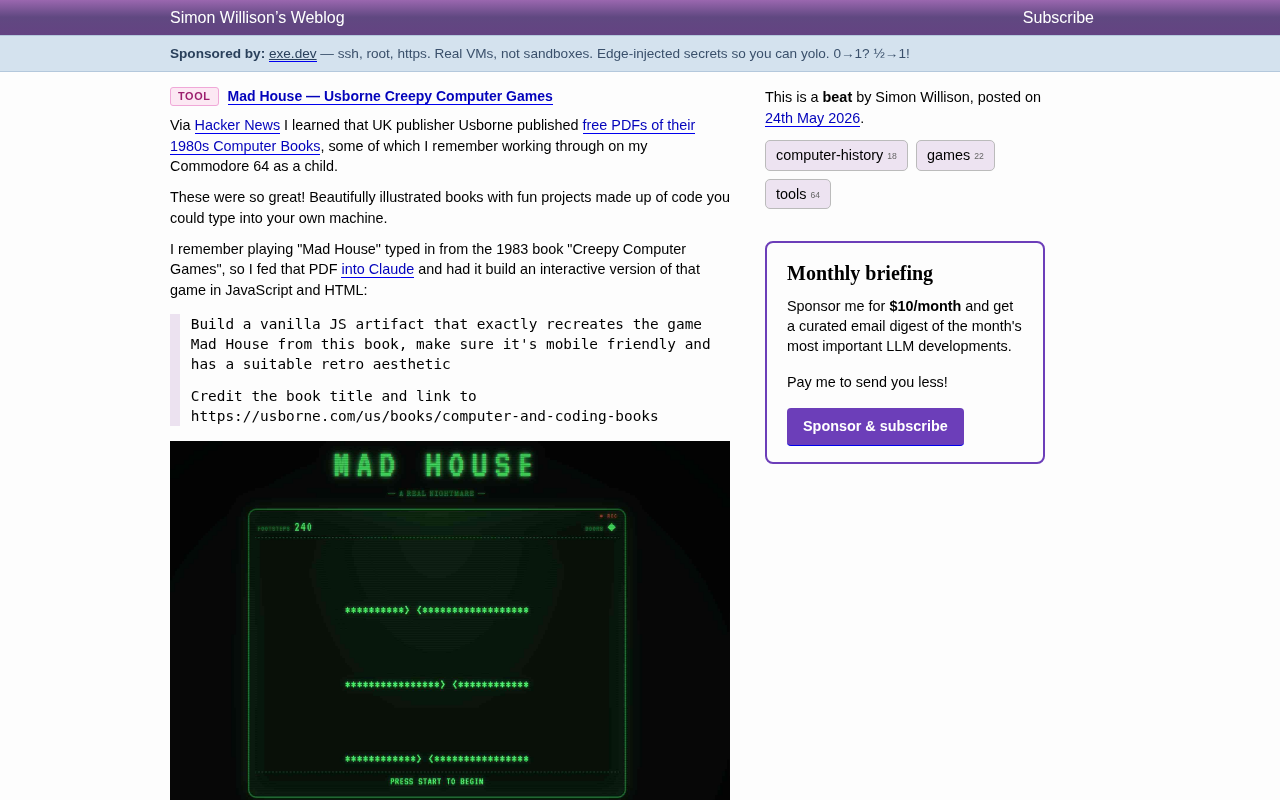
The generated game adopts the classic green phosphor terminal style—green text on a black background, ASCII characters forming corridors, and clean control buttons. The game interface includes the following elements:
- The title "MAD HOUSE — A REAL NIGHTMARE —"
- ASCII corridor scenes drawn with asterisks and arrow symbols
- A FOOTSTEPS counter and DOORS counter
- Touch buttons adapted for mobile devices
The retro aesthetic recreation is quite well-executed, faithful to the 1980s computing experience while incorporating modern responsive web design that plays smoothly on phones.
Insights from This Case Study
AI's Potential as a "Code Archaeology" Tool
This project reveals a highly valuable AI application scenario: "reviving" historical code from obsolete platforms and languages. "Code Archaeology" is an emerging topic in the software history community—as hardware capable of running legacy software accelerates toward obsolescence, vast numbers of early programs face the risk of permanent loss. The Internet Archive's software preservation project, the MAME emulator community, and tools like DOSBox are currently the primary forces in digital heritage preservation, but these solutions rely on precise hardware emulation with high maintenance costs. AI-assisted code translation offers an alternative path: migrating a program's "functional intent" to modern platforms rather than restoring the original runtime environment. This approach is closer to literary translation than archaeological restoration—it involves trade-offs in fidelity, but dramatically lowers the barrier to giving historical software new life, offering unique value for education and cultural heritage.
Low-Barrier Rapid Creative Implementation
The entire process from conception to completion likely took no more than a few minutes, with two prompts producing a complete, playable web game. This efficiency is extremely attractive for rapid prototyping, educational demonstrations, and personal creative projects, dramatically lowering the technical barrier to turning ideas into reality.
Conclusion
From children patiently typing BASIC code line by line in 1983, to two sentences generating a complete playable game via AI in 2025, the computing world has undergone earth-shaking changes in 42 years. But what remains constant is that curiosity about programming and the joy of creation. If you're interested in computer history, Usborne's freely available PDF programming book archive is absolutely worth exploring.
Key Takeaways
- Simon Willison used Claude AI to transform a 1983 Usborne BASIC game into a modern JavaScript web version
- British publisher Usborne has made its classic 1980s programming books freely available as PDFs
- Just two prompts completed the entire conversion from PDF to playable game
- BASIC and JavaScript have fundamental differences in design philosophy; AI must understand code "intent" rather than merely converting syntax
- The generated game maintains a retro terminal aesthetic style and supports mobile devices
- Demonstrates AI's potential in code archaeology, multimodal document understanding, and rapid prototyping
Related articles
 Tech Frontiers
A Rare Quiet Day in AI: Recursive Self-Improvement Stirs Beneath the Surface
A rare quiet day in AI sees multiple sources go silent simultaneously. Behind the calm, Recursive Self-Improvement (RSI) research continues. What this means for the industry.
 Tech Frontiers
Reve 2 vs. Ideogram 4: A Deep Dive into Layout Control in AI Image Generation
A deep comparison of Reve 2 and Ideogram 4's layout control capabilities, covering technical approaches, real-world use cases, and industry trends for designers and creators.
 Tech Frontiers
In the Weights: Check Your Influence Score in the AI World
In the Weights is an AI influence search engine that quantifies your presence in the AI world with a score. Explore how it evaluates practitioners and what it means for digital identity.