Revix AI: Teaching AI Code Review to Learn Your Repository's Rules

Revix AI scans repositories to generate custom rules, making AI code review more aligned with project architecture.
Revix AI is an AI code review tool ranked #13 on Product Hunt. Its core idea is to scan repositories and automatically generate custom rules that match project patterns and architecture, rather than relying on generic rule libraries. When reviewing each PR, comments tag specific rule names, intent labels, and severity levels, improving the actionability of feedback. Rules continuously learn and update as the repository changes, and it's free for public repositories. The product addresses the gap between generic review tools and project-specific conventions and has the potential to reduce noisy comments. However, community discussion is currently limited, and rule accuracy and false positive rates still need to be verified through actual use—teams are advised to try it on a small scale first.
Code review is a critical part of ensuring software quality, but traditional tools often rely on generic rules and struggle to fit each repository's unique architecture and patterns. Revix AI, a new product ranked #13 on Product Hunt, aims to change that—it scans your repository, automatically generates custom rules, and keeps learning. This article walks through its core mechanisms and potential value.
From Generic Rules to Repository-Specific: The Core Idea Behind Revix AI
Most static analysis tools and AI review assistants are built on predefined rule sets or general best practices. That means they may work well for common issues but fail to capture project-specific conventions such as naming style, module layering, or dependency direction. Revix AI takes a different approach: it first scans your repository to generate a set of rules that match that repository's patterns and architecture, then reviews each pull request against those rules.
According to its Product Hunt page, these rules continuously learn and update as the repository evolves. Every comment explicitly identifies the rule being violated and tags its intent and severity. This design makes review feedback more contextual rather than generic.
Static analysis tools typically pattern-match code based on abstract syntax trees (ASTs) or control flow graphs, while AI review assistants mostly rely on large language models for semantic understanding of code snippets. Both face a common challenge: a lack of project context. What Revix AI emphasizes as "repository-specific rules" is essentially a context-aware constraint generation mechanism—it needs to infer implicit conventions from the codebase (such as layering dependency direction and module boundaries) and turn them into executable review rules. This approach of learning rules from the repository differs from traditional rule configuration (such as ESLint config files), which requires manual writing and maintenance, whereas the former attempts to automate this process.
How Comments Are Presented: Rule Naming and Intent Tagging
When Revix AI leaves a comment in a PR, it doesn't simply say "there's a problem here"—it references the specific rule name and attaches an intent label (e.g., "maintainability" or "security") along with a severity level. This helps developers understand the reasoning behind the issue and allows teams to prioritize fixes based on severity.
Although the official documentation doesn't detail the specific classifications of intent and severity, from the product positioning it's clearly meant to make review feedback more actionable and easier to accept. For teams, being able to trace each comment back to its corresponding rule also helps with knowledge retention.
In code review, "intent tagging" refers to classifying the design goal behind a review comment, such as maintainability, security, performance, or consistency. This relates to what academic research often calls "code review concern classification." Clarifying intent helps developers judge whether a comment aligns with the goal of the current change, thereby reducing unproductive debates. Severity levels typically borrow from defect severity grading (such as blocker, critical, major, minor) to prioritize fixes. Combining rule names, intent, and severity levels can transform review comments from "subjective suggestions" into "traceable quality gates," and also makes it easier for teams to analyze the distribution of different types of issues.
Continuous Learning and Free Strategy: Lowering the Adoption Barrier
Revix AI emphasizes "continuous learning"—as the repository evolves, rules are dynamically adjusted. This is particularly important for long-term projects, since architecture and patterns are not static. However, the official documentation doesn't disclose the specific learning mechanism (e.g., whether it's based on commit history or code change patterns), so actual effectiveness remains to be verified by users.
Another highlight is that it's free for public repositories. This is good news for open-source maintainers, who can get customized AI review at zero cost. Pricing for private repositories isn't yet specified on the page, but the free strategy clearly helps attract early users and community feedback.
In software engineering, continuous learning usually refers to systems dynamically updating models or rules based on new data without requiring full retraining. For code review scenarios, possible data sources include commit history, code change patterns, PR discussion records, and developer feedback on comments (such as ignoring, accepting, or disputing). A key risk is "concept drift"—as repository architecture evolves, old rules may become outdated and new rules may be unstable. Therefore, continuous learning mechanisms need to design forgetting or confidence decay strategies, otherwise they may introduce noise. Currently, Revix AI hasn't disclosed its learning signal sources, and actual effectiveness depends on whether its rule updates are sufficiently validated.
Potential Value and Points to Watch
From the product description, Revix AI addresses a real pain point: the gap between generic review tools and project-specific rules. If it can accurately generate and maintain rules, it will significantly reduce noisy comments and improve review efficiency. At the same time, attaching rules and intent to each comment also helps new team members quickly understand project conventions.
However, whether automatically generated rules are accurate enough, whether they produce false positives, and whether continuous learning introduces unstable rules all need to be tested in practice. Additionally, there are currently only 83 votes and 4 comments on Product Hunt, so community discussion is still limited and independent third-party evaluation data is lacking. For teams considering adoption, it's advisable to first try it on public repositories or small-scale projects and observe the quality of its rules and the relevance of its comments.
Overall, Revix AI represents a promising direction—making AI code review more attuned to each repository's own context. Whether its actual performance can deliver on its promises will need time and user feedback to prove.
One-line Summary
Revix AI scans repositories to generate custom rules, making AI code review more aligned with project architecture.
Paragraph Summary
Revix AI is an AI code review tool ranked #13 on Product Hunt. Its core idea is to scan repositories and automatically generate custom rules that match project patterns and architecture, rather than relying on generic rule libraries. When reviewing each PR, comments tag specific rule names, intent labels, and severity levels, improving the actionability of feedback. Rules continuously learn and update as the repository changes, and it's free for public repositories. The product addresses the gap between generic review tools and project-specific conventions and has the potential to reduce noisy comments. However, community discussion is currently limited, and rule accuracy and false positive rates still need to be verified through actual use—teams are advised to try it on a small scale first.
Related articles
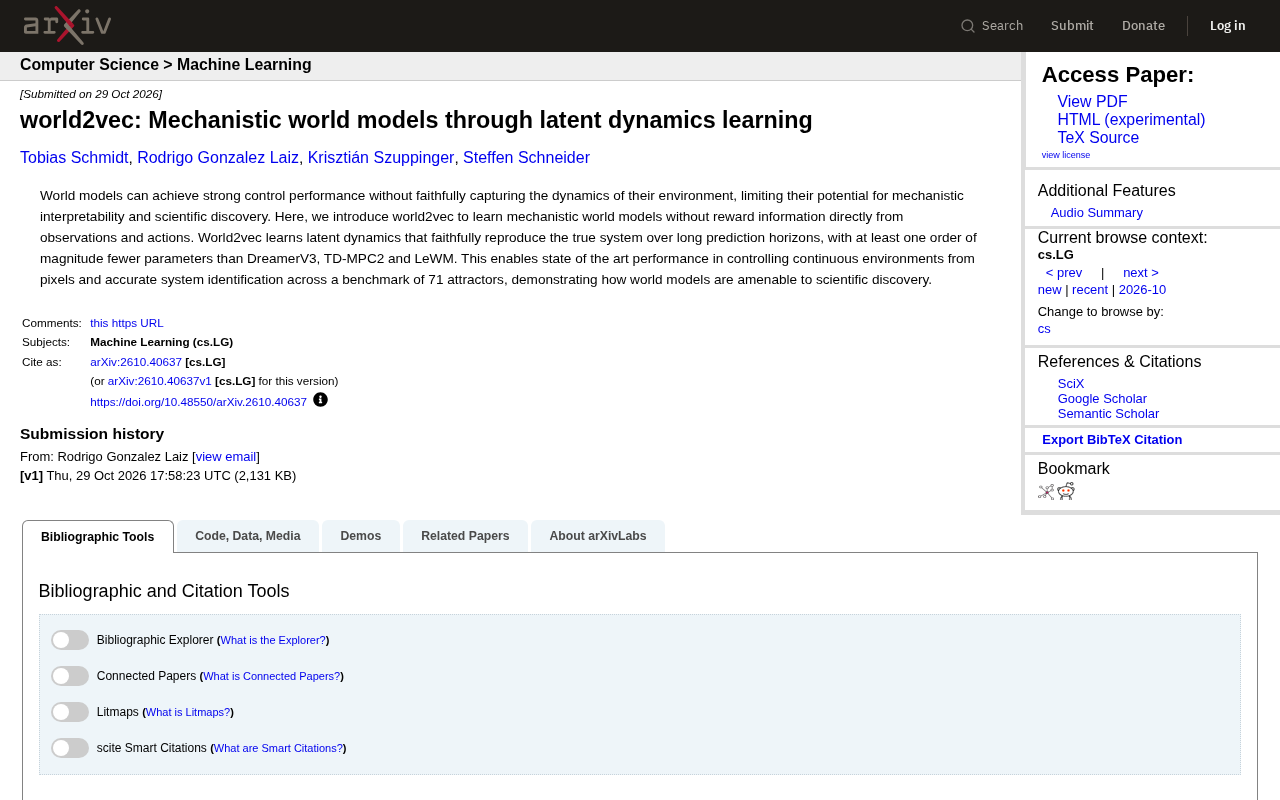
world2vec: Building Mechanistic World Models with Latent Dynamics Learning
world2vec proposes a reward-free method for learning mechanistic world models via latent dynamics, faithfully reproducing systems over long horizons with at least an order of magnitude fewer parameters than DreamerV3, TD-MPC2, and LeWM, and achieving accurate system identification on 71 attractor benchmarks.

A New KL-DRO Paradigm: Adaptive Scenario Generation Around a Learned Density Model
KL-DRO research proposes centering the KL ball on a learned density model instead of the empirical distribution, with adaptive scenario generation guiding sampling toward the worst case. Experiments show lower cost under distribution shift when records are scarce and the model can extrapolate, with comparable in-distribution cost.

ODE Samplers for Discrete Diffusion Models: Exponential Residual Flows Accelerate Generation
Discrete diffusion models lack deterministic ODE sampling? This article introduces Exponential Residual Flows (ERFs), which introduce continuous residual variables per token to construct piecewise ODEs for deterministic sampling and support consistency distillation acceleration. Superior to prior methods on code and text generation tasks.