Rhodium Group Report: China's AI Model Revenue Only 10% of OpenAI and Anthropic Combined

China's total AI model ARR is just 10% of OpenAI and Anthropic combined, per Rhodium Group report.
A Rhodium Group report systematically maps the structural gap between Chinese and American AI industries across investment scale, revenue, gross margins, and financing channels. China's total AI model ARR stands at just $10.7 billion — roughly 10% of OpenAI and Anthropic's combined figure — while free cash flow for Alibaba, Tencent, and Baidu turned negative in H1 2025. DeepSeek's API gross margin rivals Anthropic's, but margins at Zhipu AI and MiniMax are declining. U.S. giants rely on bond markets for capital, while Chinese firms face constraints in both equity and debt financing, with open-weight model strategies further limiting monetization potential.
A research report from Rhodium Group on China's AI financing reveals stark gaps between the Chinese and American AI industries in terms of revenue scale, profitability, and funding channels. The YouTube/Bilibili channel Sima Qian offered a detailed breakdown of the report, highlighting several striking data points: the total annual recurring revenue (ARR) of all Chinese AI models is only 10% of OpenAI and Anthropic's combined figure, yet DeepSeek's API gross margin is comparable to Anthropic's. This article summarizes the report's core arguments and examines the structural issues underlying China's AI financing challenges.
A Double Gap in Investment Scale and Revenue
The report's first conclusion is that China's AI infrastructure investment is roughly 15–20% of the United States'. That gap alone isn't necessarily fatal — Goldman Sachs has repeatedly pointed out that China operates at lower costs, spending less while managing to keep pace. From a large model performance standpoint, domestic models like Kimi did narrow the gap for a period.
But the situation is shifting. With the release of new models from U.S. players like Google Gemini, the performance gap appears to be widening again, based on benchmarks from Artificial Analysis. More critically, U.S. giants are simultaneously deploying both frontier high-performance models and low-cost models, with per-task compute costs that are competitive even against Chinese models like DeepSeekAd, which are known for cost efficiency.
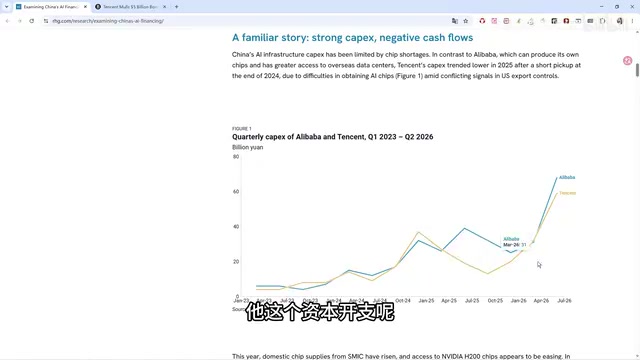
What's truly striking is the revenue data. The report notes that the total ARR of all Chinese AI models is only $10.7 billion — just 10% of the combined total for the two American AI leaders (OpenAI and Anthropic). Even when including companies like ByteDance, the figure remains remarkably limited.
ARR (Annual Recurring Revenue) is the core metric for measuring scale in SaaS and subscription businesses — it refers to the total expected recurring contract revenue over a one-year period, excluding one-time fees or hardware sales. For AI model companies, ARR primarily comes from API subscription calls, enterprise service contracts, and individual membership fees. It's a standardized measure of business size and growth health. Compared to total revenue, ARR more clearly reflects whether an AI company has built a sustainable paid user base rather than relying on one-off project income. China's total AI model ARR of just $10.7 billion means the entire Chinese AI model layer is still in early-stage commercialization — a figure that doesn't correlate neatly with usage volume or technical capability. It reflects structural issues such as low enterprise willingness to pay and an underdeveloped consumer payment culture.
A Fundamental Shift in Financing Structure
The report's second core argument concerns financing constraints. Both Chinese and American internet giants face cash flow challenges — self-funding AI development from existing revenue alone is no longer feasible. This is fundamentally different from past battles like food delivery wars or community group-buying competitions: none of those competitive races drove major tech companies to issue bonds or equity offerings. But the burn rate for large AI models is in a completely different league.
The report selects Alibaba, Tencent, and Baidu as sample cloud vendors. Their combined free cash flow turned negative in the first half of this year, reaching negative RMB 16 billion, compared to positive RMB 170 billion in the same period of 2024. This is being dragged down simultaneously on two fronts: operating cash flow (R&D talent compensation, server depreciation and amortization, electricity) and capital expenditure (GPU procurement, data center construction).
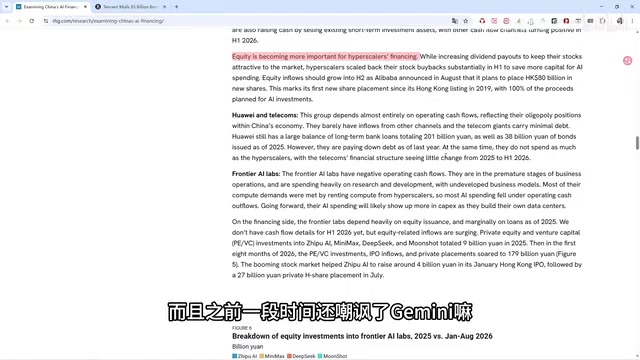
The situation in the U.S. is similar — free cash flow for the five major hyperscalers plummeted from $191 billion last year to roughly $14 billion in the first half of this year. But they remain profitable and are increasingly offsetting the cash flow decline through debt: these five companies raised cash from bond markets that surged from $90 billion to $163 billion. Tencent is starting to go down this route as well — Bloomberg reported it is considering refinancing $5 billion in bonds, and in June it already raised $4.7 billion through USD and RMB bonds for AI use.
China's AI companies are divided into four categories covering 13 firms: hyperscale cloud vendors, Huawei and the three major telecoms operators, frontier AI unicorns like Zhipu AI and MiniMax, and independent data center operators like GDS Holdings. Alibaba's announcement in August of an HKD 80 billion new share placement — its first since its 2019 Hong Kong listing — with all proceeds directed toward AI-related investments, is the kind of financing move that would have been unthinkable in past business competition cycles.
Free Cash Flow (FCF) refers to the cash a company has left after accounting for capital expenditures required to maintain and expand its business, calculated as operating cash flow minus capex. This metric reflects a company's true "cash generation" ability better than net profit, since it strips out non-cash items like depreciation and amortization while accounting for large-scale expansion investments. When a company's free cash flow turns negative, it means day-to-day operations are no longer generating enough cash to cover investment needs, forcing reliance on external financing (debt or equity issuance). The swing from positive RMB 170 billion to negative RMB 16 billion for Alibaba, Tencent, and Baidu is a significant signal: the AI race has pushed China's most profitable tech giants into a phase of "burning external capital" — something that never occurred in any previous round of internet business competition.
The Profitability Dilemma: Cross-Sectional and Longitudinal Margin Comparisons
The underlying problem for Chinese AI companies is ultimately a money shortage, rooted in low revenue and profitability that remains a distant prospect. Frontier AI labs primarily produce open-weight models, which directly limits potential revenue — cloud vendors can deploy open-weight models without paying the original developers. Moonshot AI (Kimi) is trying to change this model, and Alibaba is in talks with overseas cloud providers including Microsoft, Amazon, and Google about revenue-sharing agreements.
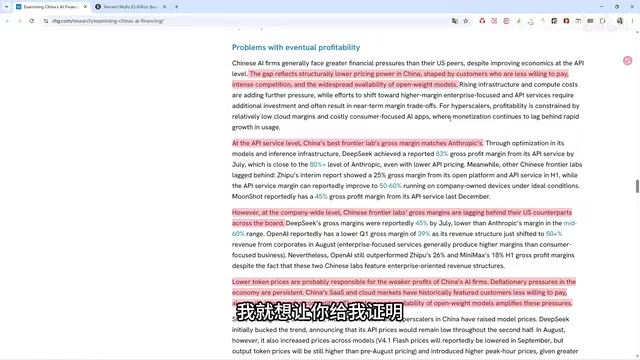
API-level gross margin data is revealing. DeepSeek's API service gross margin is 83%, comparable to Anthropic's — a true cost-performance champion in China. But others lag significantly: Zhipu AI's API gross margin for the first half of the year was only 25%, and Moonshot AI's API gross margin last year was around 45%.
At the company level, the gaps widen further. DeepSeek's overall gross margin in July was approximately 45%, below Anthropic's 60%; OpenAI, due to its high share of consumer business, has a gross margin of around 39%; while Zhipu AI and MiniMax are lower still, at 26% and 18% respectively. Looking at the trend, both Zhipu AI and MiniMax have seen declining gross margins: Zhipu AI dropped from 41% to 26%, and MiniMax from 25% to 18%.
MiniMax's margin decline stems from enterprise business growing from 30% to 80% of its mix; Zhipu AI deliberately stepped back from high-margin (42%) but small-market private deployment work to focus on its open platform (25% margin). Low willingness to pay, pricing wars, and difficult collections are collectively squeezing profitability.
Open-weight models refer to AI models whose trained parameters (weights) are publicly released, allowing anyone to download, deploy, and fine-tune them — in contrast to the closed API model. DeepSeek and Meta's Llama are prime examples. For AI companies, the commercial logic of open-weight models carries a fundamental tension: open-sourcing boosts brand influence and accelerates ecosystem development, but cloud vendors and enterprises can download the weights and self-deploy without paying the original developer, directly cutting off the most straightforward monetization path. This is why frontier Chinese AI labs have relatively low ARR — the more widely a model is used, the more API payment demand gets diverted to self-deployment. The revenue-sharing model that Moonshot AI is negotiating with overseas cloud providers is essentially an attempt to reclaim revenue rights within the open-source ecosystem, drawing on the playbook of open-source commercialization companies like Red Hat.
Double Drain from Cloud Business and Consumer Applications
Even in the profitable cloud segment, domestic cloud vendors' margins are significantly below their American counterparts. Alibaba Cloud's EBITA margin was 9% last year, improving to 10% in the first half of this year — while Amazon AWS and Google Cloud posted operating margins of 35% and 24% respectively last year. Alibaba CEO Eddie Wu has stated a target of 20%, but climbing from 10% to 20% on existing business is extremely difficult and should be considered a long-term aspiration at best.
Consumer-facing 2C applications are also burning cash heavily. Alibaba's Quark division has RMB 3 billion in revenue but comes with RMB 14 billion in net losses; ByteDance's Doubao is a money-losing operation compared to Douyin, lacking mature monetization pathways like e-commerce or advertising. Every approach has been tried, and no clear monetization model has been validated.
EBITA Margin (Earnings Before Interest, Taxes, and Amortization margin) measures a company's core operational profitability by stripping out interest, taxes, depreciation, and amortization — making it more suitable than net profit margin for comparing operational efficiency across capital-intensive businesses like cloud computing and data centers. The enormous chasm between Alibaba Cloud's 10% EBITA margin and AWS's 35% doesn't simply reflect a technology gap. Deeper causes include: intense price competition in China's cloud market driving down unit prices; enterprise customers' preference for private deployment raising service costs; and an immature domestic SaaS ecosystem creating a shortage of high-value-added software revenue at the application layer. By contrast, AWS and Google Cloud benefit from a mature enterprise software ecosystem, global pricing premiums, and the scale effects of first-mover advantages, allowing them to stack high-margin services on top of infrastructure and generate significantly superior margins.
Financing Outlook and Constraints in A-Share and Hong Kong Markets
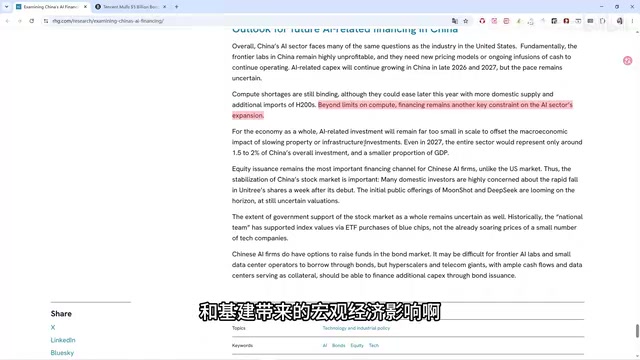
The report anticipates that capex will continue to grow in the second half of this year and throughout next year, though the pace remains uncertain. Compute scarcity is the primary constraint, with financing challenges close behind. At the macro level, U.S. AI investment contributes meaningfully to GDP, while China's AI investment scale is insufficient to offset the drag from declining real estate and infrastructure spending — even by next year, AI may account for only 1.5–2% of total investment.
Unlike the U.S., where bond markets are the primary funding channel, equity issuance is the most important financing route in China — but both A-share and Hong Kong markets face limiting factors. Frontier AI labs find it very difficult to survive without going public, and Kimi (Moonshot AI) and DeepSeek are reportedly planning A-share listings, which would create additional supply pressure. Bond markets are a viable option, but mainly for large players like Tencent; the three major telecoms operators reported poor performance this year, with revenues declining for the first time in years, leaving them with little appetite to continue burning cash.
Overall, the Chinese and American AI industries face the same fundamental challenge — deep losses and an ongoing search for viable business models. The difference is that American giants can sustain themselves through debt and existing profitability, while Chinese companies face the dual constraints of weakening domestic demand and limited financing channels, making the road ahead considerably more difficult.
Related articles

Should U.S. College Fraternities Be Banned? A Researcher's Incisive Observations
Why not just ban U.S. college fraternities? A researcher finds the key resistance comes from decision-makers' own fraternity identities and schools' "willful ignorance."

Microsoft Discovery: Accelerating Scientific Discovery with AI Agents
Microsoft's Discovery platform runs specialized AI agents to help researchers screen and prioritize the most promising compounds and experimental paths, reducing experiments and accelerating scientific discovery.

Cambridge Heavy Industries Secretly Develops Desktop-Scale Nuclear Fusion Device
Cambridge Heavy Industries is secretly developing a desktop-scale laser-driven nuclear fusion device, targeting the equipment supply market for fusion power plants. This article analyzes its miniaturization technology path, commercialization logic, and unique positioning in the fusion startup wave.