Ridian: An AI-First Meeting Scheduling Suite

Ridian connects booking, payments, CRM, and calendars with AI agents to automate meeting information flow.
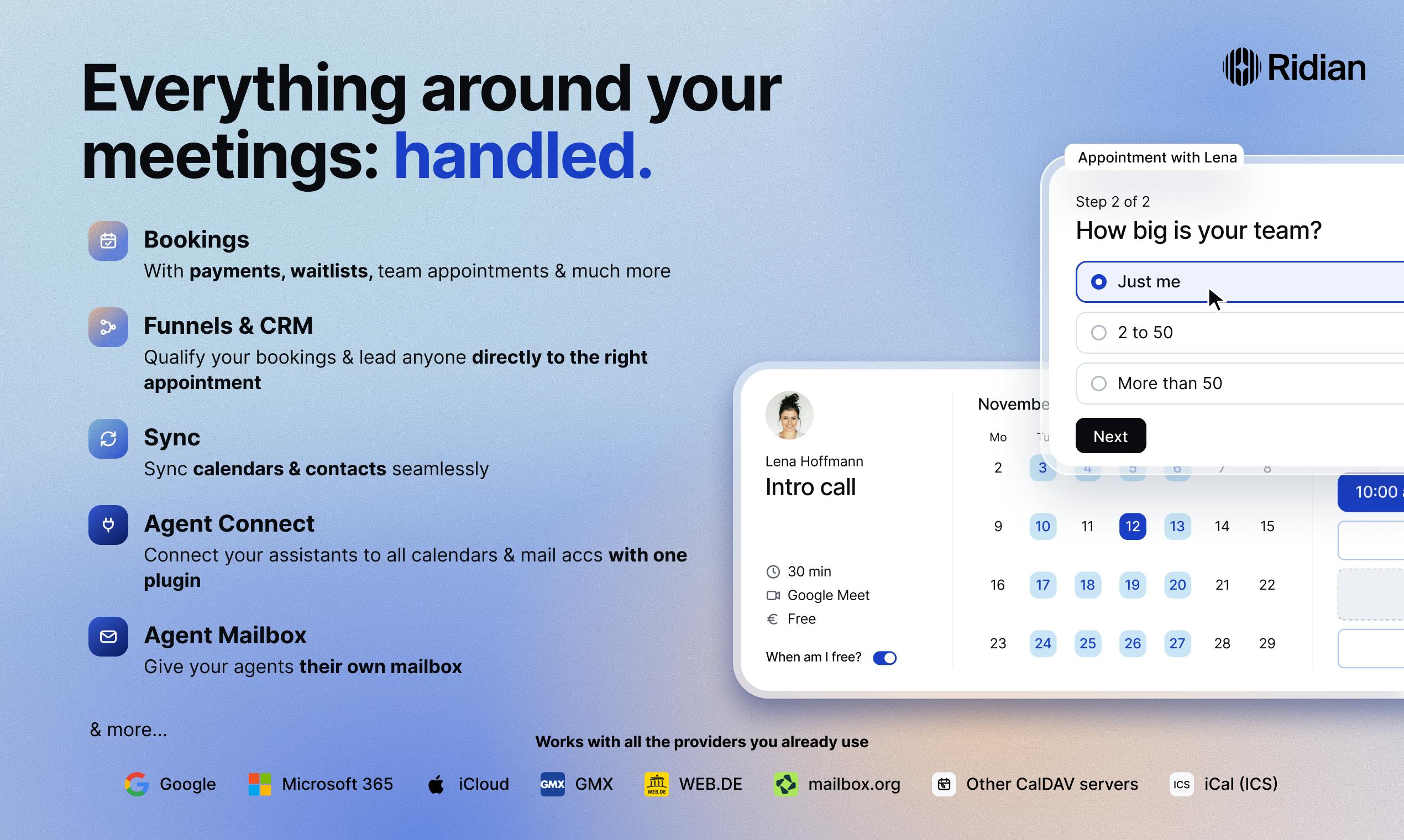
Ridian is an AI-first scheduling suite on Product Hunt that integrates booking, payments, waitlists, group bookings, lead funnels, built-in CRM, and cross-platform calendar sync. Its standout feature lets users connect AI agents like Claude and ChatGPT with dedicated email addresses to handle meeting emails and scheduling. It received 72 upvotes and 10 comments on launch day, ranking 11th.
Beyond the Meeting, Everything Can Be Automated
Ridian, which debuted on Product Hunt, positions itself as an "AI-first scheduling suite" targeting the entire cumbersome workflow surrounding meetings—booking, payments, waitlists, group scheduling, lead qualification, CRM records, and cross-platform calendar sync. It's not content to be just a booking-link generator; instead, it aims to use AI to connect every piece of the meeting lifecycle.
On its launch day, the product received 72 upvotes and 10 comments, ranking 11th and performing solidly in the Productivity category. For a heavyweight product aimed at productivity tools, this result suggests it has hit on a real pain point many teams face in schedule management: tools are too fragmented, data doesn't flow, and AI can't be put to use.
Feature Breakdown: From Booking Pages to AI Agent Email
Booking Pages That Go Beyond "Pick a Time"
Ridian's booking pages support payments, waitlists, group bookings, and team bookings. This means it can handle paid consultations, course registrations, multi-person meetings, and more without needing to bolt on separate payment or form tools. For consultants, coaches, and small service businesses, one less redirect means one less drop-off.
Funnel and CRM Integration
The product includes a built-in lead funnel that lets you ask key questions before booking and route each lead to the appropriate call type. All bookings and funnel responses land in the built-in CRM. This design turns "booking" from an isolated action into part of the sales process—users no longer need to shuttle data back and forth between calendar tools and CRM.
The Role of Lead Funnels in Booking Scenarios
Lead funnel is originally a marketing and sales term referring to the path a potential customer takes from first contact to final conversion. Ridian embeds it into the booking flow: before users select a time, a few key questions (such as budget, needs, company size) screen and score the lead, then route them to different call types or service packages. The benefit is that booking is no longer "anyone can book"—instead, a lightweight round of qualification happens upfront, reducing wasted meetings. All responses are automatically written to the built-in CRM, forming structured lead records that facilitate follow-up and conversion analysis. For consulting and sales teams, this is equivalent to automating part of the sales development representative (SDR) initial screening work.
Cross-Platform Calendar and Contact Sync
Ridian supports syncing with major calendars and contacts including Google, Microsoft, and iCloud. Multi-calendar and multi-mailbox aggregation is table stakes for scheduling tools, but Ridian's differentiator is that it opens these connections to AI agents.
Giving AI Agents a Dedicated Email Address
This is Ridian's most distinctive feature. You can connect Claude, ChatGPT, or Alvin to let them handle scheduling matters directly, and even assign dedicated email addresses to agents. Agents can send and receive meeting-related emails and coordinate times on your behalf. This effectively moves AI from the "chat window" into real-world scheduling workflows.
What Does an AI Agent's "Dedicated Email" Mean?
In Ridian's design, AI agents aren't assistants confined to a chat window—they have a real email address and can send and receive meeting-related emails, reply to confirmations, and coordinate times like a human assistant. This typically relies on IMAP/SMTP protocols or email APIs, allowing the agent to read the inbox, parse meeting requests, and send replies on the user's behalf. The value of a dedicated email is that the agent has a clear communication identity; email exchanges no longer require manual forwarding or pasting by the user, and AI can complete time negotiation directly within the email thread. At the same time, a dedicated email facilitates permission isolation—enterprises can grant the agent access only to specific mailboxes rather than all emails on the primary account, reducing data leakage risk. However, this also requires the product to do its homework on email content filtering, sensitive information redaction, and operation auditing; otherwise, the agent could misread or mis-send emails.
Deep Dive: The Competitive Logic of AI Scheduling Tools Is Changing
Over the past few years, the core competitive battleground for scheduling tools has been link aesthetics, time zone handling, and calendar sync reliability. Ridian has shifted the focus to "whether AI can directly operate on scheduling data."
There's a rationale for this direction. Meeting-related information is scattered across email, calendars, CRM, and payment records, and human assistants spend enormous time integrating it. If AI agents can directly access this structured data and have independent communication identities, there's room for order-of-magnitude improvements in coordination efficiency.
But the challenges are equally obvious. Letting AI agents handle email and scheduling means handing mailbox and calendar permissions to a third-party tool, and enterprise customers' data security concerns will not be minor. In addition, the reliability of models like Claude and ChatGPT in temporal reasoning remains a variable, and the risk of agents misjudging times or missing conflicts needs product-level safeguards.
Ridian's choice to enter at this moment is a bet that AI agent capabilities are mature enough and that users are willing to pay for "less worry." Based on early Product Hunt feedback, at least a group of productivity tool enthusiasts are willing to give it a try.
Technical Prerequisites for AI Agents to Operate Scheduling Data
For AI agents to directly operate on scheduling, the underlying infrastructure needs to connect calendar and email APIs and give the model "function calling" capabilities—that is, the model can autonomously decide which interface to call and what parameters to pass based on user intent. For example, after receiving a meeting invitation email, the agent needs to parse the time, time zone, and participants, then call the calendar API to check for conflicts, create the event, and send confirmation. This is far more complex than pure text generation because temporal reasoning involves error-prone steps such as date calculations, daylight saving time, and cross-time-zone conversion. Current mainstream large models perform reasonably well on simple time expressions, but can still make mistakes under multiple constraints (such as "next Tuesday afternoon but avoid my existing meetings and leave a 30-minute buffer"). Therefore, product layers typically need to add rule engines or human confirmation steps as safeguards rather than fully delegating autonomous execution to agents.
Who It's For, and Who It's Not For
Ridian is better suited to teams whose business revolves around "calls/meetings": consulting firms, sales teams, coaching services, and recruiting agencies. These users have genuine needs for booking payments, lead screening, and CRM archiving, and are more likely to perceive the efficiency gains from AI agents.
For individual users who just need a simple booking link, Ridian's feature density may be too high, and the learning curve could become a barrier. Whether the product can strike a balance between "full-featured" and "easy to get started" will determine how large its user base can grow.
Final Thoughts
Ridian's approach is clear: the meeting itself is just a moment, but the information flow surrounding it is the real productivity black hole. Using AI agents to take over these information flows is a product direction worth watching. Whether it can move from early Product Hunt buzz to long-term retention depends on the stability of AI agents in real scheduling scenarios and on building trust.
One-line Summary
Ridian uses AI agents to connect booking, payments, CRM, and calendars, targeting automation of the information flow around meetings.
Paragraph Summary
Ridian is an AI-first scheduling suite that debuted on Product Hunt. It's not content to be just a booking-link generator; it integrates booking, payments, waitlists, group bookings, lead funnels, built-in CRM, and cross-platform calendar sync. Its most distinctive feature is allowing users to connect AI agents like Claude and ChatGPT and assign them dedicated email addresses so AI can directly handle meeting emails and time coordination. The product received 72 upvotes and 10 comments on its first day, ranking 11th, showing interest from productivity tool enthusiasts. The article argues that competition among scheduling tools is shifting from link aesthetics and time zone handling to "whether AI can directly operate on scheduling data," but data security concerns and the reliability of models' temporal reasoning remain challenges. Ridian is better suited to consulting, sales, and coaching teams centered on meetings; individual users may face a learning curve.
Related articles

Gemini 4 Neon Leak: A Potential Strong Contender Against Opus 5.5
A Hacker News thread suggests Gemini 4 Neon looks like an Opus 5.5 competitor. This article unpacks the product positioning behind this community signal, shifts in the top-model competitive landscape, and what it means for developers' model selection strategy.

Claude Fable 5.2's Self-Authored Short Film 'Fable' Sparks Discussion
A short film 'Fable,' credited to Claude Fable 5.2 for script, visuals, and directing, appears on Hacker News. This article analyzes the significance of full-pipeline AI creation, community reactions, and what it means for content creators.

Anthropic IPO Pricing: A Signal of AI Giants Going Public
Anthropic's IPO pricing draws attention. This article analyzes its potential impact on AI industry valuation, commercialization paths, and the competitive landscape, and highlights public-market expectations and challenges for AI companies.