Riemann Hypothesis Proof Controversy: AI Code Accused of Cheating, Yet All Six Independent Checkers Pass
AI-assisted Riemann Hypothesis formal proof accused of cheating; multi-kernel verification confirms placeholder code harmless, merely engineering leftovers.
Alberg collaborated with Claude for six weeks to produce 17.37 million lines of Lean 4 code, claiming to have formalized the Riemann Hypothesis and Generalized Riemann Hypothesis. Researcher Nielsen then accused the code of containing an "always returns true" cheating function any_geometry, claiming the entire proof is spinning its wheels. Independent source audits confirmed three placeholder codes do exist and are within the dependency closure of the main theorems, but the key difference is: the definition of the Riemann Hypothesis is locked in the external Mathlib library and cannot be altered, the proof has no custom axioms, and six independent kernel checkers passed with zero rejections in a network-free sandbox, also verifying elementary arithmetic generalizations equivalent to the Riemann Hypothesis. The placeholder code is actually engineering leftovers from unreconstructed geometric interfaces during six weeks of rapid AI iteration, with substantive derivation borne by parallel separation rates and analytic inequalities. The real concerns of academia are how to translate massive code into human-readable proofs, checking axiom strength, and the impact of AI compute on the paradigm of mathematical research.
Riemann Hypothesis Proof Controversy: AI Code Accused of Cheating, Yet All Six Independent Checkers Pass
On November 20, mathematician Alberg announced that after about six weeks of collaboration with Claude, he had found a proof of the classic Riemann Hypothesis and the Generalized Riemann Hypothesis for Dirichlet L-functions. Since a human-readable paper would exceed 250,000 pages, he directly released a 14-volume Lean 4 formalization codebase, which decompresses to about 1031 MB, containing 175,187 files and 17.37 million lines of code. The next day, the Lean and Mathlib communities jointly certified the classic Riemann Hypothesis portion as correct, and MIT mathematician Andrew Sutherland completed a sandbox reproduction and multi-kernel testing, confirming that all five main theorems passed verification.
However, on the same day, researcher Jenny Lorraine Nielsen uploaded a rebuttal paper to arXiv (originally referred to as Fail Archive), directly claiming the proof is invalid, and revised it 17 times within 72 hours. She claimed that the code contains a "always returns true" cheating function, and the entire project is just spinning its wheels. This controversy quickly ignited the global tech community.
The Focus of the Controversy: Three Instances of "Lazy Code" Do Exist
Independent source code audits by tech blogger Frank Chu, developer Harry Tong, and Carlos Toledo confirmed that the three code phenomena Nielsen identified from 175,000 files do exist. The first is a placeholder named any_geometry. In the definition files related to abelian variety theory, the code defines two placeholders of the same geometric type six lines apart: the former, geo_of, requires a real geometric witness, while the latter, any_geometry, returns true regardless of the input parameters. Scanning shows that any_geometry appears in 24 files and is used 118 times. The second is a set of degenerate geometric models with zero volume and norm, where the positivity condition is directly set to true. The third is that in the construction step, the height function is directly overwritten by an explicit formula via set, using logical reflexivity to make the equation hold.
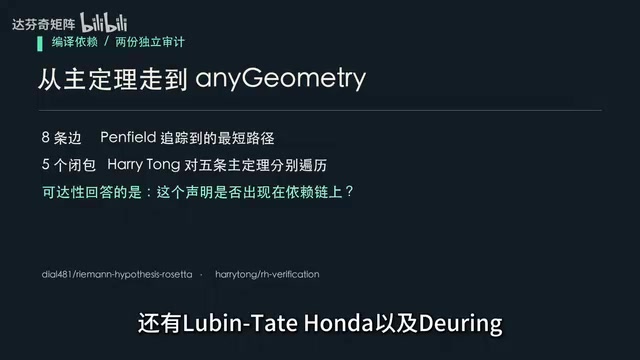
Harry Tong conducted a complete compilation dependency closure audit of over 1.478 million declarations in Lean 4.3.1, and the results confirmed that all these placeholder codes are within the active compilation dependency closure of the five main theorems. Among them, any_geometry is only 8 dependency edges away from the final Riemann Hypothesis main theorem, and 24 declarations in the closure depend on it.
Why Does "Returns True" Not Equal Cheating?
The key difference is: cheating means tampering with the final goal or introducing false axioms, whereas here it is merely filling intermediate auxiliary interfaces with empty shell conditions. The mathematical definition of the classic Riemann Hypothesis is locked in the external official Mathlib library's RiemannZeta file, which no one can modify. After comparison using two independent tools, Comparator and ConnectK, the community confirmed that the theorem proved by Alberg is completely consistent with the native Mathlib definition, and there are no custom axioms in the environment.
An analogy: the theorem requires first providing a geometric condition and then proving that under this condition the Riemann Hypothesis can be derived. Instantiating the geometric condition as any_geometry, which always returns true, indeed makes proving this condition effortless. But precisely because what is inserted is an empty shell with no information content, when it comes to proving the bridge theorem itself, it is completely impossible to extract any geometric properties from this condition. The entire weight of substantive mathematical derivation must be independently borne by other non-trivial inequalities running in parallel.
Carlos Toledo traced the connection points of the compiled proof terms and found that although the height assignment holds by reflexivity, two inequalities independently proved externally are simultaneously connected at the same connection point. Sampling just four related declarations involves substantive dependency closures of 299 to 1999 compiled constants.
Lean 4 and Mathlib: Lean is an interactive theorem prover led by Leonardo de Moura at Microsoft Research, and also a dependently typed functional programming language. Its core feature is "proofs as programs": a mathematical proposition is encoded as a type, proving the proposition is equivalent to constructing a term of that type, and the Lean kernel is responsible for checking the validity of this term line by line. Mathlib is a vast mathematical library built on Lean, collaboratively maintained by hundreds of mathematicians worldwide, covering hundreds of thousands of theorems from basic set theory to algebraic geometry and analytic number theory, and is one of the most important infrastructures of contemporary formal mathematics. The official formal definition of the Riemann Hypothesis is locked in Mathlib's RiemannZeta file, which any external project can reference but not modify. It is precisely because of this "external anchor" that Alberg's team cannot fabricate a false proof by redefining the Riemann Hypothesis.
Multi-Kernel Cross-Validation: Zero Rejections
To seal off malicious metaprogramming and single-kernel vulnerabilities, the community independently recompiled in a sandbox with no network and read-only source code, exporting over 1.468 million declarations that only include the actual dependencies of the main theorems as 61.57 GB of pure static files, and handed them to multiple external independent checkers for repeated verification. The official Lean kernel implementation replayed with zero rejections, and the Rust-written 99ODA, ConnectK and Conrun with set-theoretic relative consistency proofs, as well as the external type checker Lean4Lean, all fully passed. Andrew Sutherland also connected the proof with the classic Robin 1984 formalization library, relying only on three standard core axioms, and verified two elementary arithmetic generalizations equivalent to the Riemann Hypothesis—the Robin inequality and the Lagres inequality.
In a system with no custom axioms, multi-kernel cross-validation, and even elementary arithmetic corollaries running seamlessly, Nielsen's assertion that the entire proof is just spinning is logically impossible. Nielsen himself also admitted in the paper's appendix that he cannot prove that this proof term fails type checking.
Independent Kernels and Type Checkers: Lean's official kernel is implemented in C++, with a relatively concise codebase, but in theory there may still be implementation vulnerabilities or bypasses by malicious metaprogramming. To this end, the community has developed multiple independent verification paths: Lean4Lean reimplements a kernel in Lean itself; if it can accept the same proof export, it shows that the official kernel's behavior does not depend on a hidden bug; ConnectK and Conrun come with consistency proofs relative to set theory, to rule out implicit dependence on axioms stronger than ZFC. The so-called "zero-rejection replay" means serializing the proof terms into pure static files and replaying type checking line by line by these checkers in a sandbox with no network and read-only source code, with no declaration rejected throughout. The significance of multi-kernel consensus is: even if one implementation is flawed, the probability of all independent implementations failing simultaneously is extremely low, thereby elevating "code passes" to "logically credible".
The Truth of Deprecated Interfaces: Engineering Leftovers from AI Brute-Force Exploration
University of Waterloo mathematician Mike Rubinstein compiled a human-readable guide file based on the codebase, revealing the real approach: generalizing the classic Chebyshev prime upper bound idea from a single integer to linear maps between higher-dimensional lattices. The core tools include Boss's separation law inequality, Stahler-Grayson's derivative of elliptic curves with negative multiplication over the green passage band, Lubin-Tate-Honda, and formal groups of height dimension two in Durin G theory, combined with iterative Theta lifts to construct the main inequality and characteristic estimates. Rubinstein particularly noted that the entire argument does not use curve geometry theory over finite fields at all.
Why are AnyGeometry and degenerate models left in the code? This has nothing to do with cheating; it is purely an engineering product of AI brute-force exploration plus unreconstructed legacy code. The Math Overflow community commented that this version of the code "looks like throwing the entire kitchen sink in at once." During six weeks of rapid iteration, Claude and Alberg initially built an abstract framework with geometric surfaces and derived slots; on October 20 they switched to display summation; on November 15, after breaking through the proof with iterative Theta lifts and separation rate estimates, the early geometric slots were completely unusable. Faced with 175,000 massive files, the AI did not spend extra compute to dismantle and refactor the entire interface, but instead inserted always-true functions and zero-volume degenerate models to make the old shell pass type checking, while connecting the real work of separation rates and analytic inequalities to the main theorems.
Dependency Closure and "Active Dependencies": In Lean, the proof term of each theorem or definition references other declarations, forming a directed dependency graph. Starting from the final main theorem, recursively collecting all directly or indirectly referenced declarations gives its "compilation dependency closure." The key audit question is: does a placeholder like any_geometry fall within the active closure of the main theorem? If it is outside the closure, it is just dead code and irrelevant to proof correctness; if it is inside the closure, it indeed participates in type checking, but whether its logical content is used still requires further analysis. Harry Tong's audit confirmed that the placeholder is within the closure, but Carlos Toledo traced the connection point and found that non-trivial inequalities independently proved externally are connected in parallel at the same connection point, and the substantive mathematical weight is borne by the latter. This is precisely the technical meaning of "inside the closure but harmless".
The Background of the Skeptic and the Real Concerns of Academia
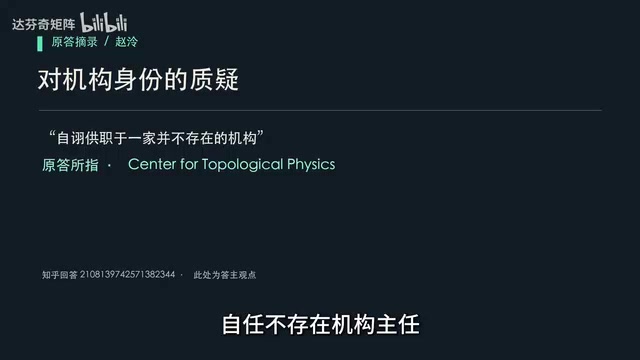
Nielsen is a PhD candidate in the Department of Philosophy and Department of Physics at the University of Kansas, holding a master's in physics and a master's in philosophy, and graduated summa cum laude from the University of Missouri-Kansas City with a bachelor's in physics and mathematics. He co-authored formal astronomical observation papers with astrophysicists early on, with an h-index of 5. But in the past two years, his self-appointed "TOP Physics Center" has promoted fringe ideas such as TOP unified field theory, TOP twist drive, and speed-taking cannon, and has批量 claimed on platforms like arXiv and ResearchGate to have solved century-old problems such as the Navier-Stokes equations and the Yang-Mills existence and mass gap, and has also密集 accused others of plagiarism. Alberg released the codebase on November 20, and Nielsen archived the first version of the rebuttal paper the same day, revising it to the 17th version within 72 hours, with obvious path-tracing errors in between—the mathematical community judges that he most likely used large language models at high frequency to scan the code and批量 generate rebuttal text.
Setting aside Nielsen's misleading accusations, the mainstream mathematics community is truly seriously discussing four deeper issues. First, how to digest 17.37 million lines of code into a proof that humans can understand; Rubinstein's guide file and the organizing preprints gradually appearing on the Hexagon platform are the beginning of this translation project. Second, the distance between formal verification and the traditional peer review of the Clay Millennium Prize—as of the announcement, the Clay Mathematics Institute website still lists the Riemann Hypothesis as unresolved. Third, the fine check of the strength of the underlying axiom system: the standard axiom system of dependent type theory is higher in proof-theoretic strength than ZFC, and although the checkers come with consistency proofs relative to set theory, thoroughly confirming that there is no implicit dependence on higher-order universe strength beyond ZFC remains a serious task for logicians. Fourth, the anxiety about AI compute hegemony and the paradigm of mathematical research; mathematicians such as Terence Tao and Po-Shen Loh have expressed in public articles and comment sections concerns about commercial compute monopolies, the definition of authorship, and human mathematicians' over-reliance on black-box answers.
There was also an episode on the same day: Italian mathematician Alessandro Maria Masullo released a 940-page pure human manuscript "The Music of the Primes" after 12 years of work, targeting the Generalized Riemann Hypothesis. Stanford number theory expert Brian Conrad had reviewed it for months and provided continuous feedback. Because Alberg announced first, American Mathematical Society president Ravi Vakil urgently posted the mid-revision manuscript on his personal blog requesting community verification, and about 8 hours later confirmed that multiple individuals using different AI models had detected flaws in the manuscript. Vakil explicitly stated that he would not endorse any proof strategy until the problem is satisfactorily resolved. Nielsen then also uploaded a paper claiming Masullo's proof invalid—which precisely shows that he is not defending the dignity of human mathematics, but firing indiscriminately at all competitors claiming to have conquered the Riemann Hypothesis.
Conclusion: The Division of Labor Between Machine Verification and Human Understanding
This turmoil is not a successful academic debunking, but more like a false alarm that misread AI's abandoned empty-shell interfaces as logical cheating. It did not shake the progress that the Riemann Hypothesis has been rigorously verified by multi-kernel machines, but in an unexpected way reminded everyone: in the new era where AI can write tens of millions of lines of formal proofs on its own, file names, declaration names, and type interface names are completely untrustworthy; the code saying abelian variety theory by no means indicates that the proof really relies on these theories. Machines can guarantee that every step of derivation is flawless with absolute patience and rigorous logic, but penetrating empty-shell naming, stripping redundant scaffolding, extracting core insights, and turning cold machine verification into vivid mathematical understanding in human minds—this work must still be done by clear-headed humans.
Related articles

Nvidia CEO Removal Saga: Trump Intervenes Over the Weekend, Jensen Huang Reinstated Monday
Vergecast podcast reveals Nvidia CEO drama: earnings call said he wouldn't return and a new CEO was being sought; Trump intervened over the weekend, with J.D. Vance brokering a security guarantee to the board; Jensen Huang reinstated at 9 a.m. Monday.
Semantic Caching Explained: Reusing the Same Answer for Similar Questions
Semantic caching uses embeddings to judge whether queries are similar in meaning and reuses cached results for similar prompts. This article explains how it works, the difficulty of threshold tuning (such as the risk of misjudging negations), and its applicable boundaries.

How Did Trump Personally Turn Nvidia into the "Twelfth Board Member"?
A YouTube political commentary offers a sharp view: behind Nvidia's market cap milestone, Trump's deep involvement earns him the title of "twelfth board member." The article breaks down the commentator's logic on stock market achievements, the break from small-government tradition, and power display.