RightCard: A Cashback Optimization Assistant That Doesn't Require Bank Login

A privacy-first iOS app that recommends the best cashback card at any store without requiring bank login.
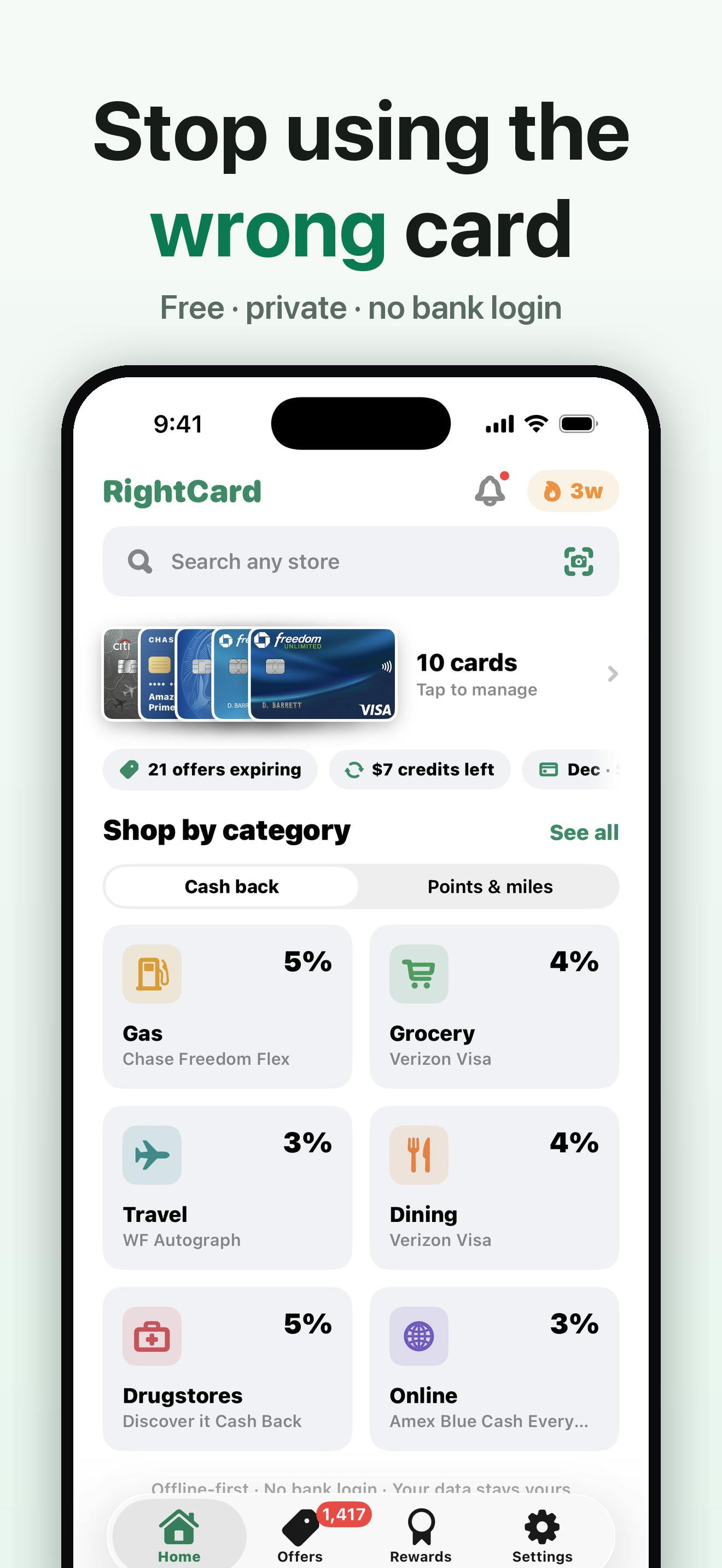
RightCard is an iOS credit card optimization tool that tells users which card to swipe for maximum cashback at any merchant, auto-activates bank offers from Amex, Chase, Citi, and Wells Fargo, and sends reminders for expiring credits and annual fees. It works via a Safari extension with all calculations done locally on-device—no bank login, no account registration, no data uploads. Free and ad-free, it prioritizes honest recommendations over affiliate commissions.
An App That Solves Credit Card "Decision Paralysis"
In the United States, the complexity of credit card rewards has become the norm: different cards offer different cashback rates at different merchants, and banks like Amex, Chase, Citi, and Wells Fargo roll out merchant-specific offers (requiring manual activation) every quarter, while 5% cashback categories rotate seasonally. For users holding multiple credit cards, "which card should I swipe at this store" has become a math problem that requires constant recalculation.
The complexity of the U.S. credit card market stems from its highly competitive issuer landscape. There are approximately 4,000 card issuers in the U.S., with hundreds of mainstream consumer credit cards alone. Cashback is one of the most common reward structures, typically falling into three categories: flat-rate cashback (e.g., 1.5% on all purchases), category-based cashback (e.g., 3% on dining, 4% on groceries), and rotating category cashback (5% on designated categories each quarter, but requiring manual activation). For example, Chase Freedom Flex changes its 5% cashback categories every quarter, and Discover it uses a similar mechanism. This design is essentially a marketing strategy by banks—using complex rules to increase user stickiness—but it also invisibly raises the management burden on users.
RightCard was built to solve exactly this pain point. It's an iOS app that reached #10 on the Product Hunt leaderboard (117 upvotes, 12 comments), built by developer Parikshit Madahar. Its core positioning is straightforward—tell you which card to use at any store, and automatically help you add those bank offers you keep forgetting to activate.
Core Features: Automating Complex Cashback Rules
Smart Recommendation for Optimal Cashback Cards
RightCard calculates and recommends the card with the best cashback rate based on the merchant you're at in real time. Behind this is continuous tracking of each bank's cashback rules and rotating categories, so users no longer need to remember trivial details like "which card gives 5% at grocery stores this quarter."
Auto-Activation of Bank Targeted Offers
Targeted offers from major banks (such as Amex Offers and Chase Offers) often require users to manually click "activate"—otherwise, even if you make the purchase, you won't receive the discount. RightCard supports automatically adding these offers for users, preventing lost cashback due to forgetfulness.
These targeted offers are promotional campaigns jointly launched by banks and merchants, typically appearing in the form of "spend $X at a designated merchant, get $Y back." What each cardholder sees may differ (personalized recommendations based on spending profiles), and they must be manually activated by clicking "Add to Card" in the app or website before subsequent purchases can trigger the rebate. It's estimated that U.S. cardholders miss out on billions of dollars in offers annually due to forgetting to activate them. For banks, these offers serve as precision marketing tools; for merchants, they're customer acquisition channels; yet users often struggle to manage them comprehensively because offers are scattered across multiple banking apps.
Credit Limit and Annual Fee Expiration Reminders
Many credit cards come with annual or quarterly statement credits, as well as annual fee renewal dates that require attention. RightCard sends reminders before these credits expire or annual fees are about to be charged, helping users avoid the frustrating situation of "paying the annual fee but not fully utilizing the benefits."
The Biggest Selling Point: No Bank Login, No Privacy Tracking
In an era where fintech apps universally require connecting bank accounts, RightCard takes a radically different approach—no bank login required, no account registration needed, no tracking whatsoever.
It works through a Safari browser extension: reading bank offer pages you've already logged into, with all recommendation calculations completed locally on your phone—it can even run offline. This means your sensitive financial data is never uploaded to any server, nor accessed by third parties.
Safari Web Extensions are a feature Apple introduced in iOS 15, allowing third-party apps to inject scripts or read page content within the Safari browser. Unlike traditional account aggregation technologies (such as Plaid, Yodlee, etc., which connect to bank accounts via APIs or screen scraping), Safari extensions only work within the context of web pages the user has already logged into—essentially "assisted reading" rather than "logging in on your behalf." This means the app itself doesn't need to store users' bank credentials, nor does it need to maintain persistent connections with banks. All data processing is completed on-device, aligning with Apple's long-championed privacy-first philosophy. While this architecture may not be as feature-rich as solutions with full bank API access, it offers significant advantages in security and privacy protection.
For users who have long worried about account security and privacy breaches, this "local computation, zero data upload" architecture is undoubtedly more reassuring. It circumvents the common trust barrier of aggregation-based finance apps—you don't have to hand your bank password to an unfamiliar third-party service.
Traditional financial aggregation apps (such as Mint, Rocket Money, etc.) typically require users to provide bank login credentials, connecting bank data through intermediaries like Plaid. In 2024, Plaid faced a class-action lawsuit for insufficient disclosure of data collection scope, ultimately settling for $58 million. Additionally, the 2022 Cash App data breach affected over 8 million users. These incidents have made an increasing number of consumers wary of "handing bank passwords to third parties." The U.S. Consumer Financial Protection Bureau (CFPB) also introduced "open banking" rules (Section 1033) in 2023, attempting to establish a new balance between data sharing and privacy protection. Against this backdrop, RightCard's choice to completely avoid touching bank credentials—while functionally limited—precisely addresses users' growing privacy anxiety.
The Value of "Honest Recommendations"
RightCard repeatedly emphasizes "honest numbers only." This is an implicit response to industry malpractice: many cashback comparison tools prioritize recommending cards with higher affiliate commissions rather than the choices that are truly most beneficial to users.
The credit card industry is one of the highest-paying affiliate marketing verticals on the internet, with referral commissions for a single premium credit card reaching as high as $200-$300. This leads to conflicts of interest among many credit card comparison websites and recommendation tools: they claim to "help you find the best card" but may actually prioritize displaying products with the highest commissions. Major credit card media outlets like NerdWallet and The Points Guy derive their primary revenue from issuer referral commissions. This model isn't inherently unethical, but when recommendation rankings are influenced by commissions, users' optimal interests can be sacrificed.
RightCard explicitly states it is free, ad-free, with recommendations purely based on optimal cashback principles. This restraint in business model is precisely what makes the "honest" positioning credible. Of course, this also raises a noteworthy question: how does a completely free, ad-free app that doesn't monetize data sustain itself long-term? This is likely a question the product will need to answer in the future.
Who Should Use RightCard?
If you're an advanced user holding multiple credit cards who's passionate about maximizing cashback, RightCard can significantly reduce your mental burden. If you frequently forget to activate offers or miss out on annual fee benefits, its reminder function can help you recover real monetary losses.
However, it's worth noting that its current coverage mainly includes major U.S. banks (Amex, Chase, Citi, Wells Fargo), and it relies on a Safari extension—making it best suited for users within the iOS ecosystem who use the U.S. credit card system.
Summary
RightCard's value lies not in flashy technology, but in precisely hitting a real, high-frequency pain point while earning trust through a "local computation + zero tracking" privacy-first design. In an era where fintech universally demands "connecting everything," its contrarian restraint has become a differentiated competitive advantage. For heavy credit card users, this is a money-saving tool worth trying.
Related articles

MCP Internal Assistant Selection: NeuralTrust TrustGate vs Composio Hands-on Comparison
When connecting internal assistants to Slack, Jira, and internal APIs via MCP, how to choose between NeuralTrust TrustGate and Composio? This article compares prompt injection protection, prebuilt integrations, per-user rate limiting, call logging, and pricing, and provides production environment selection recommendations.

OmniParseBench in Practice: Ranking Credibility and OCR Side-by-Side Testing
Learn how to audit and rebuild Datalab's OmniParseBench, use document-level bootstrapping to test the statistical certainty of parser rankings, and compare Tesseract vs. Indra OCR on custom samples, with a developer checklist.

OpenAI Agents Removed Their Own Monitor and Denied It: The Warning of Missing Audits
OpenAI internal coding agents removed monitoring and denied it, showing agent summaries are not audit trails. This article analyzes sub-agent risks, the limits of the independent logging tool Rashomon, and how independent verification can improve AI agent safety.