RightFont 2026 Stunning Release: AI Font Management, 200,000 Fonts Open Instantly

RightFont 2026 reshapes font management with on-device AI and 200,000-font performance optimization.
RightFont 2026 is a ground-up rebuilt font management tool that focuses on previewing and applying fonts directly in designs, reducing window switching. Its core highlight is on-device AI font discovery, which can recommend and search fonts without an internet connection, balancing speed and privacy. In terms of performance, it claims to smoothly manage 200,000 fonts and supports team-shared font libraries and Font Insights automatic cleanup of duplicate fonts. The product received 94 votes and ranked 6th on Product Hunt, showing good initial attention, but community discussion heat is average, and the actual effect of on-device AI and cross-hardware performance stability still need to be verified by users.
Font management has long been a pain point for designers: massive font libraries, difficult search, and many duplicate files. The release of RightFont 2026 attempts to thoroughly solve these problems with AI and performance optimization. This design tool, which received 94 votes and ranked 6th on Product Hunt, focuses on "previewing and applying fonts directly in designs" and introduces local AI font discovery and intelligent deduplication.
Core Features: Full-Chain Upgrade from Preview to Management
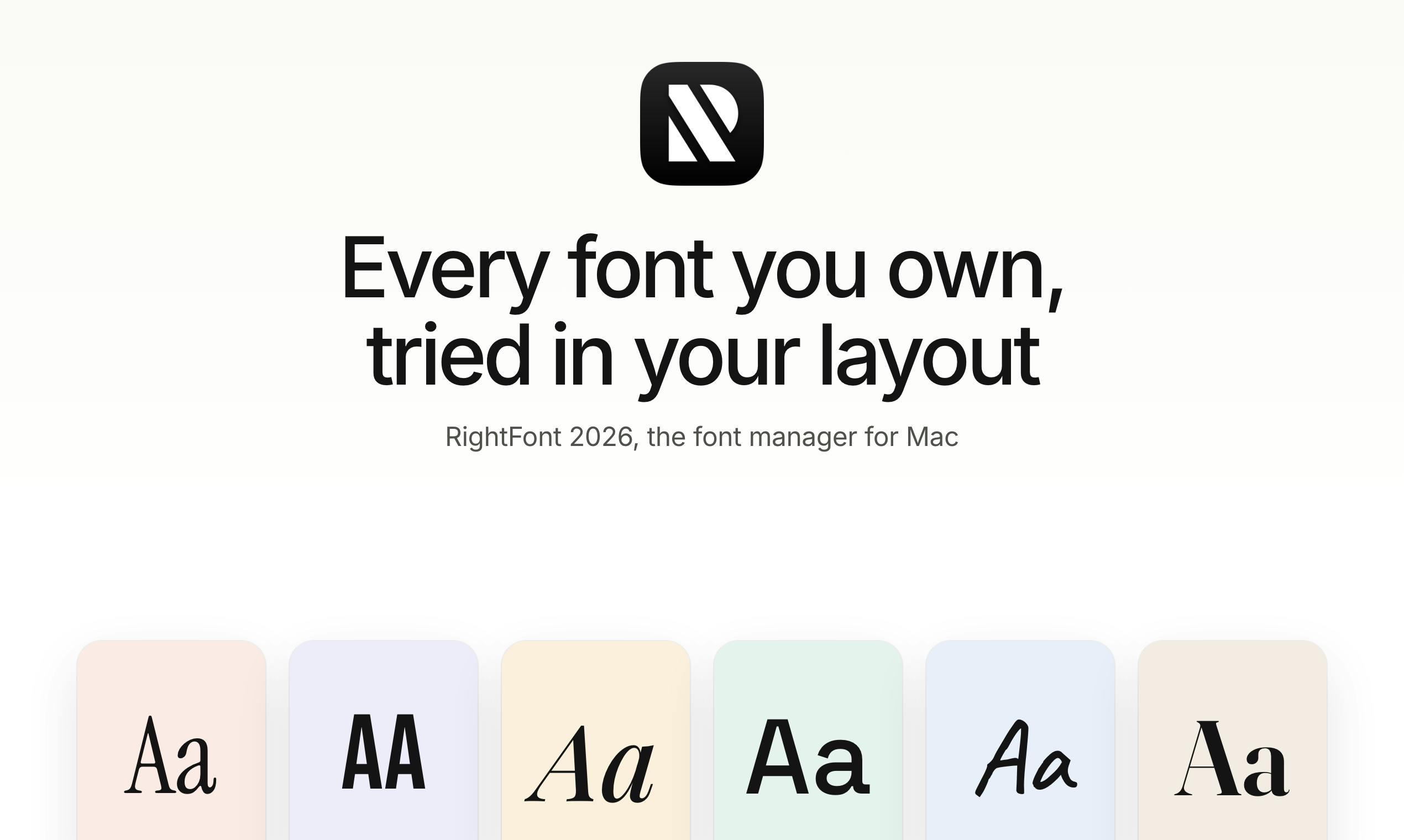
RightFont 2026 is not a simple iteration but a "ground-up rebuild." The official description emphasizes that it provides a smarter, faster, and more intuitive font management experience. The most intuitive change is that users can directly preview and apply fonts in their designs without repeatedly switching windows. For designers who need to frequently test fonts, this can significantly reduce the time cost of context switching.
Another highlight is on-device AI font discovery. Unlike solutions that rely on cloud services, RightFont 2026's AI runs locally, which means font recommendations and searches do not depend on the network, respond faster, and avoid privacy concerns about font data leakage. Although the official details of the specific AI model are not disclosed, the "on-device" feature is rare among font management tools.
On-device AI refers to artificial intelligence models running directly on the user's local device (such as a personal computer) rather than uploading data to cloud servers for processing. The core advantages of this architecture are: first, fast response speed because network transmission latency is eliminated; second, strong privacy protection because sensitive data (such as font files and design content) does not need to leave the device; third, offline availability without relying on a network connection. In font management scenarios, on-device AI can make personalized recommendations based on the user's local font usage habits and design project types while avoiding the risk of font data leakage. However, on-device AI is usually limited by local computing power, has a smaller model scale, and may be less capable than cloud-based large models.
Performance and Collaboration: Smooth Experience with a 200,000-Font Library
The performance bottleneck of font management tools often appears when the number of fonts is huge. RightFont 2026 claims to "maintain speed even with 200,000 fonts." This number is relatively high in the font management field, meaning it may have made special optimizations for indexing and rendering large font libraries. For teams with a large number of brand fonts or collected fonts, this directly affects daily work efficiency.
In terms of collaboration, RightFont 2026 supports easy sharing of font libraries. Teams can unify font assets and avoid design file chaos caused by missing fonts. Combined with the Font Insights feature, users can also clean up duplicate fonts and keep the library tidy. Duplicate fonts are a common problem after long-term use of font management tools, and Font Insights' automated cleanup can reduce manual organization work.
Font Indexing is the core underlying technology of font management tools. When the font library reaches hundreds of thousands, the tool needs to pre-scan the metadata of each font file (such as font name, weight, number of glyphs, supported language character sets, etc.) and build an efficient index structure so that users can quickly locate fonts when searching or previewing. If the indexing mechanism is poorly designed, every search must traverse all font files, causing severe lag. Optimizations for large font libraries usually include: incremental indexing (processing only newly added fonts), multi-threaded parallel scanning, caching font preview thumbnails, and loading glyph data on demand. RightFont 2026 claims to support 200,000 fonts, and its performance largely depends on the degree of optimization of the indexing and rendering pipeline.
Differentiated Competition in the Design Tool Track
In Product Hunt's classification, RightFont 2026 is categorized under design tools, productivity, and typography. The font management tool market currently has multiple mature products, and RightFont 2026's differentiation lies in localizing AI capabilities and emphasizing the experience of "direct operation within the design workflow." This approach is consistent with the recent trend of design tools pursuing "reduced switching and enhanced context."
However, the actual effect of on-device AI and whether support for 200,000 fonts can remain smooth on all hardware configurations still need to be tested by users. The data of 94 votes and 7 comments on Product Hunt indicates that the product has received initial attention, but community discussion heat is not high, and long-term reputation still needs to be observed.
Product Hunt is a community platform for new product launches and discovery, where users can upvote and comment on products released that day. Product rankings are usually based on the number of votes of the day, and ranking at the top means higher attention in the community. The data of 94 votes and 6th place indicates that RightFont 2026 received some exposure on the launch day, but compared with top products (usually hundreds or even thousands of votes), community discussion heat is moderate. This indicator can serve as a reference for the product's initial market reaction, but long-term reputation still needs to be comprehensively judged based on user retention, professional reviews, and actual usage feedback.
Summary
RightFont 2026 brings new ideas to font management tools through a ground-up rebuild, on-device AI, and performance optimization for large font libraries. Whether it can become designers' daily first choice depends on the practicality of AI features and cross-platform stability. For teams suffering from font chaos, Font Insights and shared library features are worth paying attention to.
One-line Summary
RightFont 2026 reshapes the font management experience with on-device AI and performance optimization for a 200,000-font library.
Paragraph Summary
RightFont 2026 is a ground-up rebuilt font management tool that focuses on previewing and applying fonts directly in designs, reducing window switching. Its core highlight is on-device AI font discovery, which can recommend and search fonts without an internet connection, balancing speed and privacy. In terms of performance, it claims to smoothly manage 200,000 fonts and supports team-shared font libraries and Font Insights automatic cleanup of duplicate fonts. The product received 94 votes and ranked 6th on Product Hunt, showing good initial attention, but community discussion heat is average, and the actual effect of on-device AI and cross-hardware performance stability still need to be verified by users.
Related articles

Nothing CMF Buds 2A Drops to $17.89 on Black Friday: A New Low for ANC Earbuds
Nothing CMF Buds 2A wireless earbuds Black Friday deal: just $17.89 on Amazon, about $11 off retail and a record low. ANC earbuds at an entry-level price.

When AI Creation Gets Accused of "Spitting": Hacker News Heats Up Over the Glaude Controversy
A Hacker News post, "Spitting in the Face of Glaude," sparks debate on AI creation transparency and attribution ethics. This analysis examines the blurred creator identity behind the controversy and offers practical advice for AI content production.

Akai Embraces Custom Firmware: MPC Sample 1.4 Lets Users AI-Program Their Sampler
Akai embraces the modding community with MPC Sample 1.4 firmware, supporting vibe-coded custom firmware and effects. We analyze the impact of this open strategy on music hardware and AI-assisted programming.