Rime CLI in Practice: Adding Voice Summaries to Your AI Coding Assistant
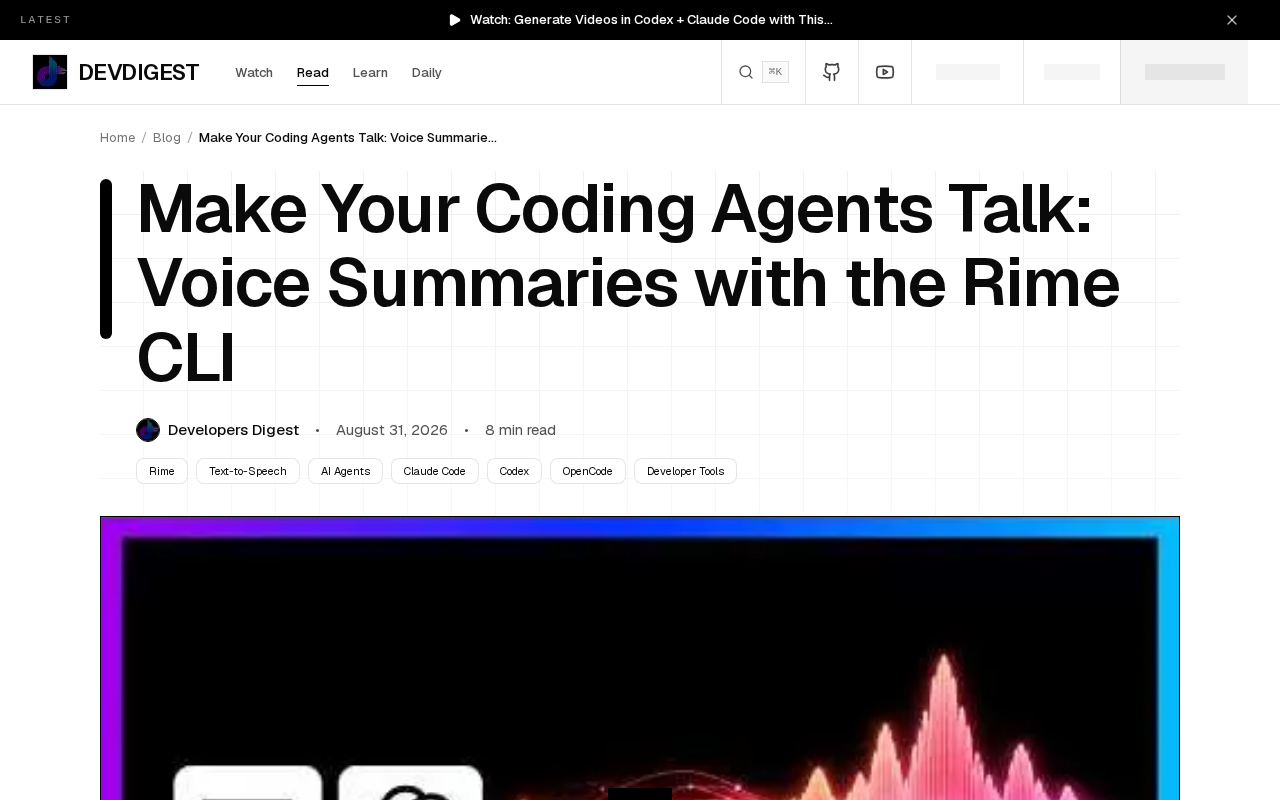
Rime CLI adds streaming voice summaries to AI coding assistants, freeing developers from screen-watching.
Rime CLI is a streaming TTS tool that gives AI coding agents like Claude Code, Codex, and Devin the ability to speak. By combining low-latency voice synthesis with carefully designed prompt patterns, it delivers concise spoken summaries after each task step, letting developers track progress by ear. The article covers its streaming architecture, Unix-pipe integration philosophy, prompt design principles for auditory output, and practical considerations including accessibility benefits and known limitations.
When Your Coding Assistant Learns to "Talk"
In an era where AI coding assistants are everywhere, tools like Claude Code, Codex, Devin, and OpenCode can already autonomously execute multi-step coding tasks. What these tools have in common is the ability to independently plan, code, debug, and even deploy complete projects — going far beyond simple single-turn Q&A-style code completion. Claude Code is Anthropic's command-line coding assistant that reads/writes files and executes commands directly in the terminal; Codex comes from OpenAI's code generation ecosystem; Devin, developed by Cognition Labs, positions itself as an "AI software engineer" capable of independently completing entire projects; and OpenCode is the open-source community's coding Agent solution, emphasizing transparency and customizability.
But there's a long-overlooked UX pain point: after handing a complex task to one of these Agents, you often find yourself glued to the terminal, waiting for its next progress update or question. Your attention is locked to the screen.
Rime CLI aims to change this. It's a text-to-speech (TTS) tool that streams natural-sounding voice output directly from the terminal, enabling coding Agents to "speak" a brief voice summary after completing each step, along with a confirmation question for the next action. This means that while waiting for code generation, test execution, or deployment, you can look away from the screen and track task progress by ear alone.
Core Capabilities of Rime CLI
Streaming Speech Synthesis: Generate and Play Simultaneously
Rime CLI's standout feature is its "streaming" output. Traditional TTS solutions typically need to generate the complete audio file before playback, introducing noticeable latency — usually ranging from several seconds to over ten seconds, which is virtually unacceptable for interactive scenarios requiring frequent feedback. Rime uses streaming synthesis technology, segmenting text into smaller semantic units (such as phrases or sentences), synthesizing them incrementally, and immediately outputting the audio stream, dramatically reducing the wait time from text to speech. Behind this lies advances in autoregressive models or chunked neural network architectures, along with native streaming support from audio codecs (like Opus), which typically compress the Time to First Byte (TTFB) to the hundreds-of-milliseconds range. For coding scenarios that demand frequent feedback, this low-latency experience is especially critical.
It emphasizes "natural-sounding" voice, which directly determines comfort during extended use. Overly mechanical synthesized speech quickly causes auditory fatigue, while near-human voice quality makes "listening to your Agent report on its work" a sustainable workflow.
Seamless Integration with Mainstream AI Coding Agents
Rime CLI has a very clear positioning — it's not trying to replace any coding assistant, but rather acts as a "voice layer" stacked on top of existing tools. Whether you're using Anthropic's Claude Code, OpenAI's Codex ecosystem, the autonomous coding system Devin, or open-source OpenCode, you can invoke Rime from the command line to enable voice announcements.
This "tool-agnostic" design philosophy stems from a core Unix principle — "Do One Thing Well." In Unix/Linux systems, the pipe mechanism allows connecting one program's standard output (stdout) directly to another program's standard input (stdin), forming flexible data processing chains. Rime CLI follows this tradition: it doesn't care where the text comes from; it's solely responsible for converting the text stream into a high-quality voice stream. This means it can be combined with any command-line tool using a simple pipe operator (|), greatly reducing integration costs. It's essentially a pipe — take the Agent's text output in, send voice output out, without interfering with the Agent's own logic.
How It Works: The Agent Prompt Pattern
The key to making an Agent "talk" isn't just the CLI tool itself — it's the prompt pattern behind it. Prompt patterns are an important concept in Prompt Engineering, analogous to Design Patterns in software engineering. They abstract best practices for interacting with large language models into reusable, standardized templates. Common patterns include the "Persona Pattern," the "Template Pattern," and others. The Agent Prompt pattern used by Rime is a type of "output format constraint pattern" — by explicitly specifying the output structure in the system prompt, it guides the model to organize its responses according to a specific information architecture.
Structured Voice Feedback Design
To make voice summaries genuinely useful, you need to guide the Agent to output content in a specific format. Based on Rime's demos, the ideal pattern has the Agent produce two components at the end of each step:
-
A brief, conversational summary: A recap of what was just completed. The key here is "brief" — text suitable for reading aloud is fundamentally different from text suitable for reading. Lengthy technical details are fine to read but terrible to listen to. The prompt must explicitly require the Agent to generate concise, conversational summaries.
-
A confirmation question for the next step: Ending with a question like "Should I proceed to run the tests?" or "Do you want me to commit this change?" This design elevates voice from mere "broadcasting" to "interaction," creating a closed loop of human-AI collaboration.
Why Prompt Design Is the True Differentiator
Many people assume the core of voice functionality is TTS engine quality, but in reality, how you organize the text being read aloud is what determines whether the experience is good or bad. Reading an Agent's raw terminal output — packed with code blocks, file paths, and error stacks — sounds terrible.
This relates to the fundamental cognitive differences between visual and auditory channels. According to cognitive psychology research, vision is spatial, allowing users to freely scan, skip, and backtrack; hearing is temporal, with information arriving in linear sequence, making it difficult to "look back." Alan Baddeley's working memory model identifies the Visuospatial Sketchpad and the Phonological Loop as two independent subsystems, each with its own processing capacity. This means that leveraging the auditory channel can provide additional information bandwidth when the visual channel is busy, but overly long or complex audio information quickly exceeds the phonological loop's capacity limits, causing comprehension efficiency to drop sharply.
The prompt pattern Rime provides is essentially teaching the Agent "how to write for the ear." This is an easily overlooked but extremely valuable design insight: voice interaction isn't simply reading text aloud — it requires reorganizing information density and structure specifically for the auditory channel.
Use Cases and Value Analysis
Freeing Visual Attention and Boosting Multitasking Efficiency
Rime CLI's most direct value is liberating developers from "staring at the screen and waiting." When running a time-consuming Agent task, you can go handle other things and only return to the terminal when you hear a key voice prompt. For developers who juggle multiple tasks in parallel, this is a tangible productivity boost. From a cognitive science perspective, this essentially leverages the independence of the visual and auditory subsystems in human working memory — when the visual channel is occupied by other tasks, the auditory channel can still receive and process the Agent's status feedback, enabling truly parallel information processing.
Accessibility Support and Expanded Interaction Modalities
Voice feedback also opens new possibilities for developers with visual impairments. Accessibility in software development has long faced unique challenges: visually impaired developers primarily rely on screen readers (such as JAWS, NVDA, VoiceOver) to access IDE and terminal content, but code's highly structured nature — indentation, brackets, dense symbols — makes the traditional screen reader experience far from ideal. According to GitHub survey data, approximately 1.1% of active developers report having a visual impairment, and globally, about 2.2 billion people have some degree of vision impairment. The rise of AI coding Agents brings new possibilities for accessible development — when Agents can summarize code changes and execution results in natural language, visually impaired developers can complete previously vision-heavy workflows through voice interaction.
More broadly, it expands the interaction dimensions between humans and AI coding tools — from purely "looking and typing" to "listening and confirming," making coding collaboration more multidimensional.
Limitations to Keep in Mind
Of course, tools like this have their boundaries. In open office environments or situations requiring quiet, continuous voice playback may not be appropriate (headphones work better). Additionally, the value of voice feedback is highly dependent on prompt design quality — if summaries aren't precise enough, they may become a distraction rather than a help. It's also worth considering that the linear nature of audio information means it's not suitable for conveying complex structured content (like detailed code diff comparisons or deeply nested error stacks), which still require returning to the visual interface.
A Small Experiment in Interaction Paradigms
Rime CLI itself is a small, focused tool, but the direction it represents is worth watching: as AI Agents take on increasingly autonomous tasks, the human-machine interface needs to evolve accordingly. From pure text to voice, from passive viewing to proactive reporting — these seemingly minor changes are actually redefining how we collaborate with AI.
Behind this trend is a more macro-level shift: as AI Agents evolve from "tools" to "collaborators," the interaction paradigm is shifting from a "command-response" model to a "delegate-report" model. In the traditional model, humans issue commands and wait for results; in the delegation model, Agents autonomously execute tasks, proactively report progress, and request confirmation at critical junctures. Voice, as one of the most natural ways for humans to receive information, fits perfectly with this "reporting" style of interaction — just as you don't need to watch a colleague write every line of code, you just need them to sync you on progress at key milestones.
For developers who heavily use coding Agents, it's worth trying to let your code assistant "speak up" — it might change your entire workflow rhythm while waiting for code generation.
Key Takeaways
Related articles
The Dude System: How Dual-Detection Multi-Agent AI Catches Inconsistencies Between Papers and Code
Dude is the first dual-detection multi-agent system for paper-code discrepancy detection, using granularity-aligned negotiation and two-stage salience filtering to boost recall and precision by up to 22.8%.
Implicit Instruction Following in Full-Duplex Voice Assistants: DSB-IFEval Benchmark Analysis
In-depth analysis of the DSB-IFEval benchmark reveals full-duplex voice assistants' capability gaps in implicit instruction following, persona reasoning, and conflict resolution. Covers comparative testing of six voice systems and examines behavioral vs. content trade-offs driven by architectural differences.
Personalizing AI Teaching Assistants with Prompt Engineering: A Deep Dive into the Six-Dimension Learner Profile Framework
Explore a prompt engineering framework for AI teaching assistants using six-dimension learner profiles and Bloom's Taxonomy to deliver 96 personalized teaching styles without model retraining.