Rippling AI Spend Console: A Practical Guide to Enterprise AI Spend Management and ROI Quantification

Rippling's AI Spend Console helps enterprises track AI costs and link them to engineering output for ROI measurement.
Rippling launched AI Spend Console, a free tool that breaks down enterprise AI spending by vendor, model, and employee while linking costs to GitHub output metrics like Pull Requests. Targeting finance and engineering leaders, the product addresses the growing challenge of AI cost management as enterprise AI spending surges. It reflects the broader emergence of AI FinOps as a critical enterprise discipline.
When AI Tools Proliferate, How Do Enterprises Account for the Costs?
Over the past two years, AI tools—from Claude to Cursor, from ChatGPT to GitHub Copilot—have been infiltrating enterprise workflows at a staggering pace. Engineering teams use them to write code, finance teams for analysis, and product teams for prototyping. Yet as subscription fees and API call invoices pile up like snowflakes, an uncomfortable question surfaces: Is all this spending actually worth it?
The wildly different pricing models of mainstream AI tools are a root cause of management difficulties. Take large language model APIs as an example: OpenAI and Anthropic charge per token (with different prices for input and output tokens), and costs can vary by orders of magnitude between models—GPT-4o is far more expensive than GPT-4o-mini. GitHub Copilot and Cursor, on the other hand, use monthly per-seat subscriptions, with some plans including limited premium model call quotas. This hybrid pricing landscape means enterprise AI bills are often a mix of subscription fees, usage-based charges, and overage costs—nearly impossible to reconcile without a unified tool.
According to Gartner's forecast, global enterprise spending on generative AI will exceed $30 billion in 2025, potentially doubling by 2027. Flexera's 2024 report shows that over 60% of enterprises say their AI-related spending has exceeded original budgets. A typical mid-sized tech company (around 500 employees) equipping its entire engineering team with GitHub Copilot and Cursor could easily spend over $300,000 per year on subscriptions alone—and that's before factoring in API calls and experimental projects. AI spending can quietly balloon out of control. The phenomenon of "Shadow AI"—employees subscribing to AI tools on their own and expensing them—makes cost management even harder.
Recently, HR and IT management platform Rippling launched a new product on Product Hunt—AI Spend Console—aimed squarely at this increasingly thorny pain point of enterprise AI spend management. The product performed impressively, earning 130 upvotes and 31 comments, landing at #3 on the daily leaderboard, categorized under "Artificial Intelligence," "Data Analytics," and "Finance."
Core Value: Tying AI Spend to Business Outcomes
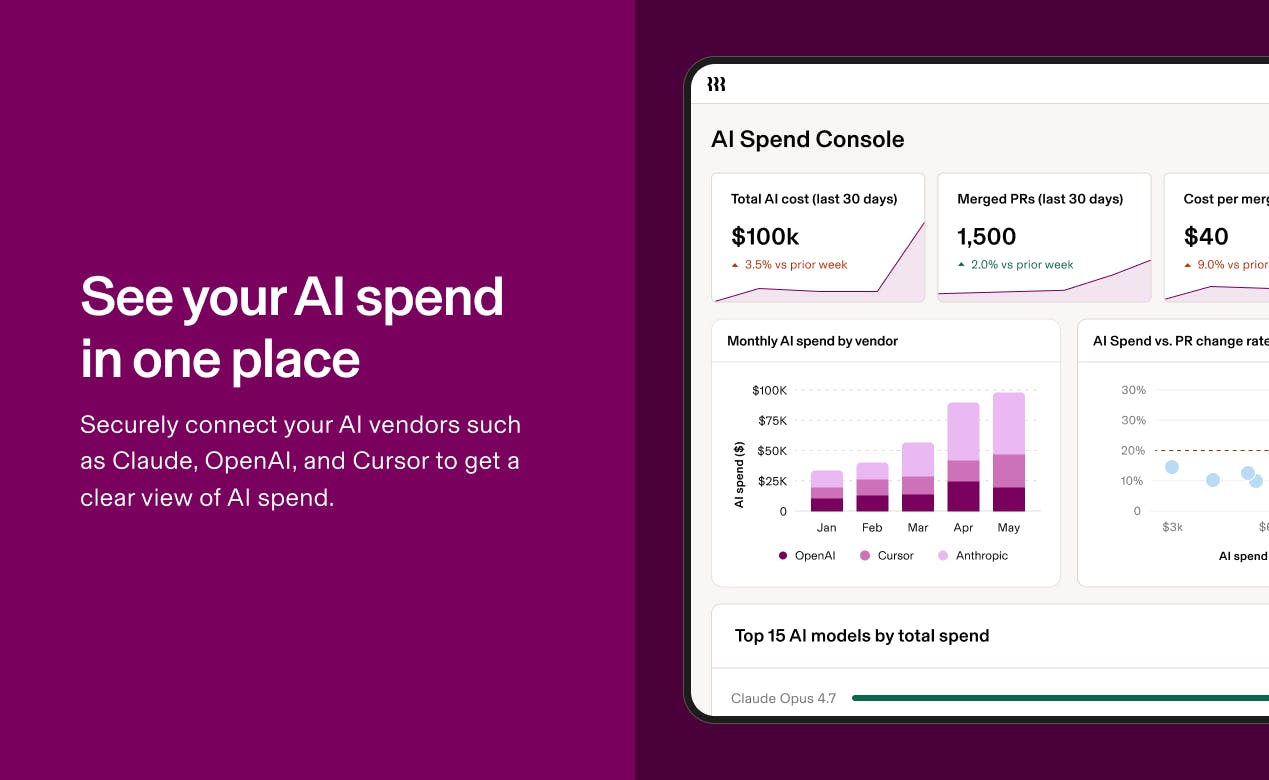
The product positioning of AI Spend Console is crystal clear, as its tagline states—"Track your AI spend and connect it to business outcomes."
Its target users are finance leaders and engineering leaders, providing a unified view for two teams that typically speak different languages. Traditional cost management tools can only tell you "how much you spent" but can't answer "what you got for it." AI Spend Console's differentiation lies precisely in that second half—directly linking AI spend to quantifiable business outcomes.
Rippling's ability to do this is closely tied to its platform DNA. Founded in 2016 by Parker Conrad (who previously founded Zenefits), Rippling positions itself as an "Employee System" that integrates HR, IT, and finance management into a single unified platform. As of 2024, Rippling's valuation has exceeded $13.5 billion, serving thousands of enterprise customers. Its core competitive advantage lies in using employee data as a central hub, connecting the entire workflow from onboarding to device allocation, software permissions, and payroll. The launch of AI Spend Console represents Rippling's strategic move to extend its platform capabilities from "people management" to "AI tool management," leveraging its existing employee identity data and IT asset management capabilities for precise AI spend attribution.
Breaking Down AI Costs Across Three Dimensions
According to official descriptions, the tool supports granular breakdowns of AI spending across three dimensions:
- By Vendor: Clearly see how much is being spent on each tool—Claude, Cursor, and others;
- By Model: Distinguish costs across different models to identify which ones offer better cost-effectiveness;
- By Employee: Drill down to the individual level to understand each team member's AI usage.
This multi-dimensional breakdown makes previously tangled AI bills transparent. For finance teams, it means AI budget allocation finally has a factual basis; for engineering managers, it helps identify which tools are genuinely used at high frequency and which are just "collecting dust."
Standout Feature: Quantifying AI ROI by Linking to GitHub Output Data
If cost breakdowns are just the basics of "bookkeeping," then AI Spend Console's true killer feature is its ability to directly link spending to GitHub output data, thereby quantifying the return on investment of AI tools.
Specifically, it can tie AI tool expenditures to code output metrics such as:
- Pull Request count: How many code merge requests the team has submitted;
- Code revisions: How frequently code is being iterated and refined.
The design intent is clear: in the past, when enterprises paid for AI coding tools, they could only rely on "gut feeling" to judge whether efficiency improved. Now, managers can attempt to build a quantifiable chain from "input" to "output"—is the money spent on Cursor actually translating into more PRs and a faster development cadence?
Of course, using Pull Request counts and code revision frequency to measure development efficiency has always been a controversial topic in software engineering. The DORA (DevOps Research and Assessment) team's four key metrics—deployment frequency, lead time for changes, change failure rate, and time to restore service—are widely considered more reflective of engineering effectiveness than raw code output volume. Academic research also extensively shows that there is no positive correlation between lines of code or PR counts and software quality. In fact, high-quality refactoring may reduce code volume, and concise code written by experienced engineers may be far more valuable than large amounts of redundant code.
Therefore, whether a true causal relationship exists between code output volume and AI value remains a topic worthy of deeper discussion. An increase in PR count doesn't necessarily equate to increased business value—it could even be a case of "gaming the metrics." Nevertheless, being able to put AI spending and observable engineering metrics on the same dashboard is itself a significant step forward for ROI assessment—it at least provides a starting point that makes more refined causal analysis possible down the road.
Free Strategy: Lowering the Barrier to AI Cost Management
A noteworthy detail in the commercial strategy: you can start using it for free without a Rippling subscription.
For a company whose core business is a subscription-based platform, this is a fairly bold open approach. It lowers the barrier for potential users—even if you're not an existing Rippling customer, you can start using the tool right away. This is clearly a "tool-as-lead-gen" customer acquisition strategy: first establish a touchpoint with a high-frequency, practical free tool, then gradually funnel users into the broader HR, IT, and finance management product ecosystem.
At a time when no clear market leader has emerged in the nascent AI cost management space, Rippling's choice to use a free strategy to capture mindshare is a shrewd move.
Industry Trend: AI FinOps Is Becoming an Enterprise Imperative
The emergence of AI Spend Console reflects the trend of enterprise AI adoption entering a phase of "refined operations."
During the first wave of AI adoption, enterprises generally prioritized "embracing" and "experimenting," with cost control taking a back seat. But as AI tools evolve from sporadic trials to large-scale deployments, FinOps (Financial Operations) extended into the AI domain—"AI FinOps"—is gradually becoming a real and pressing need.
FinOps itself is a financial management practice framework that originated in the cloud computing era, first standardized by the FinOps Foundation (now part of the Linux Foundation). Its core philosophy is to bring engineering, finance, and business teams together to optimize cloud resource spending through data-driven approaches. Traditional IT procurement was a one-time capital expenditure (CapEx), but cloud computing transformed it into an ongoing operational expenditure (OpEx), turning cost management from a procurement department responsibility into a continuous cross-team collaborative process. The three pillars of FinOps are: Inform, Optimize, and Operate. Now, with the explosive growth of AI API call and subscription costs, the FinOps methodology is being naturally extended into the AI domain.
When monthly AI bills swell from a few hundred dollars to tens or even hundreds of thousands, "where is it being spent, is it worth it, and how do we optimize" become questions that CFOs and CTOs must tackle together.
From this perspective, Rippling's timing is spot-on. Rather than building yet another AI application, it chose to become "infrastructure" for the AI era—helping enterprises manage and optimize their AI investments. This "selling shovels during a gold rush" positioning often holds more long-term value than chasing the latest application trends.
Conclusion: The Future of AI Spend Management
AI Spend Console is a product with clear positioning that hits a genuine pain point. It consolidates scattered AI spending into one place and boldly attempts to link costs to engineering output, offering enterprises a new lens for evaluating AI ROI.
Of course, it still needs to answer some deeper questions: Can code output metrics truly represent the value AI creates? How can teams be prevented from distorting their behavior to game the metrics (as warned by Goodhart's Law—when a measure becomes a target, it ceases to be a good measure)? Will future iterations need to integrate more dimensions of business data—such as product delivery speed, customer satisfaction, and code quality scores—to more comprehensively measure AI ROI? These questions await answers as the product matures in real-world deployments.
But one thing is certain: as AI becomes deeply embedded in enterprise operations, the ability to "clearly and thoroughly account for AI spending" will become an increasingly important capability—and Rippling has already taken a step worth watching.
Related articles

Poison-Resistant Concept Anchoring: A New Approach to Defending Against AI Data Poisoning
Deep dive into Poison-Resistant Concept Anchoring, defending against data poisoning via signed anchors and bounded updates. Experiments show 62% poison isolation with 0% false rejection rate.

Hungarian Algorithm Explained: Principles, Complexity, and Engineering Implementation Guide
In-depth explanation of the Hungarian Algorithm: core principles, O(N³) time complexity advantages, and engineering implementation. Covers assignment problem definition, step-by-step algorithm walkthrough, Python/C++ libraries, and applications in multi-object tracking and resource scheduling.
OpenAI's First Enterprise AI Report: H…
OpenAI's First Enterprise AI Report: How ChatGPT Is Changing the Way Organizations Work
OpenAI's first enterprise AI report reveals three key traits of ChatGPT Enterprise adoption: the shift from novelty to necessity, writing and coding as top use cases, and data governance as a core prerequisite.