ripwire: An Open-Source Tool That Maps Codebases for AI Programming Assistants
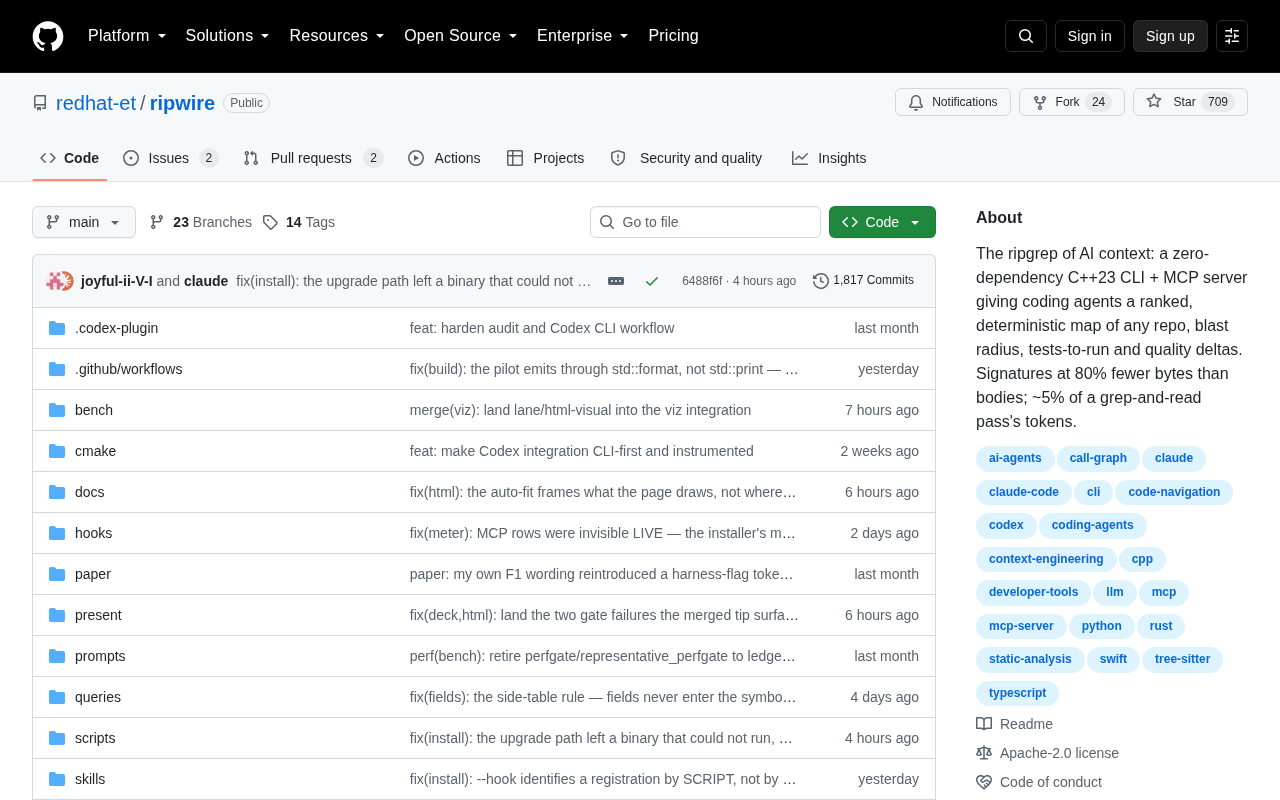
Open-source tool that maps codebases for AI assistants, solving context window limitations
ripwire is an emerging open-source tool that provides AI programming assistants with structured "maps" of codebases. Supporting both CLI and MCP protocol, it helps AI tools like Claude and Cursor navigate large projects efficiently rather than relying on limited context windows, representing a shift toward specialized context engineering in AI tooling.
When AI Programming Assistants Get Lost in Codebases
With the growing popularity of AI programming tools like GitHub Copilot, Cursor, and Claude Code, more developers are relying on AI to understand and modify code.
Context on GitHub Copilot and the AI Programming Tools Ecosystem: GitHub Copilot is an AI programming assistant launched by Microsoft's GitHub in 2021, trained on OpenAI's Codex model. It generates real-time code suggestions based on code context and comments. Cursor is an AI-native code editor built on VSCode, integrating multiple large language models and supporting natural language code editing. Claude Code is a programming assistance feature from Anthropic that emphasizes safety and interpretability. What these tools share is their use of large language models to understand code semantics, but they're all constrained by context window size—the amount of code the model can "see" at once.
However, a common pain point is emerging: AI programming assistants often lack a global view when dealing with large codebases.
While context windows of large language models continue to expand, they still cannot accommodate tens or even hundreds of thousands of lines of code in a single pass.
Technical Limitations of Context Windows: The context window is one of the core technical limitations of large language models, referring to the maximum number of tokens a model can process in a single inference. Tokens are the basic units for text processing—typically one English word corresponds to 1-2 tokens. Context window size directly affects how much information AI can "remember." Early GPT-4 versions supported 8K tokens (roughly 6,000 words), with later versions expanding to 32K or even 128K. Claude 3 series supports up to 200K tokens. However, expanding the window brings quadratic growth in computational cost and attention dilution issues—the model's ability to grasp details in overly long contexts decreases.
When AI needs to understand an unfamiliar repository's structure, locate function definitions, or trace call relationships, it often can only perform "blind men and the elephant" style reasoning based on limited file fragments. This leads to hallucinations, incorrect modification suggestions, and inefficient multi-turn interactions.
The open-source project ripwire, recently appearing on Hacker News, directly addresses this problem. It positions itself as "the ripgrep of AI context" with the goal of providing a "map of any codebase" for coding agents.
What is ripwire: The ripgrep of AI Context
Developers familiar with command-line tools surely know ripgrep (rg)—one of today's fastest code search tools, renowned for its exceptional performance in text matching across large projects.
Technical Background on ripgrep: ripgrep (command abbreviated as rg) is an open-source code search tool developed in Rust, created by Andrew Gallant in 2016. It combines the flexibility of regular expression searching with extreme performance optimization, typically running several times faster than traditional grep or ag (The Silver Searcher). ripgrep's core advantages include: default recursive search, automatic .gitignore file exclusion, support for multiple encodings, and parallel processing. It has become standard in modern developer toolchains, with many editors (like VSCode and Vim) integrating ripgrep into their internal search functionality.
ripwire borrows this analogy, attempting to replicate ripgrep's value at the "AI context" level. Simply put, ripwire doesn't just search text—it extracts and organizes structured context from codebases for AI. It offers two interface forms:
CLI Command-Line Tool
Developers can invoke ripwire directly in the terminal to quickly generate a structural overview of a repository. This approach continues the Unix tool philosophy: lightweight, composable, and easy to integrate into existing workflows.
MCP Protocol Interface
More critically, ripwire supports the MCP (Model Context Protocol) protocol.
MCP Protocol Explained: Model Context Protocol (MCP) is an open protocol introduced by Anthropic in 2024, aiming to standardize interactions between AI models and external data sources and tools. MCP defines a unified interface specification that allows AI assistants to access resources like file systems, databases, and APIs through standardized "servers" (MCP Servers). This is similar to REST API or GraphQL in web development, but designed specifically for AI context scenarios. MCP's core value lies in decoupling: tool developers only need to implement the MCP interface once to be called by all MCP-supporting AI clients; AI application developers don't need to adapt each tool individually. Currently, Claude Desktop, Cursor, Zed, and other tools support MCP, with the ecosystem rapidly expanding.
Through the MCP interface, AI assistants supporting the protocol like Claude and Cursor can directly invoke ripwire to obtain real-time codebase "maps" without manual intervention. This design means ripwire is not just a tool for humans, but infrastructure for AI agents.
Why AI Programming Assistants Need "Codebase Maps"
Understanding ripwire's value requires first understanding the core limitations facing current AI programming assistants.
Context windows are limited and expensive. Even for models like Claude that support 200,000 token contexts, stuffing an entire large project is neither realistic nor economical. More importantly, feeding the model irrelevant code indiscriminately actually dilutes critical information and reduces reasoning quality. This is why precise context selection remains crucial even with large windows.
AI needs "navigation," not "full text." When skilled human programmers take on unfamiliar projects, they don't read all code word-by-word but first build mental models: What's the directory structure? What are the core modules? How do functions call each other? What ripwire attempts to provide AI is precisely this structured navigation information—a map that tells AI "where to find answers" rather than "remember all answers."
This approach aligns with the recent rise of code indexing and semantic retrieval (RAG for code) directions.
Background on Code Indexing and RAG Technology: Code indexing refers to preprocessing codebases to extract structured information like symbol definitions, function signatures, and dependency relationships, building quickly queryable indexes. Traditional code indexing tools like ctags and cscope are syntax-based. Modern tools like Sourcegraph and GitHub Semantic Code Search combine semantic understanding. RAG (Retrieval-Augmented Generation) is the current mainstream AI context optimization technique, where relevant document fragments are first retrieved through vector search, then injected into the model's context. When applying RAG to code scenarios, the structural nature of code must be addressed: code isn't pure text but has rich structures like syntax trees, call graphs, and type systems. Excellent code RAG systems must understand these structures to provide precise context.
The difference is that ripwire emphasizes lightweight, fast ripgrep-like experience and native integration with the MCP ecosystem.
ripwire's Technical Positioning and MCP Ecosystem Significance
ripwire's emergence reflects that AI programming toolchains are moving toward stratification and specialization.
Early AI programming assistants often adopted "all-in-one" solutions: one model plus simple file reading logic. But as practice deepened, the industry gradually realized the need for dedicated "context engineering" components—responsible for providing the right information to models at the right time.
AI Tool Architecture Evolution: Early AI programming assistants used end-to-end monolithic architectures: one large model plus simple file reading. But as scenarios became more complex, the industry is forming a consensus on layered architecture. The bottom layer is code understanding, responsible for syntax analysis, symbol extraction, and dependency tracking—tools like Tree-sitter and Language Server Protocol (LSP). The middle layer is context engineering, responsible for retrieving, ranking, and trimming relevant code fragments—ripwire belongs to this layer. The top layer is the reasoning layer, the large language model itself. This division of labor resembles traditional software's MVC architecture, with each layer focusing on its specialized task. Context engineering is becoming an independent technical field because with the same codebase and model, different context strategies can result in generation quality varying by orders of magnitude.
ripwire is a product of this trend. By integrating with the MCP protocol, ripwire also joins the open tool ecosystem pushed by Anthropic. MCP is becoming the universal "interface standard" connecting AI with the external world, with more tools choosing to release as MCP Servers to be callable by any MCP-supporting client. ripwire's adoption of this route means it can seamlessly integrate into environments like Claude Desktop and Cursor that already support MCP.
Realistic Assessment: Limitations of Early-Stage Open-Source Projects
To be fair, judging from the discussion heat on Hacker News (only 6 upvotes and 2 comments at the time of observation), ripwire is currently still an early-stage open-source project that hasn't yet received widespread validation.
For these types of context engineering tools, developers can focus on several key questions during evaluation:
- Index Quality: Does the generated "map" truly capture the codebase's key structure and dependency relationships?
- Performance: Can indexing and query speeds maintain ripgrep-level experience when facing extremely large repositories?
- Language Support: Does it support your programming languages? How does it handle cross-language projects?
- Actual Benefits: In real AI programming scenarios, can it noticeably reduce hallucinations and improve modification accuracy?
Answers to these questions often require hands-on testing in actual projects.
Conclusion: Rather Than Expanding Context Windows, Teach AI to Read Maps
ripwire represents a noteworthy direction in AI programming tool evolution: rather than infinitely expanding model context windows, help models learn to "read maps." This "teach a person to fish" approach may be more efficient and economical than simply piling on context.
For teams and individual developers building AI programming workflows, open-source tools like ripwire that focus on context engineering are worth monitoring. As the MCP ecosystem matures, we have reason to expect more specialized components to emerge, collectively assembling more powerful and reliable AI programming experiences.
Key Takeaways
- AI programming assistants face context window limitations in large codebases, struggling to establish global views
- ripwire positions itself as "the ripgrep of AI context," providing AI with structured codebase navigation
- Supports both CLI and MCP protocol interfaces, seamlessly integrating with tools like Claude and Cursor
- Reflects the trend of AI programming tools moving toward layered architecture and specialization
- Still an early-stage project; actual effectiveness needs validation in real scenarios
- Represents the technical direction of "teaching AI to read maps" rather than "expanding memory"
Related articles

Internet Archive Fundraising Crisis: Server Operations Challenge Behind 800 Billion Archived Web Pages
The Internet Archive faces server operations funding pressure with 800 billion archived pages. Analysis of Wayback Machine cost challenges, nonprofit digital preservation survival crisis, and sustainable development paths.
Bentley Torcal EV: The Luxury Brand Transformation Challenge Behind Simulated V8 Sound
Bentley's Torcal EV features simulated V8 sound, balancing electric silence with mechanical emotion. An analysis of luxury brand identity challenges in the EV transition.

Can't Keep Up with AI Model Releases? Practical Strategies for Practitioners to Handle Information Overload
AI model releases are overwhelming. Learn how practitioners can overcome FOMO, establish evaluation criteria, filter information sources, and maintain focus amid the AI model explosion.