Rivian Hits Record Deliveries: R2 Model Drives 45% Quarterly Sales Surge

Rivian hits record quarterly deliveries of 19,000+ EVs, up 45% YoY, fueled by the mass-market R2 model.
Rivian has reported a record-breaking quarter with more than 19,000 EV deliveries — roughly 45% growth year-over-year. This stands out in a broadly slowing EV market, driven largely by the more affordable R2 model, which marks Rivian's strategic push from premium niche into mainstream consumers. Growing delivery volumes directly improve revenue and cash flow, laying the groundwork for Rivian's path to profitability. Whether this strong quarter can translate into sustained long-term growth will depend on continued capacity expansion, cost discipline, and durable consumer demand.
Rivian Reaches a Delivery Milestone
Electric vehicle maker Rivian has posted an impressive set of numbers. According to newly released data, the company delivered more than 19,000 electric vehicles in a single quarter — a roughly 45% increase year-over-year — setting a new sales record.
That growth rate stands out in an EV market that is increasingly competitive and broadly slowing. For a company still in the midst of scaling up, a nearly 50% year-over-year jump sends a strong signal that Rivian's vehicles are winning broader market acceptance.
The R2 Model as a Key Growth Driver
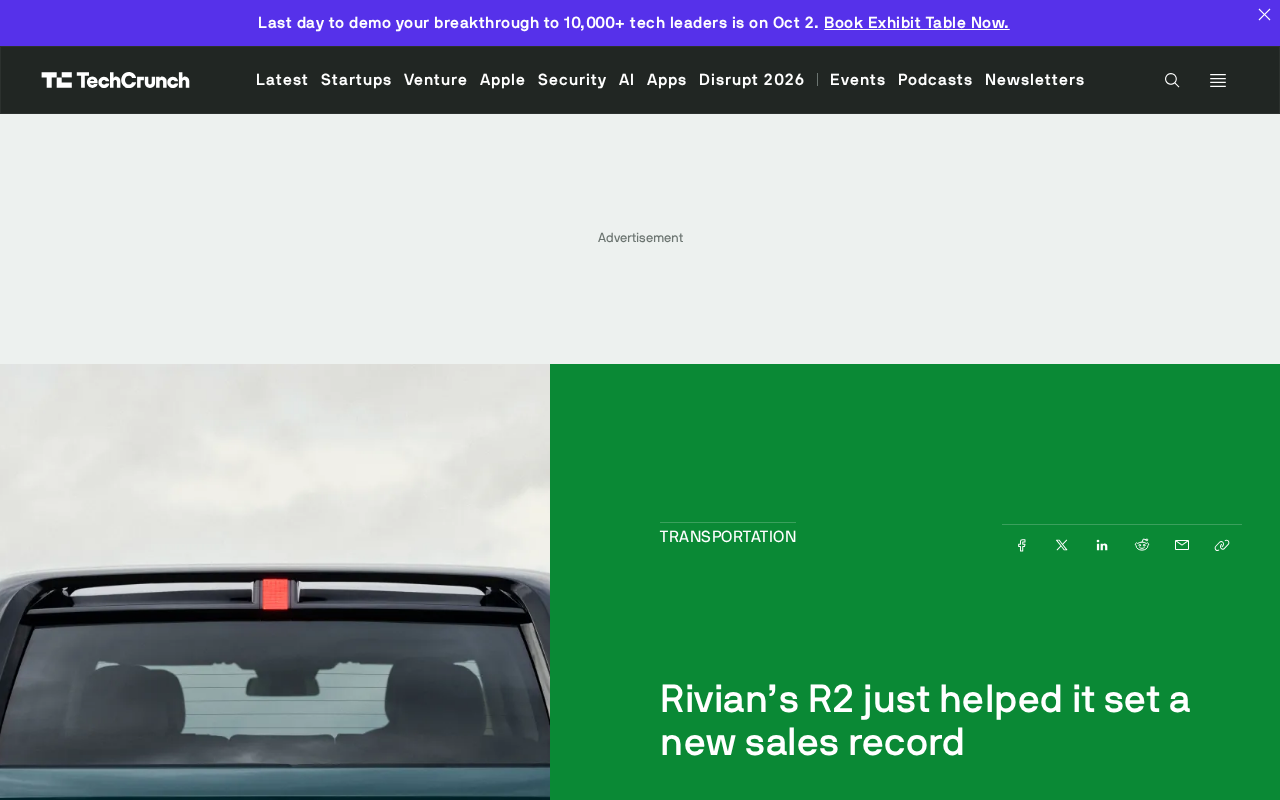
By all accounts, the R2 model was a major force behind this record delivery quarter. Compared to the higher-end R1 lineup, the R2 is seen as Rivian's gateway to the mass market — strategically designed to lower the price barrier and expand the customer base.
The R2's ramp in deliveries signals that Rivian is beginning to move beyond its niche as a premium EV player and into more mainstream consumer territory. This kind of downmarket expansion is often the path EV companies must take to achieve economies of scale and spread manufacturing costs. With more affordable models entering the market, Rivian stands to unlock demand that was previously out of reach.
The Rivian R2 is a mid-size SUV formally unveiled in March 2024 with a starting price of around $45,000 — a significant step down from the R1T pickup and R1S SUV, which routinely start above $70,000. Built on an entirely new platform, Rivian plans to produce the R2 at its Normal, Illinois plant and at a future facility in Georgia. The model is widely regarded as a make-or-break bet for Rivian's path to profitability: a lower price point opens up a far larger potential market, but it also demands tighter manufacturing efficiency and cost discipline. Much like the Tesla Model Y's strategic role in the mass market, the R2 is more than just a product for Rivian — it's a core pillar on which the company's long-term financial health will depend.
What 45% Growth Means for the Industry
Across the EV industry, growth trajectories are diverging sharply. While some leading manufacturers are hitting growth ceilings, Rivian's ability to sustain roughly 45% year-over-year gains suggests it has made real progress in supply chain management, production ramp-up, and delivery execution.
Delivery volume is one of the most important indicators of an EV company's health. It reflects not only order demand but also has a direct bearing on revenue and cash flow. For Rivian, which is still working toward profitability, a continuously expanding delivery base is the foundation for improving unit economics and gradually achieving financial sustainability.
In the EV industry, "deliveries" and "production" are two distinct key metrics. Deliveries — the number of vehicles actually handed over to customers — are a more accurate reflection of real market demand and the point at which revenue is recognized. Since 2024, the broader North American EV market has experienced a period of cooling demand, with Tesla posting year-over-year delivery declines across multiple quarters and several legacy automakers pushing back their electrification timelines. Against this backdrop, Rivian's roughly 45% year-over-year growth is partly attributable to the pull-through effect of the new R2 model, and partly to improvements in its supply chain: parts shortages and production line stoppages that previously hampered Rivian have eased in recent periods, allowing for better capacity utilization.
What This Means for Rivian's Future
This record-breaking delivery report sets a positive tone for Rivian's trajectory going forward. If the R2 can sustain its current market momentum, Rivian's share of the mass-market EV segment could continue to grow.
That said, whether a single strong quarter can translate into sustained long-term growth still depends on continued capacity expansion, cost control, and the durability of consumer demand. How Rivian performs over the next several quarters — whether it can maintain or even exceed this pace — will be a critical indicator of where its growth story is truly headed.
Related articles

NVIDIA's 30,000 Developers Use Cursor, Code Commit Volume Triples
Cursor engineer Chris Diaz breaks down five organizational gaps blocking enterprise AI coding scale—strategy, risk tiering, governance, metrics, and operating model. NVIDIA's 30,000 developers use Cursor daily, tripling code commits while defect rates stay flat. The key: rewrite the SDLC, not add tools.

Ponytail: Giving AI Coding Agents a Senior Engineer's Mindset
Ponytail is a free GitHub tool that injects a senior engineer's mindset into AI coding agents, making them ask whether code is even necessary first. According to TamilDeck, it can compress 200 lines of AI-generated code to 30, cutting token costs, with support for Cursor rules and Claude Code skill integration—though security review still requires human oversight.

Complete Guide to Connecting Cursor AI to the GitHub MCP Server
A step-by-step guide to connecting Cursor AI to the GitHub MCP server: create a personal access token, configure mcp.json, store the token in the ENV block, and verify with a PR query.