Rivian R2 SUV Becomes Best-Selling Model, Full-Year Delivery Guidance Raised Again

Rivian R2 overtakes R1 to become the brand's best-selling model, with the company raising guidance for the second time this year.
Rivian's second-generation product strategy is getting a positive market response. The all-new all-electric SUV R2 has surpassed the previous R1T and R1S to become the brand's best-selling single model, marking validation of the downward product strategy on the demand side. Originally seen as an independent product line, the R2 has now become the main engine driving overall sales, while the R1 series carries more of the high-end brand image. Due to strong new-model sales, Rivian has raised Wall Street guidance for the second time this year, reflecting better-than-expected sales progress and affecting market views on capacity utilization, unit-cost dilution, and cash burn pace. However, the mid-size all-electric SUV segment is densely competitive, with Tesla Model Y and others long dominant; whether R2 can gain traction externally, sustain sales growth, and maintain stable ramp-up deliveries remains a key test.
Rivian's second-generation product strategy is getting a positive response from the market. According to the latest information, Rivian's all-new all-electric SUV—the R2—has become the company's current best-selling model. At the same time, Rivian has raised its performance guidance to Wall Street for the second time this year, indicating that the sales momentum generated by this model has exceeded internal expectations.
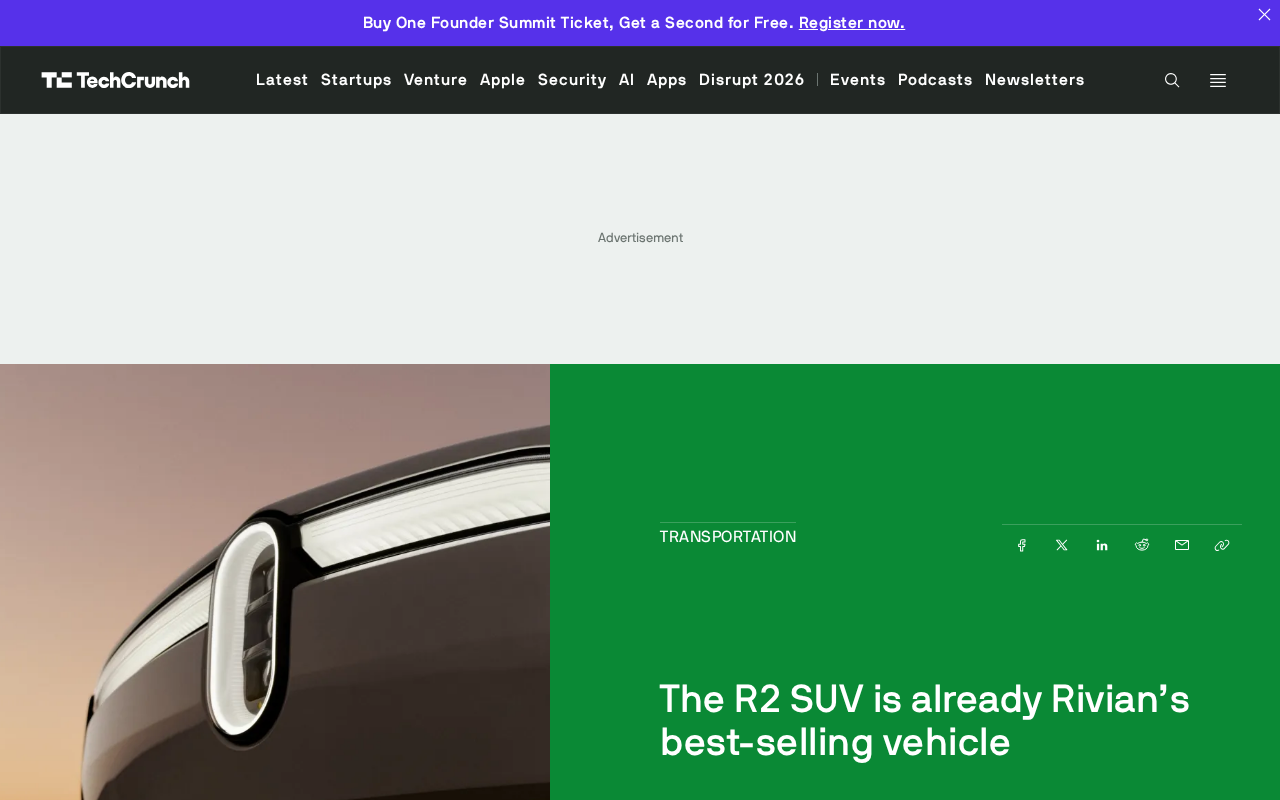
R2 Takes the Top Spot: From Product-Line Supporting Act to Sales Pillar
Rivian previously entered the market with the R1T pickup and R1S SUV, but these two models were positioned in the high-end, higher-priced segment, and their sales ceiling was relatively clear. The R2 is positioned lower, in a more mainstream segment, and carries the task of expanding the user base. Now the R2 has surpassed the R1 series to become the brand's best-selling single model, showing that the downward product strategy has been validated on the demand side.
This change is significant for Rivian's product cadence. The R2 was originally seen as an independent product line, but it has now effectively become the main engine driving overall sales, while the R1 series plays more of a role in carrying brand premium and high-end image.
Rivian's R1T and R1S belong to its early flagship product line. Both vehicles are developed on the same skateboard chassis platform and are positioned as high-end electric pickups and mid-to-large SUVs, typically starting above $70,000, targeting outdoor enthusiasts and high-end early adopters. This positioning determines the price-band ceiling of the R1 series: sales are limited by the narrower demand pool associated with high prices, making it difficult to support the annual sales volume a carmaker needs to achieve scaled profitability. The R2 is Rivian's planned small-to-midsize, low-cost platform model, aimed at more mainstream family users, with a significantly lower price threshold. The transition from R1 to R2 is essentially the typical path of a carmaker moving from "validating brand and technology" to "pursuing scale and unit-cost dilution," similar to Tesla's shift from Model S/X to Model 3/Y.
Second Guidance Raise This Year: What Signal Does It Send?
The original text mentions that Rivian has raised its performance guidance to Wall Street for the second time because sales of the new model have been strong enough. Raising guidance twice in the same fiscal year usually means actual sales progress is significantly better than management's initially conservative expectations.
For an EV company still in the capacity ramp-up and profitability improvement stage, a sales guidance increase is not just a change in numbers. It also affects the market's judgment on capacity utilization, unit-cost dilution, and the pace of subsequent cash burn. Rivian's choice to raise guidance again at this time shows that internally it has some confidence in the R2's continued volume growth.
Performance guidance is the range of expectations for future quarterly or full-year operating metrics that a listed company proactively provides in or after its financial report, commonly covering revenue, deliveries, gross margin, and capital expenditure. It is not mandatory disclosure, but once given, management usually tends to deliver on it, because significantly missing guidance directly hits the stock price and credibility. Raising guidance multiple times within the same fiscal year is seen in capital markets as a strong positive signal: it shows actual operating data has continuously exceeded management's initially conservative assumptions. For EV companies in the capacity ramp-up phase, guidance also indirectly reflects capacity utilization expectations—higher delivery guidance means fixed costs (factory depreciation, labor) will be spread across more vehicles, and per-vehicle costs are expected to decline, thereby improving the pace of loss narrowing.
Competitive Test in the Mainstream Segment
The R2 competes in the mid-size all-electric SUV segment, where competition is quite dense, and models such as the Tesla Model Y have long dominated. The R2 becoming Rivian's own sales champion shows that it has at least completed the replacement of older models within the brand, but that is still a different matter from establishing a foothold in the external market.
Key indicators to watch going forward include whether R2 sales growth can continue after the guidance raise, and whether delivery cadence remains stable during the capacity ramp-up. If both hold true, Rivian's path from a high-end niche brand to a scaled carmaker will have truly been proven.
The mid-size all-electric SUV segment is one of the most fiercely contested price bands in the global EV market, with representative models including the Tesla Model Y, Hyundai Ioniq 5, Ford Mustang Mach-E, and numerous Chinese-brand products. This segment is characterized by price-sensitive consumers, high requirements for range and charging convenience, and relatively low brand loyalty, so both product strength and cost control are indispensable. For Rivian, the R2 surpassing the R1 within the brand does not automatically equate to gaining share in the external market; the real measure is the R2's relative sales growth rate in this price band and whether its gross margin can turn positive as scale rises. Common risks during the ramp-up phase include supply-chain bottlenecks, production-line yield fluctuations, and delivery delays, all of which directly affect the credibility of guidance fulfillment.
Editorial View
The R2 becoming the best-selling model is direct evidence that Rivian's product strategy adjustment is working, and it also explains why the company dares to raise guidance for the second time this year. However, a single model reaching the top is only a阶段性 achievement; the real test is whether this sales momentum can be translated into sustained economies of scale and whether it can hold its position in the highly competitive mainstream all-electric SUV market.
One-line Summary
Rivian R2 overtakes R1 to become the brand's best-selling model, and the company raises performance guidance for the second time this year.
Paragraph Summary
Rivian's second-generation product strategy is receiving a positive market response. The all-new all-electric SUV R2 has surpassed the previous R1T and R1S to become the brand's best-selling single model, marking validation of the downward product strategy on the demand side. The R2 was originally regarded as an independent product line, but now it has effectively become the main engine driving overall sales, while the R1 series plays more of a high-end brand image role. Due to strong sales of the new model, Rivian has raised its performance guidance to Wall Street for the second time this year, reflecting actual sales progress better than management's initial expectations and affecting the market's judgment on capacity utilization, unit-cost dilution, and cash burn pace. However, the mid-size all-electric SUV segment where the R2 competes is densely competitive, with Tesla Model Y and others long dominant; whether the R2 can establish a foothold in the external market, whether sales growth can continue, and whether capacity ramp-up deliveries remain stable are still key tests.
Related articles

14 Core Concepts of Reasoning Models: From Chain of Thought to GRPO Explained
A systematic breakdown of 14 core concepts of reasoning models: chain of thought, test-time compute, verifiers, RLVR and GRPO, distillation, and reward hacking, plus rules for controlling thinking-token costs to help you decide when reasoning is worth paying for.
OpenAI's Claimed Refutation of ETH Sparks Debate, Meta Bets Big on AI Infrastructure
OpenAI claims an AI-assisted discovery that challenges the Exponential Time Hypothesis (ETH) and launches the mid-tier GPT-6.1 Tera. Cloudflare discloses a cross-customer data leak postmortem, and Meta plans $95B in AI infrastructure financing.

Data Scraping, AI Proofs, and Open Source Contracts: This Week's Deep Dive into the Tech World
From the 3D model crawler controversy and OpenAI's Lean formal proofs to AI agents challenging Brooks' Law and Debian rejecting LLM review, this week's tech discussions center on openness and verifiability.