Rivian Recalls R2 Electric Vehicle Over Battery Pack Fastening Issue, Affecting Around 14 Units

Rivian recalls ~14 R2 EVs for loose battery pack fasteners; issue already fixed on the production line.
Rivian has issued a small-scale recall for its new volume model, the R2, after a batch of vehicles were found to have improperly tightened battery pack fasteners — a potential safety concern. Only around 14 vehicles are affected, indicating the problem was caught and isolated early in production. Rivian has already corrected the assembly process, so future units are unaffected. For impacted owners, the fix typically involves re-torquing the fasteners — a quick, low-cost procedure. The incident is widely seen as evidence of Rivian's quality monitoring working effectively during the early ramp stage.
Rivian R2 Battery Pack Fastening Issue Triggers Recall
American electric vehicle manufacturer Rivian has issued a recall for its new R2 model due to improperly tightened battery pack fasteners on a small number of vehicles. According to the company, approximately 14 vehicles are affected — a relatively limited scope — and the issue has already been resolved at the assembly line level.
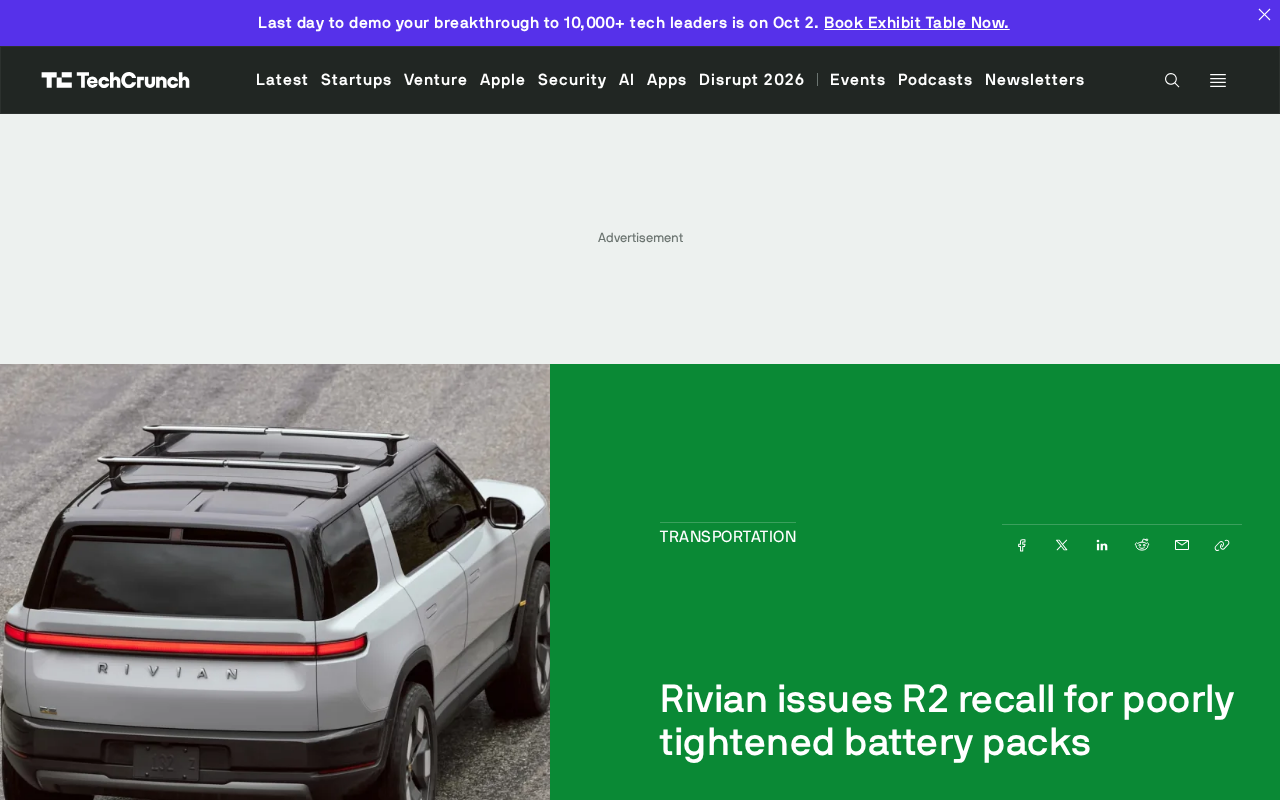
As one of the most critical and heaviest components in an electric vehicle, the battery pack's secure mounting is directly tied to vehicle safety and driving stability. Fasteners that aren't tightened to specification could cause the battery pack to shift during extended driving or over rough terrain, posing potential safety risks. Despite the small number of affected vehicles, Rivian's decision to proactively issue a recall reflects a cautious approach to quality issues during the early production ramp of a new model.
Scope and Resolution
Rivian has stated that approximately 14 vehicles are expected to be affected. This figure is exceptionally low by recall standards, typically indicating that the issue was identified and isolated early in production. The company also confirmed that the relevant assembly process has been corrected at the factory level, meaning R2 vehicles produced going forward will not carry the same defect.
For the small number of vehicles already delivered or in the delivery pipeline, the standard fix involves inspecting and re-torquing the battery pack fasteners — a low-cost, quick-turnaround remedy with minimal impact on owners' day-to-day use.
In the United States, any safety-related vehicle recall must be filed with the National Highway Traffic Safety Administration (NHTSA), regardless of how many vehicles are involved — which is why Rivian must go through the formal recall process even for just 14 units. NHTSA's public recall database logs every incident, and consumers can check whether their vehicle is affected by searching its Vehicle Identification Number (VIN). For emerging EV companies, filing recalls promptly and proactively is also an important way to build consumer trust.
What This Means for Rivian's Production Ramp
The R2 is a highly anticipated volume model for Rivian — positioned as a more accessible alternative to the flagship R1 lineup and seen as central to the company's push for greater market share. Minor process-level issues during the early stages of mass production are not uncommon; what matters is whether a company can detect and correct them before scale-up accelerates.
The recall's extremely small footprint and the fact that the issue has already been addressed on the production line suggest that Rivian's quality monitoring systems kicked in effectively at an early stage. For an EV maker in the midst of a production ramp, catching a defect within just a dozen or so vehicles is far preferable to discovering it after large-scale deliveries have begun.
New EV models commonly face what's known as the "ramp-up" challenge — the period of transition from small-batch production to full-scale manufacturing, during which process stability is often not yet fully mature. Tesla famously struggled with its Model 3 ramp, entering what Elon Musk himself called "production hell" and raising widespread market doubts about its delivery capacity. Rivian itself experienced similar process fluctuations during the early production of the R1T and R1S. The fact that R2's fastening process issue was exposed and contained within just 14 vehicles suggests that quality inspection protocols were already active before the line reached full speed — helping prevent defects from compounding into a systemic problem as production volumes grow.
Summary
Rivian's R2 recall is a textbook early-stage, small-scale quality event. Approximately 14 vehicles are affected, and the battery pack fastening issue has been corrected at the assembly line. For consumers, the impact is manageable; for the company, it represents a real-world test of quality control during the critical early phase of mass production.
Related articles

Reinforcement Learning Takes On Getting Over It: Distributed Training Strategies Behind 63% Progress
A developer uses deep reinforcement learning to tackle Getting Over It. The agent climbs from the bottom to 63% progress but gets stuck at the anvil. The project is open-sourced, using divide-and-conquer training and CPU-only training, seeking community collaboration to break the bottleneck.

Sigma FP2 Released: The World's Smallest Full-Frame Camera Gets Sensor and Screen Upgrades
Sigma launches the FP2 full-frame camera, retaining its smallest-and-lightest design with three key upgrades: improved sensor, articulating LCD screen, and longer battery life—built for portable video creators.

AAAI 2027 Phase 2 Decisions Imminent: Community Debates Review Fairness and Submission Ecosystem
AAAI 2027 phase 2 review results are imminent, with the Reddit community debating reviewer consistency and process transparency. This article examines pre-decision sentiment, structural tensions in top conference review, and practical strategies for authors.