Roblox Allegedly Scraped 145GB of Models Without Authorization, Including Adult Content

Roblox is accused of scraping 145GB of 3D models, including adult content, from Open3DLab without asking, sparking debate over authorization ethics.
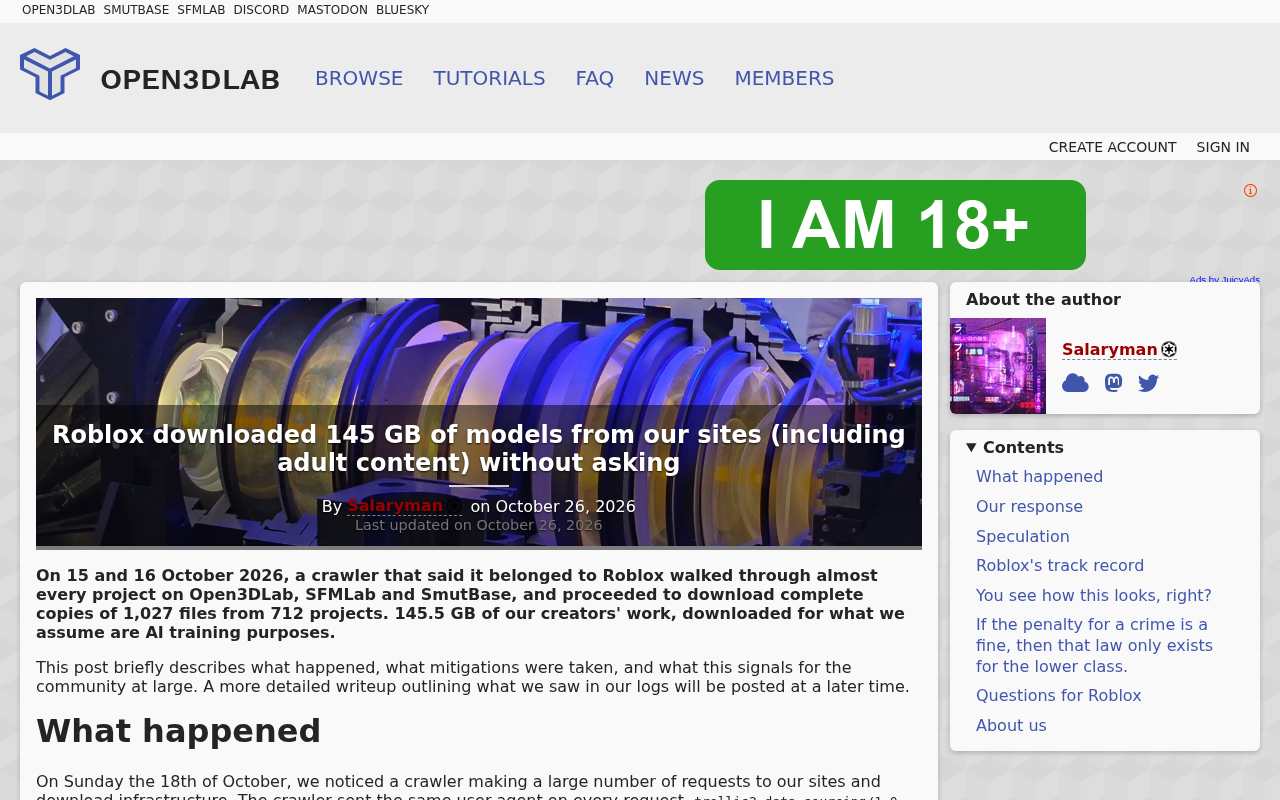
Open3DLab announced that Roblox downloaded 145GB of 3D model assets from its site without consent, including adult content; the incident garnered 268 points and 174 comments on Hacker News. The article notes the core controversy is not the download itself but the platform's failure to ask creators beforehand, touching on the authorization boundaries of AI training data. Small creative communities lack the technical means and bargaining chips to deal with silent scraping by big companies, which could weaken willingness to share openly. It also analyzes the compliance complexity introduced by adult content and the chain effects on the 3D generative model data ecosystem, offering community sites three recommendations: log analysis, clear terms, and public disclosure.
The Incident: A Silent Mass Data Scrape
According to an announcement published by Open3DLab, Roblox downloaded as much as 145GB of 3D model assets from its site without obtaining prior consent from the site or its creators. Open3DLab is an open-source model-sharing community for 3D creators, covering model files ranging from game characters to scene props and more. The announcement's title was blunt: the downloaded assets even included adult content.
The news quickly sparked discussion on Hacker News, where the related post garnered 268 points and 174 comments—clear evidence of how sensitive the developer community is to "platforms scraping third-party content without permission."
As of now, Roblox has not issued a public response to the matter, and Open3DLab has not disclosed the specific technical details of how it detected the downloads—whether through log analysis, traffic monitoring, or a third-party tip. This information gap is itself one of the most noteworthy parts of the incident.
Open3DLab is one of the more representative open-source model-sharing platforms in the 3D creation community, with content mainly consisting of user-uploaded game-extracted models, fan creations, and scene assets. Community-run sites typically rely on limited donations or advertising revenue to sustain servers and bandwidth, and lack infrastructure and legal resources comparable to those of large platforms. As a result, when one party pulls content at scale through automated means, communities often only notice after the fact through traffic anomalies or log audits, making it difficult to intercept or negotiate beforehand. This asymmetry in technical capability and resources is the contextual premise for understanding why such incidents recur.
Why This Matters
Creators' Authorization Boundaries Were Ignored
3D models, like text and images, are copyrighted digital assets. The models on Open3DLab are mostly uploaded and shared voluntarily by community creators, and their terms of use typically impose clear restrictions on commercial use and redistribution. Roblox's unilateral bulk download of 145GB of content—whether for model training, building an asset library, or other internal processes—bypassed the basic step of communicating and negotiating with creators.
For small creative communities, scraping at this scale is especially damaging: sites have limited bandwidth and storage costs, and a single "silent pull" by a big company can create substantial operational pressure.
Adult Content Makes the Problem More Complicated
The announcement specifically emphasized that the downloaded content included adult-oriented models. This means the incident is not just a copyright issue but also involves content compliance and platform responsibility. If these assets were used to train generative AI systems or entered Roblox's content pipeline, how adult content is handled would directly bear on whether the platform's content safety policies are internally consistent.
As a platform serving a large number of underage users, Roblox has always been cautious about adult content. If the scraping is confirmed, whether its internal data governance processes are sufficient to isolate such sensitive material is a reasonable question for outsiders to ask.
"Isolation" in content compliance typically refers to platforms using rating labels, access controls, and review workflows to restrict sensitive or adult content to specific areas and prevent it from entering product pipelines aimed at underage users. For a platform like Roblox, whose user base skews young, content safety policies generally require strict filtering of adult material. If externally scraped 3D assets are used for training or enter internal data pipelines, the platform needs to demonstrate that its data governance processes can identify and isolate such content; otherwise, even if the scraping itself has a commercial rationale, it will face compliance scrutiny.
"Not Asking" Is the Core Controversy
What's noteworthy is not the act of "downloading" itself, but the fact that "no one asked beforehand." Amid escalating copyright disputes over AI training data, platforms quietly scraping third-party resources has become an industry-wide chronic problem. Open3DLab's public accusation is essentially a creative community's direct challenge to big tech's data acquisition practices: if there wasn't even a single inquiry, the so-called "fair use" defense loses its moral foundation.
Chain Reactions for AI and the 3D Content Ecosystem
This incident reflects a larger structural conflict. With the rise of 3D generative models and world models, high-quality 3D assets have become scarce training resources. Big companies have incentives to harvest data at scale from public communities, while community creators lack the technical means and bargaining chips to protect their work.
If such scraping goes unchecked, a possible consequence is that creators further tighten their willingness to share, shifting toward closed or paywalled models, ultimately undermining the vitality of the entire open-source 3D content ecosystem. Conversely, if platforms establish transparent authorization and attribution mechanisms, they could instead secure sustainable data supply at lower cost.
3D generative models and world models have become hot directions in AI research in recent years, but the annotated 3D assets needed for training are far scarcer than text and image data. Public 3D model communities have therefore become one of the sources of scarce data, and such assets often come with creators' licensing terms. Copyright disputes over training data have already spawned numerous lawsuits and licensing practices in the text and image domains; in the 3D field, because asset scales are small and creators are dispersed, related norms have yet to take shape. This means that when big companies collect 3D data from communities, they lack both mature licensing templates and industry-standard attribution and compensation mechanisms, further amplifying the potential for conflict.
What Creators and Communities Can Do
For small and mid-sized sites that depend on community content to survive, this incident offers several practical lessons:
- Document and preserve evidence: Regularly analyze access logs, identify anomalous large-scale download behavior, and maintain a traceable evidence chain.
- Clarify terms: Clearly state restrictions on data scraping and commercial use in the site's terms of service, providing a basis for subsequent negotiations.
- Be transparent: Proactively publicize incidents like Open3DLab did and leverage community opinion to create pressure—often more effective than negotiating alone.
For platforms, a single unnegotiated scrape can buy a long-term trust deficit. As data ethics regulation tightens, the cost of proactive communication is far lower than post-hoc PR.
The incident is still unfolding. Whether Roblox responds and whether Open3DLab takes further legal action will determine whether this controversy becomes an industry cautionary tale or just another quickly forgotten news item.
Feasible log analysis methods in practice include monitoring high-frequency requests from a single IP or IP range, identifying bulk downloads with non-browser User-Agents, and setting alerts for download rate and total volume thresholds. On clarifying terms, service terms can include language prohibiting automated scraping, restricting commercial use, and reserving the right to pursue liability. While terms alone cannot stop technical scraping, they provide textual grounds for subsequent negotiations and legal claims. Public disclosure is effective because it transforms a single-point dispute into a reputational cost visible to the community, pushing platforms to respond or adjust strategy under public pressure.
Related articles

Will GitHub Die? Open Source Maintainer Burnout and the Collaboration Crisis in the AI Era
Lex Fridman podcast discussion on open source maintainer burnout and GitHub's predicament: massive pull requests overwhelm core maintainers, and AI worsens code bloat. Using math journal peer review and Poincaré conjecture verification as analogies, the article analyzes why verification in knowledge production must be deliberately slow, and how open source communities can avoid the failure mode of maintainers exiting.

Stop Building Cookie-Cutter AI Websites: 3 Tools That Transform Your Coding Agent
Three tools that boost AI coding agents: FFmpeg skill for local video editing in Claude Code and Cursor, Hallmark's 50 design themes to fix cookie-cutter AI sites, and Jailbreaks' 25+ model prompts.

How America's Gerontocracy Squeezes the Younger Generation
Americans over 55 hold nearly three-quarters of national wealth, alongside an 80-year-old president and elderly congressional leaders. The Atlantic's Idrees Kahloon explains how gerontocracy drives up housing costs, squeezes opportunities for the young, and explores zoning reform and child poverty reduction as practical fixes.