Robot Developer Builds Custom B-rep Kernel with 3,487 Tests

Developer builds a custom B-rep geometry kernel with 3,487 tests, targeting the gap in robotics-specific CAD.
A developer showcased a custom B-rep geometry kernel on Hacker News with 3,487 tests, driven by the belief that robotics needs better CAD tools. B-rep precisely represents 3D solids and demands higher precision and robustness in complex robot assemblies, where general CAD kernels fall short. Building a custom kernel is extremely high-barrier: mature commercial kernels have decades of accumulation, but focused robotics scenarios offer differentiation opportunities. Risks include long maturity cycles, test passes not equaling usability, and ecosystem building. The project's impact depends on real-world performance and community feedback.
A developer showcased their custom B-rep (boundary representation) geometry kernel on Hacker News, complete with 3,487 tests. The project, posted as a "Show HN," stems from a straightforward judgment: robotics needs better CAD tools.
Why Robotics Needs a Dedicated CAD Kernel
B-rep is the core data structure for representing 3D solid shapes in CAD software, precisely describing objects by recording geometric faces, boundaries, and topological relationships. Traditional CAD kernels mostly serve general mechanical design and face unique challenges in robotics scenarios.
Robot design involves complex assemblies such as links, joints, and sensor layouts, demanding higher precision and robustness in geometric operations. Existing tools often prove cumbersome or inflexible when handling these needs. The developer didn't elaborate on specific shortcomings in the post, but the phrase "needs better CAD" suggests they see clear gaps in existing solutions for robotics workflows.
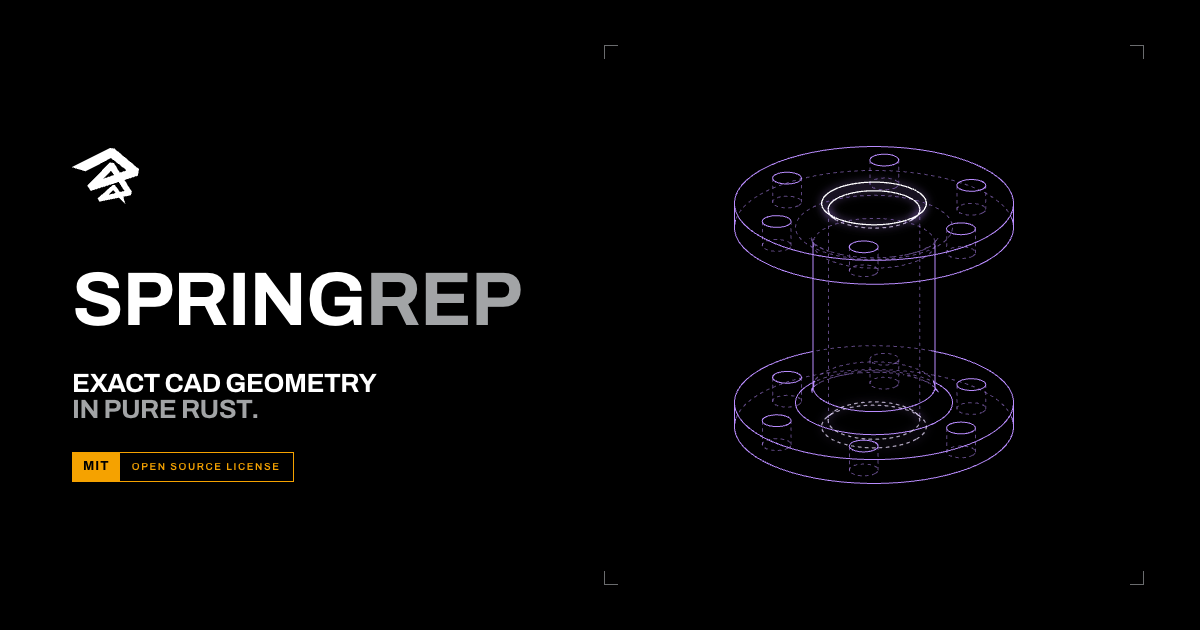
B-rep vs. mesh representation: Another common shape representation in CAD is the mesh, which approximates object surfaces with large numbers of triangular facets. Meshes suit rendering and collision detection but cannot precisely express analytic surfaces (such as cylinders or spheres) and accumulate errors during Boolean operations. B-rep, by contrast, describes solids through parametric surface patches and precise topological boundaries, guaranteeing exact geometric operations and supporting typical CAD operations like chamfering, shelling, and surface intersection. The cost is far greater data structure and algorithm complexity, with more edge cases. The link surfaces and joint mating faces common in robot design often require this precise representation, explaining why the developer chose B-rep over mesh as the kernel foundation.
What 3,487 Tests Mean
For foundational software like geometry kernels, test count is an important signal of reliability. The difficulty of B-rep kernels lies in the sheer number of edge cases: surface intersections, degenerate edges, tiny features, non-manifold topology, and more—any mishandling can cause downstream CAD operations to fail.
The 3,487 tests cover precisely these problematic corners. Without them, a kernel might perform fine on simple cases but expose defects once it enters complex assemblies of real robot models. By publicly disclosing the test count, the developer is emphasizing their commitment to robustness.
Non-manifold topology and degenerate edges: In B-rep, a manifold solid requires each edge to be shared by exactly two faces, with the local structure around each vertex homeomorphic to a disk. Non-manifold topology refers to edges shared by more than two faces, or vertices with multiple disconnected sectors—common in glued parts, zero-thickness walls, or intermediate Boolean results. Degenerate edges are edges whose length approaches zero, or "pseudo-edges" arising when adjacent faces are nearly coplanar. Such geometry is mathematically difficult to define normals and tangents for; if algorithms cannot identify and clean them up, they produce self-intersections, flipped facets, or crashes in subsequent operations. B-rep kernel tests concentrate heavily on these boundary cases precisely because they are hardest to expose with routine use cases yet most likely to trigger in real assemblies.
Opportunities and Barriers of a Custom Kernel
Writing a B-rep kernel from scratch is extremely high-barrier work. Mature commercial kernels have undergone decades of iteration, accumulating vast geometry algorithm libraries and engineering experience. Individual developers choosing this path usually do so because existing open-source solutions can't meet needs in specific scenarios, or because they hope to deeply optimize for a vertical domain.
Robotics happens to offer such soil: application scenarios are relatively focused, real-time and lightweight requirements are clear, and many features of general CAD kernels aren't necessary here. If a kernel can be specifically optimized for tasks like robot kinematics and collision detection, it has a chance to create differentiated value.
The risks are equally obvious. Geometry kernels have long maturity cycles; test pass rates don't equal practical usability, and edge cases in real models often exceed test coverage. Moreover, ecosystem building—including file format compatibility, API design, documentation, and community—determines whether a kernel can actually be adopted.
Ecosystem barriers of mature kernels: Commercial B-rep kernels (such as Parasolid and ACIS) have accumulated over decades, encompassing not only geometry algorithms but also import/export of standard formats like STEP/IGES, feature modeling history, assembly constraint solving, and extensive industry certifications. Switching kernels means rebuilding the entire toolchain and file interoperability—the main resistance to user migration. Open-source options (like Open CASCADE) are usable but often criticized for robustness and performance, with limited documentation and community support. For an individual developer building a kernel from scratch, the real barrier isn't just the geometry algorithms themselves but whether they can provide interfaces compatible with the existing ecosystem. Focusing on robotics scenarios can reduce ecosystem burden, but the kernel must at least read mainstream CAD formats, or it will struggle to enter real workflows.
Takeaways for Robotics Developers
This project reflects a trend: the foundational tools of the robotics software stack are being re-examined. As upper-layer algorithms and frameworks evolve rapidly, shortcomings in foundational areas like geometric modeling and simulation become increasingly apparent. The developer's willingness to invest effort in rewriting a kernel shows the misalignment between existing tools and robotics needs has become significant enough.
For teams focused on robotics development, this project is worth watching. It may not immediately replace existing CAD tools, but it offers a window: what characteristics robotics-specific geometry infrastructure should have, and how far an individual developer can go in this direction. The project's subsequent progress—real-world performance beyond test coverage, whether it goes open source, community feedback—will determine its actual impact.
One-line Summary
Developer builds a custom B-rep geometry kernel with 3,487 tests, targeting the gap in robotics-specific CAD.
Paragraph Summary
A developer showcased a custom B-rep geometry kernel on Hacker News with 3,487 tests, driven by the belief that robotics needs better CAD tools. The article analyzes how B-rep, as a data structure for precisely representing 3D solids, demands higher precision and robustness in complex robot assemblies, where general CAD kernels fall short. Extensive tests covering surface intersections, degenerate edges, and non-manifold topology signal reliability. Building a custom kernel is extremely high-barrier; mature commercial kernels have decades of accumulation, but focused robotics scenarios with clear real-time and lightweight needs offer differentiation opportunities. Risks include long maturity cycles, test passes not equaling practical usability, and the need for file format compatibility and community ecosystem building. The project is worth watching, but its actual impact depends on subsequent real-world performance and community feedback.
Related articles

Gemini 4 Neon Released: A Balance Between Frontier Intelligence and Efficient Task Execution
Google DeepMind releases Gemini 4 Neon, focused on frontier intelligence and fast end-to-end task execution. This article breaks down its benchmark performance in coding, enterprise analysis, scientific reasoning, and cybersecurity, its four thinking levels, pricing, and safety alignment data.

Is AI the Culprit Behind Global Outages? The Trust Crisis Behind the NSA and FAA Failures
Fourth major failure in five days hits NSA classified network. Microsoft blames a software bug, FAA denies its new AI system, NSA says routine maintenance. Senator Warner suggests AI accelerates vulnerability discovery, leading to rushed fixes — while 39% of Americans already view AI negatively, exposing a deepening trust crisis.

Russia Reportedly Planned Mass-Casualty Attack in Poland to Be Blamed on Ukraine
Yahoo News reports Russia allegedly planned a mass-casualty attack in Poland to blame Ukraine. This article covers the report's key points, Poland's strategic position, the intent behind the false flag operation, and its potential impact on the region, while analyzing the allegation's credibility and discussion traction.