Robot Learning Data Collection: A Deep Comparison of Three Paradigms — Egocentric, UMI, and Teleoperation

Comparing egocentric, UMI, and teleoperation data paradigms for robot learning.
This article provides a deep comparison of three mainstream data collection paradigms for robot learning: egocentric data, UMI (Universal Manipulation Interface) data, and teleoperation data. It examines their fundamental differences in cost, scalability, and alignment with robot embodiment, explores the core trade-off between data scale and fidelity, and recommends a layered hybrid approach for practical deployment.
Introduction: The Data Race in the Physical AI Era
As Embodied AI emerges as the next frontier in artificial intelligence, data collection methods are becoming a decisive factor in the success or failure of robot learning. Embodied AI refers to the research direction of embedding AI systems into physical entities (such as robots, drones, and autonomous vehicles), enabling them to perceive, reason, and act in the real physical world. Unlike purely digital AI (such as ChatGPT processing text), embodied AI faces core challenges rooted in the uncertainty, continuity, and irreversibility of the physical world. Since 2023, as large language models have demonstrated powerful general reasoning capabilities, the industry has begun exploring how to apply a similar "foundation model" approach to the physical world — training general-purpose robotic manipulation policies from massive datasets rather than manually programming each task. This trend has made data collection the most critical bottleneck in the entire technology stack.
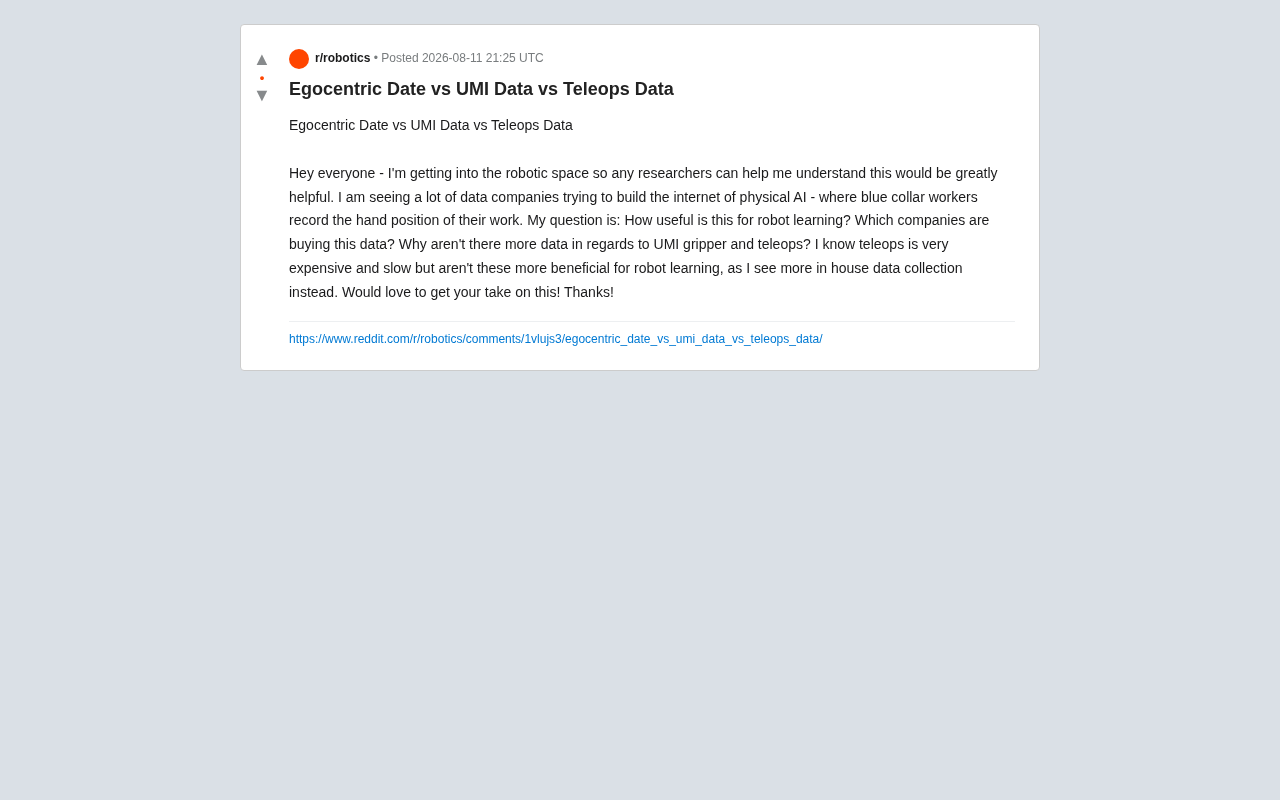
Recently, a developer new to the robotics field posed a highly representative question on Reddit: Given the constant emergence of "Physical AI Internet" data companies, which data collection method is most valuable for robot learning?
This question touches on one of the most central debates in robot learning today. The three mainstream data collection paradigms — Egocentric Data, UMI Data, and Teleoperation Data (Teleops Data) — each have their own strengths and weaknesses, and each faces unique challenges in scaling. This article will break down the fundamental differences and application value of each approach.
The Fundamental Differences Between the Three Data Collection Paradigms
Egocentric Data
Egocentric data refers to visual and hand motion information recorded by cameras worn on a person (typically on the head or chest), capturing blue-collar workers' hand movements in real work scenarios. This is exactly the mode the original poster described as "blue-collar workers recording their hand positions while they work."
The greatest advantage of this approach is its extremely low cost to scale. Workers simply wear the device during their daily tasks without changing their workflow, generating massive amounts of real operational data. Projects like Meta's Ego4D and Project Aria are accumulating this type of data. However, its fatal weakness is equally obvious: the enormous "embodiment gap" between the collected motions and the robot's physical form.
The embodiment gap is a core concept in robot learning, referring to the transfer difficulty caused by differences between the body morphology used during data collection (e.g., human hands) and the body morphology of the data consumer (e.g., a robot gripper). This problem is particularly challenging because it involves not only kinematic mapping (e.g., different degrees of freedom) but also dynamics (different ways of perceiving and applying forces) and perception (different viewpoint heights and fields of view). The academic community is currently attempting to narrow this gap through methods such as Domain Randomization, Motion Retargeting, and representation learning, but no single approach has fully solved the problem. The human hand has five dexterous fingers with 27 degrees of freedom, while a robot may have only a single-degree-of-freedom two-finger gripper — making direct mapping of human actions to robot actuators extremely difficult.
UMI Data
UMI (Universal Manipulation Interface) is an ingenious compromise proposed by Jiajun Wu's team at Stanford University in early 2024. It uses a handheld gripper device, allowing humans to directly hold a tool that matches the morphology of the robot's end effector to complete tasks, while simultaneously recording visual and motion data.
Specifically, the UMI device consists of a 3D-printed parallel gripper handle, a GoPro camera, and IMU sensors, with a total cost of under $200. When operators use the UMI gripper to complete tasks like folding clothes or pouring water, the system reconstructs the gripper's 6DoF (six degrees of freedom) trajectory using SLAM (Simultaneous Localization and Mapping) algorithms. Because the same type of end effector is used for both collection and deployment, trained policies can be transferred zero-shot to mainstream robotic arms like Franka.
The core value of UMI lies in the fact that it inherently narrows the embodiment gap — the gripper used during collection is isomorphic to the gripper the robot actually uses, so data can be more directly transferred to robot policy learning. Compared to egocentric data, UMI data has higher "usability"; compared to teleoperation, its collection cost is much lower, requiring no real robot to be present. This approach has attracted widespread attention because it reduces the "cost per hour of data collection" from hundreds of dollars for teleoperation to nearly zero, while maintaining relatively high data usability.
Teleoperation Data (Teleops Data)
Teleoperation data is currently the most widely recognized "highest quality" category of robot training data. Operators use handles, VR devices, or leader-follower robotic arms to control a real robot in real-time to complete tasks, with the robot's onboard sensors directly recording actions and states.
Teleoperation has a long history in robotics, spanning from remote operations in nuclear power plants to the da Vinci surgical robot. In the current robot learning context, teleoperation mainly follows three technical approaches: (1) Leader-follower robotic arms, such as the ALOHA system using two paired robotic arms where the operator directly moves the leader arm while the follower arm replicates the motion in real-time; (2) VR controller-based control, such as Open Teach using Meta Quest controllers mapped to the robot's joint space; (3) Glove/exoskeleton-based systems, such as using data gloves to control dexterous hands. Tesla's Optimus project reportedly employs hundreds of teleoperation operators working in 24-hour shifts to collect training data for its humanoid robot, with per-robot data collection costs potentially reaching hundreds of dollars per hour.
As the original poster pointed out, teleoperation is "very expensive and slow." It requires real robot hardware, dedicated operating spaces, and skilled operators, resulting in extremely low collection efficiency. But its payoff is also the most direct: the collected motion data represents the robot's actual movements, with virtually no transfer loss. This is why many leading companies (such as Tesla Optimus, Figure, Physical Intelligence, etc.) are heavily investing in building their own teleoperation data pipelines.
The Core Tension in Data Value: The Trade-off Between Scale and Fidelity
The original poster's confusion actually points to a fundamental trade-off in robot learning: the contradiction between data scale and data fidelity.
The three types of data can be understood along a continuous spectrum:
| Data Type | Collection Cost | Collection Scale | Alignment with Robot |
|---|---|---|---|
| Egocentric Data | Very Low | Very Large | Low |
| UMI Data | Medium | Medium | Medium-High |
| Teleops Data | Very High | Relatively Small | Very High |
Why does the poster "not see more UMI and teleops data"? The answer lies precisely in the cost structure. Egocentric data can be scaled at low cost through crowdsourcing, so data companies are more willing to bet on this route, trying to "trade scale for quality" — wagering that future algorithms will be able to bridge the embodiment gap. While UMI and teleoperation data are higher quality, they cannot experience the explosive growth seen with internet text.
There's a deeper analogy here: in NLP, text data on the internet is essentially "free," enabling models like GPT to pretrain on trillions of tokens. But by some estimates, all publicly available robot manipulation data worldwide amounts to fewer than 1 million trajectories — a gap of several orders of magnitude compared to language model training data. This data scarcity is exactly the market gap that various data companies are trying to fill, and it explains why the "low-cost, large-scale" approach of egocentric data is so tempting.
Who Is Buying This Robot Training Data?
Regarding the question of "which companies are buying data," the current market exhibits two distinctly different strategies:
The Build-Your-Own Pipeline Camp: Robot hardware companies represented by Tesla, Figure, and Physical Intelligence tend to build their own teleoperation teams to collect high-quality data. For them, the tight coupling between data and their proprietary robot hardware is a core competitive advantage — externally purchased generic data is difficult to directly reuse. This also explains the poster's observation that "it's more internal data collection."
The Data Supplier Camp: A wave of emerging data companies is attempting to become the "data layer for Physical AI," building universal datasets through crowdsourced egocentric data and selling them to research institutions and startups that lack the capability to build their own. These companies are betting on the foundation model paradigm — pretraining on massive weakly-labeled data first, then fine-tuning with a small amount of high-quality data. This paradigm draws on successful experience from NLP: the GPT series of models first pretrain at scale on internet text to acquire general language capabilities, then fine-tune with small amounts of instruction data for specific tasks. In robotics, models like RT-2 (Google DeepMind), Octo (UC Berkeley), and π0 (Physical Intelligence) are validating this approach, attempting to learn general manipulation policies from diverse robot data.
Practical Advice for Newcomers
For developers just entering this field, understanding the positioning of these three data types is more important than debating "which one is best." The realistic technology trend is layered hybrid usage:
- Use massive egocentric data to learn visual representations and task semantics;
- Use UMI data to achieve action-level alignment at low cost;
- Use a small amount of high-fidelity teleoperation data for final policy fine-tuning.
This layered architecture closely mirrors the training pipeline of current large models: the pretraining phase uses large volumes of low-quality data to establish general capabilities, the supervised fine-tuning phase uses moderate-scale labeled data to align with task objectives, and finally, methods like RLHF use small amounts of high-quality feedback for refinement. In robotics, egocentric data corresponds to pretraining corpora, UMI data corresponds to supervised fine-tuning data, and teleoperation data corresponds to high-quality human feedback.
The "high value" of egocentric data is a bet that hasn't been fully validated yet — it depends on whether algorithms can effectively bridge the embodiment gap. Meanwhile, UMI and teleoperation data, though scarce, represent the most solid "deployment-ready data" available today.
In other words, there is no absolute winner — only the optimal combination under given cost constraints. This is also one of the most fascinating and still-evolving research directions in robot learning today.
Key Takeaways
Related articles

Why Does the Tesla Roadster Need to Fly? A Deep Dive into Musk's Wild Demo
Tesla's Roadster launch showed wall-climbing, upside-down driving, and flying stunts—but The Vergecast notes the demo car may lack a battery, the Rocket version is invite-only and not street-legal, and the website terms don't guarantee delivery. After nine years of delays, why does this car still need to exist?

AI Is Not a Replacement: Human-AI Collaboration Through the Lens of Factory Root Cause Analysis
Starting from factory root cause analysis, this article explains how AI accelerates evidence chain construction rather than replacing human experts, exploring the pragmatic implementation logic and business value of 'AI supporting people rather than replacing them.'

AI Agent Decision Auditing: Building an Evidence Chain in Regulated Workflows
Starting from a Reddit discussion, this article analyzes three core issues in AI agent decision auditing within regulated workflows: what fields audit records should contain, how to handle feedback latency for erroneous decisions, and how to continuously calibrate LLM judge consistency with human judgment.