Robot Perception Failures and Training Data: Real-World Team Challenges
Perception failures and long-tail data are core bottlenecks in robot deployment; a hybrid data strategy is the pragmatic path forward.
This article centers on a robotics engineer's Reddit question, discussing how robot teams handle perception failures, edge cases, and training data supply. Perception failures surface in concentrated bursts in real environments and are hard to reproduce—an engineering bottleneck that determines whether robots can ship. The root cause is the long-tail distribution of edge cases: rare samples are scarce yet critical, making real data collection slow and costly. The article analyzes the pros and cons of external datasets (domain shift and licensing costs) and synthetic data (simulation fidelity and the sim-to-real gap), arguing that the pragmatic path is a hybrid strategy with real data as the backbone and synthetic data for targeted gap-filling. It also notes that failure handling requires a cross-role data flywheel, and for smaller teams, purchasing and synthesis essentially convert fixed costs into variable costs.
Perception Failures: The Number One Roadblock to Robot Deployment
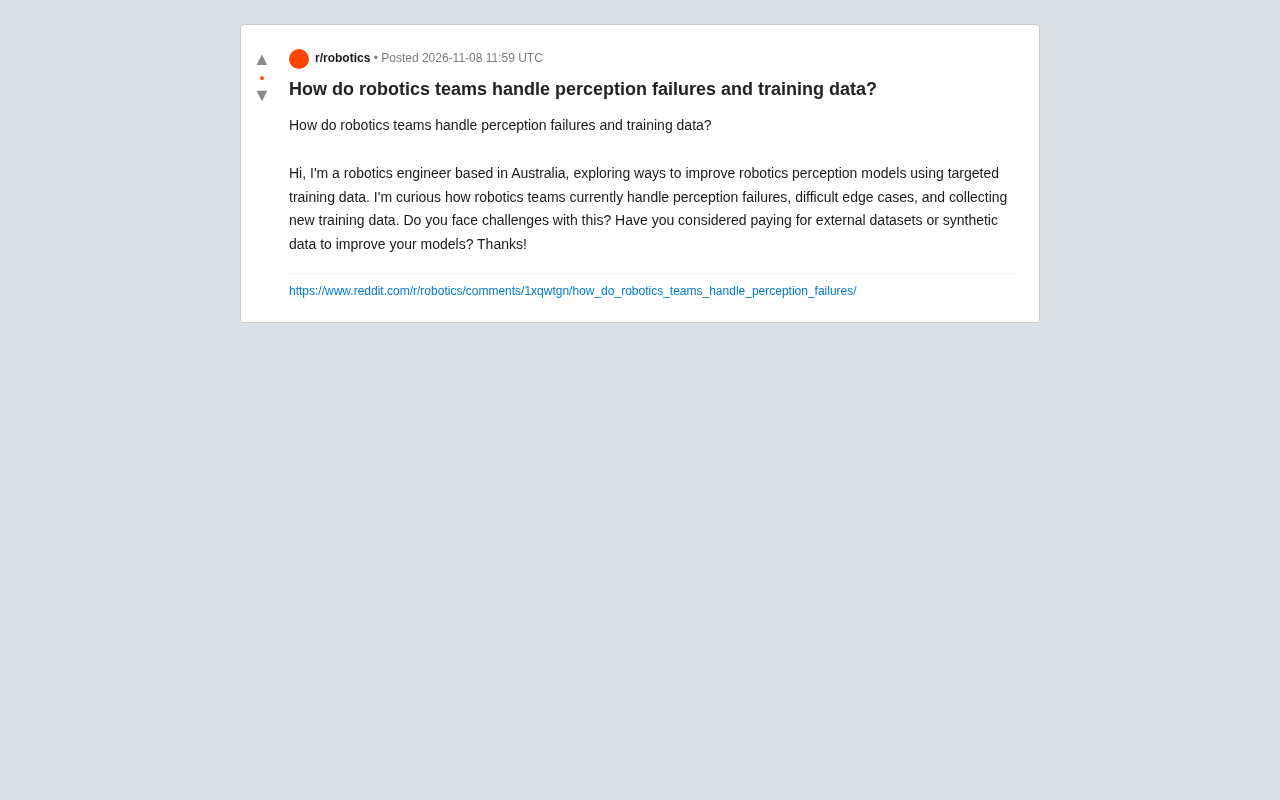
An Australian robotics engineer posted on Reddit with a question that resonated with many peers: how are robotics teams currently handling perception failures, tricky edge cases, and how do they collect new training data? He also asked whether teams have considered purchasing external datasets or synthetic data to improve their models.
This question drew attention because perception failures are often not academic problems confined to the lab, but engineering bottlenecks that directly determine whether a robot can actually go into production. Vision models perform impressively on standard benchmarks, but once they enter real environments—sudden lighting changes, occlusions, reflective surfaces, rare objects—failures surface in concentrated bursts.
What's more challenging is that perception failures are often difficult to reproduce. Change the angle or the weather in the same scene, and the model's behavior can be completely different. This makes it costly for teams to both diagnose problems and validate fixes.
Domain Shift is a key concept for understanding perception failures. It refers to the phenomenon where features a model learns on the training data distribution (source domain) no longer hold in the deployment environment (target domain). In robotics scenarios, domain shift can stem from lighting conditions, camera models, background textures, object materials, and even seasonal changes. Domain shift differs from ordinary overfitting: the model performs well on both training and standard test sets, but performance drops sharply once it crosses domains. The industry typically uses Domain Adaptation or Domain Randomization to mitigate this—the former attempts to make the model learn domain-invariant features, while the latter proactively introduces diverse appearance variations during training to make the model insensitive to domain differences. Understanding domain shift helps assess the true cost of external dataset and synthetic data solutions—they are essentially both attempts to narrow the gap between source and target domains.
Edge Cases: The "Long-Tail Hell" of Data Collection
The "difficult edge cases" mentioned in the post point to the core contradiction in robot perception: long-tail distribution. Data for common scenarios is easy to obtain, but what actually causes model failures are precisely those low-frequency yet critical edge cases.
The common practice among engineering teams is to establish a failure case feedback loop—sending field failure data back, labeling it, and retraining. But this pipeline has obvious friction: field data often involves privacy and compliance concerns, labeling is expensive, and failure samples themselves are scarce, leading to lengthy collection cycles.
This is also why the poster is interested in external datasets and synthetic data. Purchasing ready-made datasets can quickly supplement diversity, but domain shift issues are prominent; synthetic data can generate large volumes of edge cases at low cost, but the "sim-to-real" gap still requires additional handling. Neither solution is a free lunch.
Long-tail Distribution originates from statistics and describes a distribution pattern where a small number of categories account for the vast majority of samples, while a large number of categories each have very few samples. In robot perception, everyday scenarios (hallways, desktops, common pedestrians) form the head of the distribution, while rare but dangerous situations (a person lying on the ground, transparent containers, reflective metal parts, unusual postures) form a long tail. The engineering challenge of long-tail distributions is that: tail samples, though scarce, often correspond to the highest safety risks; and with random sampling by frequency, the model can barely learn these categories. Common countermeasures include resampling, class-weighted loss, and active learning—letting the model proactively identify high-uncertainty samples for human labeling. Long-tail distribution also explains why simply scaling up data volume yields limited results: without targeted coverage of the tail, most new data still falls in the head.
External Data and Synthetic Data: Filling Gaps or Digging New Ones?
Industry attitudes are not unified on whether to pay for external datasets. Supporters argue that rather than spending months collecting long-tail data, teams should purchase mature datasets directly and focus their energy on model architecture and system integration. Opponents worry about data licensing, scenario mismatches, and the hidden costs of distribution inconsistency between vendor data and their own hardware.
Synthetic data is generating more buzz. Using simulation environments to batch-generate extreme lighting, occlusion, and rare object scenarios can expand training sets in a short time. But the value of synthetic data depends heavily on simulator fidelity—rendering errors will be learned verbatim by the model, ultimately creating new failure modes in reality.
The more pragmatic path is a hybrid strategy: use real data as the backbone, use synthetic data to fill in known failure categories in a targeted manner, and then validate transfer effectiveness through small-scale real-world testing. The poster's question is essentially asking: does this hybrid approach work in real teams?
Sim-to-Real Gap refers to the performance drop that occurs when policies or perception models trained in simulation environments are transferred to the real world. Its sources include physical approximations in renderers (inaccurate modeling of lighting, material reflections, sensor noise), real-world randomness missing from simulation, and differences in geometry and texture between simulated assets and real objects. To narrow the gap, common techniques include domain randomization (randomizing lighting, textures, and camera parameters in simulation), system identification (calibrating simulation parameters with real data), and mixed training with both simulated and real data. It should be emphasized that the "fidelity" of synthetic data is not about being as high as possible, but about matching task requirements: for geometric perception tasks, shape accuracy matters more than photorealistic rendering; for semantic segmentation, texture diversity may be more critical.
Team Collaboration and Process: Handling Failures Is Not Just an Algorithm Problem
Addressing perception failures often goes beyond the isolated responsibilities of the algorithm team. A closed loop needs to be formed among field operations, data labeling, and model iteration—otherwise failure data will scatter everywhere and cannot be converted into training assets.
Some teams establish dedicated data operations roles responsible for collecting, categorizing, and prioritizing failure cases. Others embed failure monitoring into the deployment pipeline, continuously exposing the model to problems in production. What these approaches share is the recognition that perception failures are the norm, not occasional malfunctions.
For small and medium-sized teams, resource constraints make a complete closed loop difficult to build, which explains why external datasets and synthetic data solutions are attractive—they essentially convert the fixed costs of data collection into variable costs.
Data Flywheel is the systematized expression of how robotics teams convert field failures into model improvements. A complete loop typically includes: online failure detection and triggering, data feedback and anonymization, labeling and categorization, prioritization, retraining and regression validation, and post-deployment performance monitoring. The difficulty lies not in any single technology but in the latency and cost of the pipeline—the longer the cycle from failure occurrence to model fix deployment, the lower the value of the loop. Mature teams use automation tools to shorten each link, such as using uncertainty estimation to automatically screen samples worth labeling, and using continuous integration pipelines to automatically run regression tests. For resource-limited teams, the loop need not be complete—they can start with the highest-frequency, highest-risk failure categories and gradually expand coverage.
Open Questions and Industry Status
The poster did not provide specific answers but solicited experiences from the community, which itself reflects the current state of robot perception data: many methods exist, but there is a lack of universal best practices. Different teams make their own choices based on scenarios, budgets, and compliance requirements.
What is certain is that perception failure handling and training data supply have become one of the core competencies of robotics engineering. Whoever can more efficiently convert failures into data and data into model improvements will cross the gap from demo to product faster.
Related articles
 Tech Frontiers
Edge AI on Microcontrollers: When Is It Actually Worth Deploying?
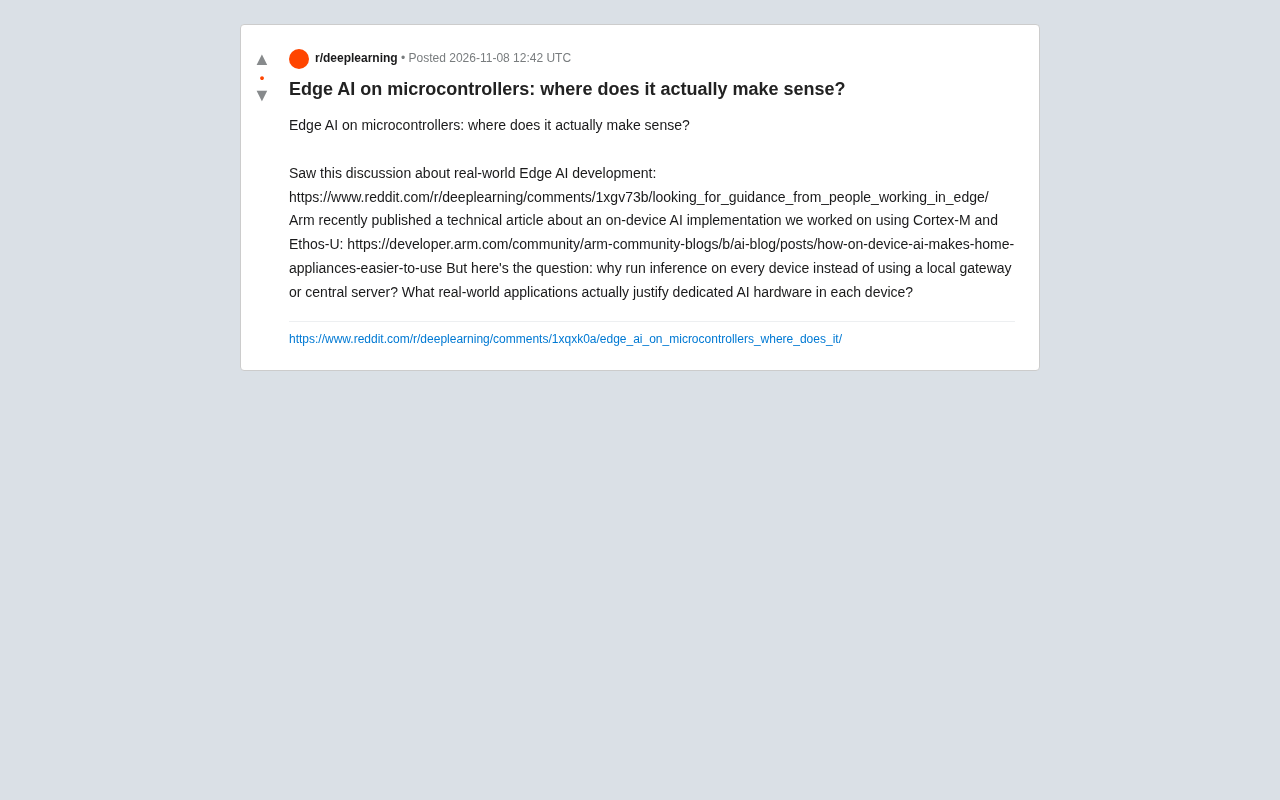
Drawing on Reddit discussions and Arm case studies, this article analyzes the real-world use cases for edge AI on microcontrollers: when each device needs independent inference, when a gateway or cloud is more reasonable, and the costs and boundaries of specialized hardware.
 Tech Frontiers
Pushing the Limits of Extreme Sudoku on a 16GB GPU: Insights from Depth and Flow Matching
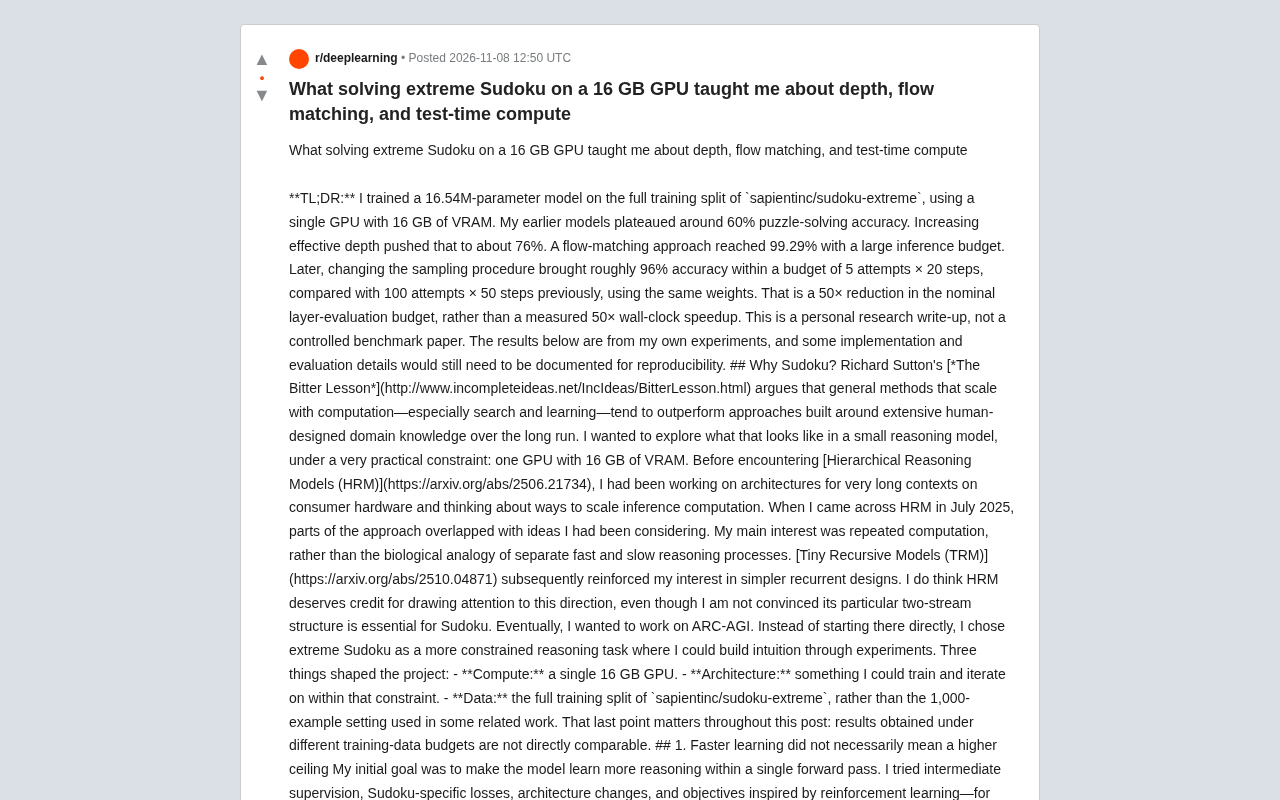
A researcher trained a 16.54M-parameter model on a 16GB GPU to solve extreme Sudoku, finding effective depth breaks the 60% plateau and flow matching with improved sampling pushes accuracy past 99% with ~50× lower layer-evaluation budget.
 Tech Frontiers
AI Agent Approval Workflows: Why Human Confirmations Always Get Mindlessly Clicked
Why do AI agent approval workflows always get mindlessly clicked? A Reddit discussion shows that separating rules from keys, low-frequency high-risk approvals, and GitHub Environments-style gates are the keys to effective approvals.