Robotics PhD Seeks Online Collaboration: Navigation Control and Underwater Robotics Experience

A robotics PhD student in Madrid seeks side project collaboration, offering technology and writing in exchange for co-authorship.
A fourth-year PhD student in Robotics and Automation in Madrid posted on Reddit seeking side project collaboration related to his technical stack, hoping to divert mental fatigue from doctoral research and gain co-publication opportunities. His core competencies center on guidance and control of autonomous aerial vehicles and underwater robotics. The two fields share underlying theories such as dynamics modeling, state estimation, and robust control, and his experience can be transferred to simulation and control algorithm tasks related to drones and underwater robots. The article analyzes the value and risks of cross-institutional collaboration, pointing out that intellectual property, data confidentiality, and author ordering need to be agreed upon in writing in advance, and emphasizes the offline communication advantage brought by his location in Madrid.
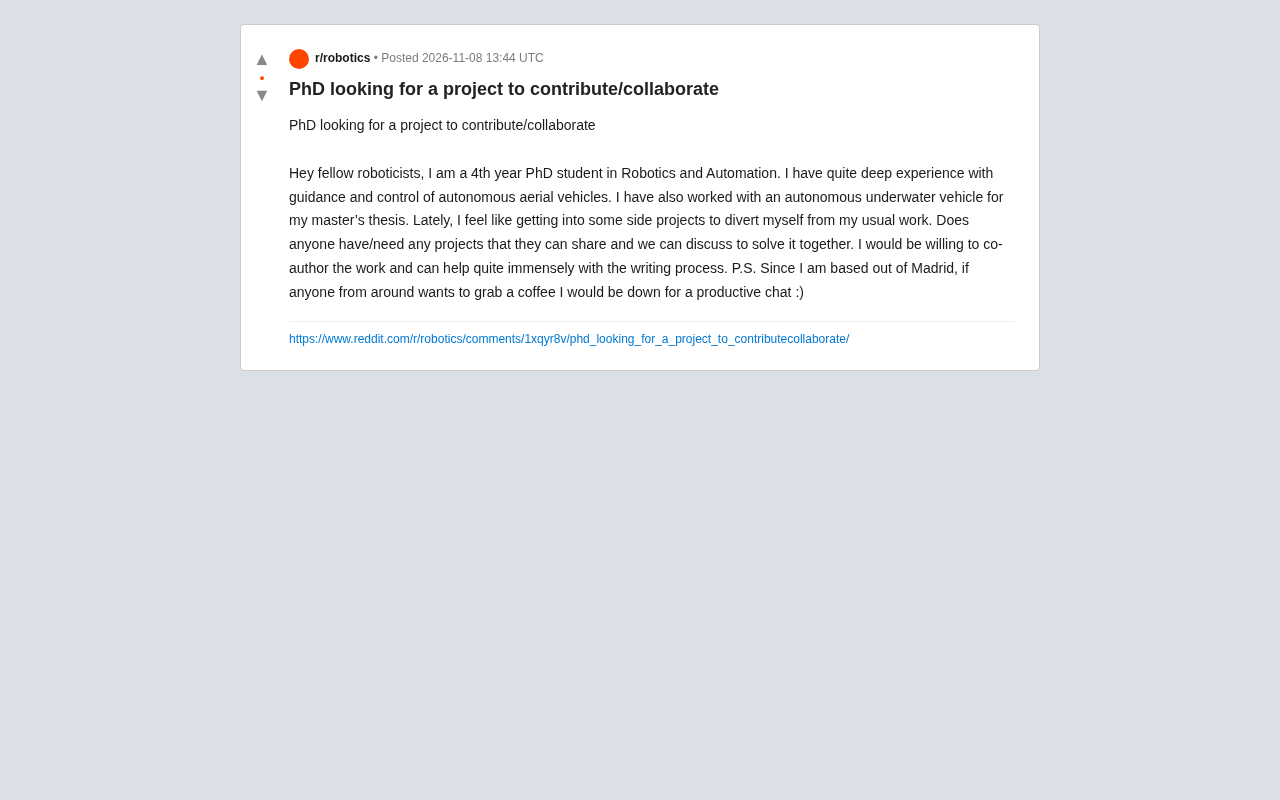
A fourth-year PhD student in Robotics and Automation from Madrid has posted on Reddit looking for side project collaborations, hoping to contribute his experience in autonomous aerial vehicle navigation control and underwater robotics, and is willing to co-author papers. This seemingly simple help-wanted post reflects several practical needs for cross-institutional collaboration in academia.
Typical Motivations for Academic Side Projects
The PhD student explicitly states that he is looking for side projects to "distract himself from daily work." Doctoral research often focuses on a narrow direction, and long-term deep engagement can easily lead to mental fatigue. Participating in a project related to one's technical stack but with a different application scenario can both maintain professional sensitivity and bring freshness.
Another motivation is collaborative publication. He is willing to co-author and emphasizes that he can provide "considerable help" during the writing process. For many researchers with engineering backgrounds, paper writing is a weak point, and this PhD student's proactive offer hits exactly that pain point. This "technology for writing" collaboration model is not uncommon in interdisciplinary projects.
Matching Scenarios for His Technical Background
This PhD student's core competencies center on guidance and control of autonomous aerial vehicles, and his master's thesis involved autonomous underwater vehicles. These two fields share many underlying theories, such as dynamics modeling, state estimation, and robust control, but their application environments differ greatly—air vs. underwater, with different communication constraints, sensor configurations, and failure modes.
For project owners seeking collaboration, this means he can quickly get up to speed on simulation or control algorithm tasks related to drones and underwater robots. If the project involves multi-agent coordination, trajectory planning, or nonlinear control, his experience can be directly transferred. According to the post, his experience is "quite in-depth," but no specific achievements or publication records are disclosed, so further understanding may be needed before collaboration.
Guidance, Navigation and Control (GNC) is the core subsystem of autonomous aerial vehicle systems, typically divided into three layers: guidance is responsible for generating reference trajectories or heading commands, navigation estimates position, attitude, and velocity through sensor fusion, and control calculates actuator commands based on state errors to track the desired trajectory. The three form a closed loop, and modeling errors in any link will affect overall performance. Underwater vehicles and aerial vehicles are highly similar in GNC architecture, but the underwater environment cannot use GPS and typically relies on a combination of inertial navigation, Doppler velocity logs, and acoustic positioning, with extremely low communication bandwidth, which makes control strategies emphasize autonomy and robustness. This characteristic of "same architecture, different constraints" is precisely the technical foundation that allows this PhD student's experience to be transferred across domains.
State estimation and robust control are key methods shared by the above two fields. State estimation addresses the question of "what state the system is currently in," commonly using Kalman filters and their nonlinear variants (such as extended Kalman filters and unscented Kalman filters) to fuse multi-sensor data; robust control deals with stability under model uncertainty and external disturbances, with common methods including H∞ control and sliding mode control. For multi-agent coordination or trajectory planning tasks, these methods are often invoked as underlying modules, so researchers with relevant experience can quickly understand and modify existing code frameworks without building a control stack from scratch.
Potential Value and Risks of Cross-Institutional Collaboration
From the project owner's perspective, the benefits of bringing in an external PhD student are obvious: free high-level technical labor, an additional paper author, and possible inter-institutional connections. But risks also exist—intellectual property ownership, data confidentiality, and uncertainty of time commitment are all boundaries that need to be clarified in advance.
This PhD student mentions that he is "willing to co-author," but does not discuss contribution division. In actual collaboration, author order and contribution statements are often harder to coordinate than technical issues. It is recommended that both parties agree in writing on expected outputs and author ordering rules before the project starts.
Contributorship in cross-institutional collaboration is typically declared according to frameworks such as CRediT (Contributor Roles Taxonomy), which breaks down contributions into multiple roles such as conceptualization, methodology, software, validation, and writing, rather than being reflected only by author order. Even so, author order still carries practical weight in academic evaluation, and the meaning of first author and corresponding author varies by discipline. In robotics and engineering, the first author usually corresponds to the main executor, and the corresponding author to the project leader. Clarifying "who does what and who ranks where" before collaboration and keeping written records can significantly reduce the probability of later disputes.
Regional Advantage and the Value of Offline Communication
At the end of the post, he mentions that he is located in Madrid and is willing to meet nearby people for coffee. Today, with highly mature remote collaboration tools, offline communication still has irreplaceable value—especially for requirement alignment and trust building in the early stages of a project. For robotics researchers in Europe, this is a low-cost opportunity to establish connections.
If you happen to have a side project related to aerial or underwater robotics and need control algorithm support or paper writing assistance, this post is worth checking out. When reaching out, it is recommended to directly state the project goals, required skills, and expected time commitment so that match can be quickly assessed.
One-line Summary
A robotics PhD student in Madrid posts seeking side project collaboration, offering technology and writing in exchange for co-authorship.
Paragraph Summary
A fourth-year PhD student in Robotics and Automation in Madrid posted on Reddit seeking side project collaboration related to his technical stack, hoping to divert mental fatigue from doctoral research and gain co-publication opportunities. His core competencies center on guidance and control of autonomous aerial vehicles and underwater robotics. The two fields share underlying theories such as dynamics modeling, state estimation, and robust control, and his experience can be transferred to simulation and control algorithm tasks related to drones and underwater robots. The article analyzes the value and risks of cross-institutional collaboration, pointing out that intellectual property, data confidentiality, and author ordering need to be agreed upon in writing in advance, and emphasizes the offline communication advantage brought by his location in Madrid.
Related articles

Hermes Agent Beginner's Guide: Hands-On with a Self-Evolving AI Agent
A beginner's guide to Hermes Agent, the open-source self-evolving AI agent that gained 41.7K GitHub stars in two months—covering Harness Engineering, the learning loop, three-layer memory, WSL installation, and hands-on configuration.

AI Agent in Action: Building a Smart Office Assistant with WorkBuddy
A practical case study shows how Tencent WorkBuddy batch-converts and archives files, compares chat LLMs with AI Agents, and analyzes WorkBuddy's credit system, use cases, and positioning for office automation selection.

From Single-GPU Bottlenecks to Hundreds of Billions of Parameters: 6 Key Questions in Large Model Distributed Parallelism
Based on a Bilibili tutorial, this article organizes core knowledge of large model distributed parallelism: starting from decoder-only architecture's token-by-token generation and the essence of X times W computation, it analyzes six key questions including data parallelism, tensor parallelism, and pipeline parallelism under single-GPU bottlenecks. Suitable for learners in private deployment and model training scenarios to build systematic understanding.