Robynn AI: Automated Website Repair and SEO Optimization Through Self-Learning Agents

Robynn AI uses self-learning agents to automatically detect, fix, and optimize website decay issues.
Robynn AI tackles the often-overlooked problem of website decay — broken links, outdated content, and declining search rankings that begin the moment a site goes live. Through intelligent multi-dimensional auditing, natural language-driven editing with human-in-the-loop approval, and a reinforcement learning-inspired feedback system that reinforces winning changes and rolls back regressions, Robynn transforms website maintenance from a reactive project into a continuously self-healing process.
The Overlooked Operations Dilemma: Websites Start Decaying the Moment They Go Live
Many teams breathe a sigh of relief the moment their website goes live, as if the job is done. But from the Robynn AI team's perspective, a website's real problems begin precisely on launch day.
As their Product Hunt introduction states: "Your website starts decaying from the day it's published." Broken links, outdated pages, gradually declining search rankings, and becoming "invisible" to AI search tools like ChatGPT — these issues accumulate over time, ultimately eroding a website's business value.
This isn't alarmist rhetoric. According to research from SEO platforms like Ahrefs, approximately 66.5% of pages on the internet have zero external backlinks, and among web pages that have been live for more than 2 years, about 25% develop at least one dead link. This decay manifests not only at the technical level (404 errors, expired SSL certificates, degraded loading speeds) but also in the continuous decline of content relevance — search engine algorithms update hundreds of times per year, user search intent constantly evolves, and competitors continuously produce new content. Even if a page has no errors, simply "not updating" is enough to cause ranking declines.
It's worth understanding that Google and other search engines use "Content Freshness" as one of their ranking factors, originating from their 2011 Freshness Update. This algorithm determines based on query type whether users need the latest information — for news and trending queries, fresh content receives significant weighting. For "evergreen" content, while freshness carries less weight, if competitors continuously update content on the same topic and earn better user engagement signals (longer dwell time, lower bounce rates), older pages will gradually be pushed out of rankings. HubSpot research shows that updating old blog posts leads to an average 106% increase in organic traffic. This means "content decay" isn't a metaphor but an objective phenomenon that can be precisely mapped with traffic curves — most pages reach peak traffic 3-6 months after publication, and without updates, traffic naturally declines at a rate of 3%-5% per month.
This is a real but often underestimated pain point. Traditional website operations rely on manual periodic reviews, or simply wait until traffic noticeably drops before responding reactively. For small and medium-sized teams, this delayed maintenance approach often means long-term losses in traffic and conversions. Robynn AI aims to fill this gap with self-learning agents.
Robynn's Core Logic: A Closed Loop of Audit, Repair, and Verification
A Non-Disruptive Integration Approach
Robynn's most noteworthy product decision is that it "connects to your live site" rather than requiring users to rebuild or migrate. This dramatically lowers the barrier to adoption — for websites that have been running for years with substantial accumulated content, rebuilding is costly and risky, making a "zero migration" promise far more attractive.
From a technical implementation perspective, this "connect to your existing site" approach typically takes several paths: gaining content read/write access through CMS plugins (like WordPress plugins), intercepting and modifying page output through a reverse proxy layer, or interacting directly with the website's backend system via API. Each approach has its applicable scenarios and security boundaries. For websites built on mainstream platforms like WordPress, Webflow, or Shopify, plugin/integration approaches are most mature; for custom-built systems, API integration requires more technical coordination. Robynn's choice of this "non-invasive" integration path is essentially a critical tradeoff in product growth strategy — sacrificing deep control over the underlying architecture in exchange for lower customer acquisition friction.
Multi-Dimensional Intelligent Auditing
After integration, Robynn performs intelligent audits on each page. The evaluation criteria aren't a single set of technical metrics but revolve around three dimensions:
- Brand voice — ensuring consistent content style
- ICP (Ideal Customer Profile) — evaluating whether content precisely reaches the target audience
- Competitor performance — benchmarking against industry competitors to find optimization opportunities
Among these, ICP (Ideal Customer Profile) is a core concept in B2B marketing. Unlike the "user persona" commonly used in B2C, ICP typically describes company-level characteristics — including industry, company size, annual revenue, tech stack, organizational structure, and purchasing decision chains. A precise ICP helps marketing teams determine which content will resonate with target decision-makers. In practice, ICP construction typically relies on analyzing existing best customers — using CRM data to identify customer segments with the shortest sales cycles, highest renewal rates, and greatest LTV (Customer Lifetime Value), then generalizing their common characteristics. For example, an enterprise SaaS company's ICP might be "B2B manufacturing companies with $50M-$500M annual revenue, 200-2000 employees, already using Salesforce CRM, with IT departments that have independent budget approval authority." When ICP is precisely defined, content teams can accordingly adjust industry terminology choices, pain point description depth, case study references, and even page CTA (Call-to-Action) wording. Robynn's inclusion of ICP in its audit dimensions means it doesn't just check page technical health — it also evaluates whether content precisely matches target buyers' cognitive frameworks in terms of language style, pain point descriptions, and value propositions. This is a marketing strategy layer that traditional SEO tools rarely touch.
This audit logic breaks free from the traditional SEO tool framework of "only looking at keyword density and technical tags," instead evaluating content quality from a marketing strategy perspective. Its repair recommendations are "evidence-backed," theoretically avoiding negative effects from blind optimization.
Natural Language-Driven Editing
At the execution level, Robynn adopts today's popular interaction paradigm: users can point to any element on a page and describe desired changes in natural language. The agent stages changes first, and only after user approval does Robynn publish them live.
This "Human-in-the-Loop" (HITL) design is an important paradigm in AI system design, referring to maintaining human decision nodes within automated workflows to ensure AI outputs pass through manual review before execution at critical junctures. This design originates from "human-machine collaboration" concepts in aerospace and military fields, and has been widely adopted in recent years across AI content generation, autonomous driving, medical diagnosis, and other domains. In the website operations scenario, every content change on a brand's official site can potentially affect brand image and legal compliance, making fully automated changes carry uncontrollable risks.
Specifically, HITL in AI products typically has three implementation levels: the first is "AI suggests, humans execute" — AI only provides recommendations while humans perform all actions; the second is "AI executes, humans approve" — AI completes the work but requires human confirmation before changes take effect; the third is "AI executes, humans monitor" — AI automatically performs most operations while humans only intervene in exceptional cases. Robynn currently employs the second level, which is the most common balance point in enterprise products. GitHub Copilot (code suggestions require developer acceptance) and Jasper AI (generated content requires editorial review before publishing) both use similar models. As user trust builds and model accuracy improves, such products typically transition gradually toward the third level — allowing users to set rules within which AI can execute autonomously, triggering manual review only when rules are exceeded.
Robynn's "staging + approval" mechanism essentially finds a balance between AI efficiency and human safety — AI handles problem discovery and solution generation, while humans retain final decision-making authority.
The Key Differentiator: Measurable, Reversible Self-Learning Mechanisms
What truly distinguishes Robynn from ordinary AI website optimization tools lies in the final link of its closed loop — performance measurement and self-evolution.
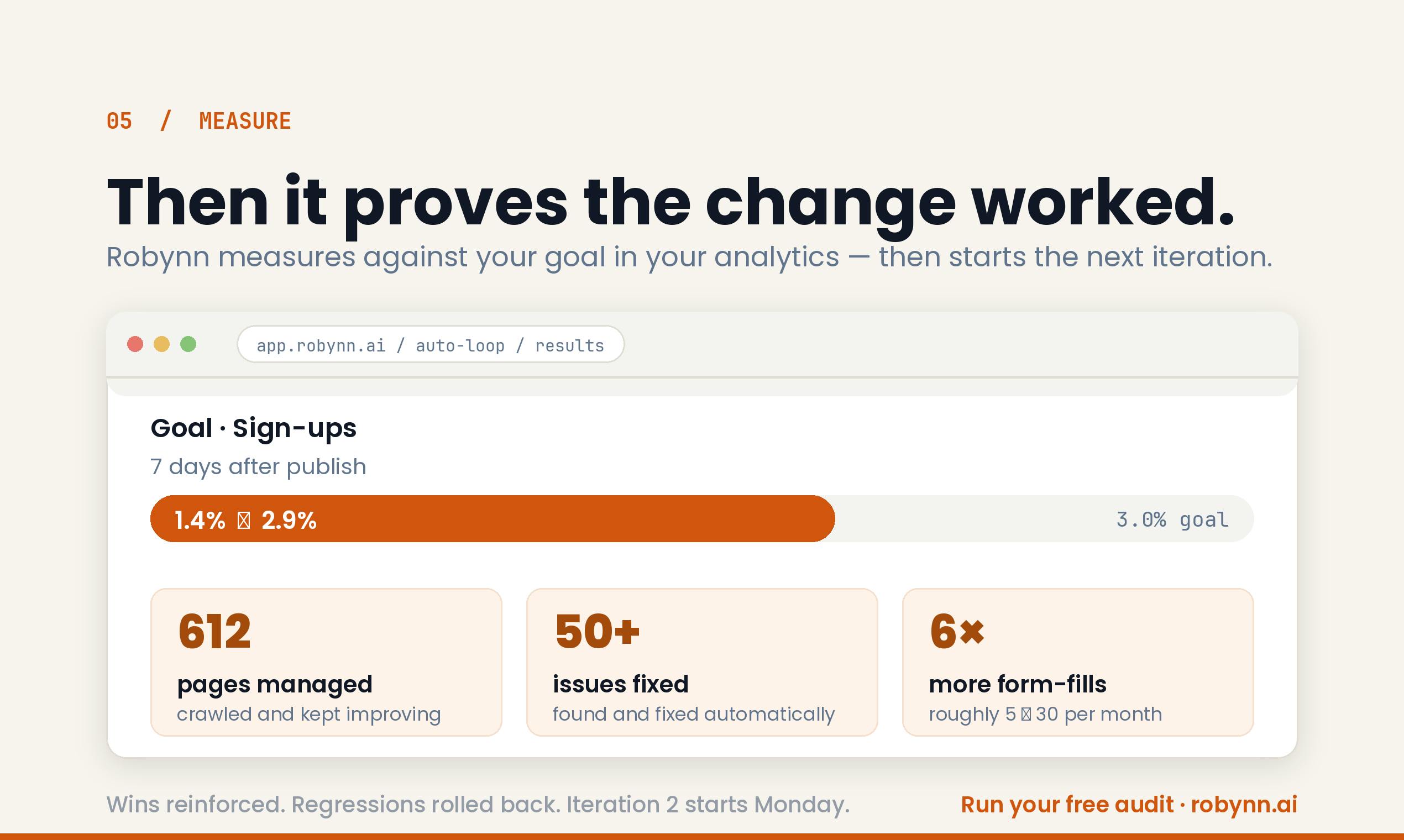
After each change is published, Robynn integrates with Google Analytics (GA) to measure actual performance changes. This embodies a simple but effective reinforcement learning approach:
- Wins get reinforced — optimization strategies verified to have positive effects are continued and amplified
- Regressions roll back — when data shows deteriorating results, the system automatically reverts changes
This mechanism aligns closely with the core principles of Reinforcement Learning (RL). In the classic RL framework, an agent interacts with its environment to receive reward signals, continuously adjusting its strategy to maximize long-term returns. Mapping this to the SEO scenario: each page modification is an "action," changes in GA metrics like traffic, bounce rate, and conversion rate are "reward signals," and the website's overall search engine performance is the long-term objective to optimize.
However, applying reinforcement learning to SEO optimization faces several unique challenges. First is the "Delayed Reward" problem — an SEO change may take days or even weeks to be re-indexed by search engines and reflected in ranking changes, making it difficult for the system to receive rapid feedback. Second is the high dimensionality and dynamism of the "State Space" — a website's "state" includes not only the page's own content and technical parameters but also the entire internet's competitive landscape, the search engine's algorithm version, user behavior patterns, and other external factors, all continuously changing. Third is the "Exploration-Exploitation" dilemma — the system must balance "exploiting known effective strategies" against "exploring new optimization directions." Excessive exploration may cause traffic volatility, while excessive exploitation may miss better solutions. These challenges mean Robynn is unlikely to use purely model-free reinforcement learning methods, and more likely combines rule-based heuristics, A/B testing statistical inference, and large language model content understanding capabilities into a hybrid optimization strategy.
Traditional A/B testing can achieve similar results, but typically requires manual experiment design, data analysis, and decision-making, with long cycles and high labor costs. Robynn's innovation lies in fully automating this cycle, dramatically increasing optimization frequency and coverage.
The significance of this mechanism is that it transforms website SEO optimization from a one-time project into a continuously self-correcting dynamic process. Theoretically, websites no longer decay over time but instead continuously "self-heal" and improve through data feedback — this is the direct embodiment of its slogan "improve and heal with self-learning."
Market Reception and Positioning Analysis
Based on Product Hunt data, Robynn AI received 300 upvotes and 60 comments, ranking #5 for the day — a solid performance. It's categorized under Marketing, SEO, and Website Builder, positioning it between marketing and website building tools.
You might not have noticed that the product specifically emphasizes visibility in AI search scenarios like ChatGPT. This touches on the hottest new concept in the SEO industry since 2024 — GEO (Generative Engine Optimization). With the proliferation of AI search products like ChatGPT, Perplexity, and Google SGE (Search Generative Experience), users' information-seeking behavior is undergoing a fundamental shift: from "clicking through ten blue links" to "directly receiving AI-generated answers." Research from institutions like Princeton University shows that websites cited in AI-generated answers gain significant traffic advantages, while uncited websites face the risk of "invisibility."
Core GEO strategies include: providing structured, authoritative content, using clear entity markup and Schema annotations, and ensuring content factual accuracy and citability. From a technical perspective, GEO differs from traditional SEO in three main ways: First, traditional SEO optimizes for "search results page rankings" while GEO optimizes for "whether your content gets selected as a reference source by AI models' RAG (Retrieval-Augmented Generation) pipeline." Second, traditional SEO emphasizes keyword matching and link authority, while GEO emphasizes content "citability" — whether content contains clear data points, explicit causal reasoning, and authoritative source citations that make AI models more inclined to cite your content when generating answers. Third, traditional SEO feedback cycles are directly observable through search rankings, while GEO effects currently lack standardized monitoring tools — brands can't accurately know how many times their content has been cited in ChatGPT or Perplexity. According to Gartner's predictions, traditional search engine traffic will decline by 25% by 2026, meaning websites that don't adapt to GEO trends may face structural traffic contraction.
This trend means traditional SEO is splitting into two tracks — optimization for traditional search engines and optimization for AI search engines. Robynn's incorporation of this trend into its audit dimensions demonstrates keen judgment about market direction.
Additionally, the "First audit is free" strategy lowers the trial barrier — it demonstrates product value at minimal user cost, allowing potential customers to see their website's problem list before paying. This "show value first, charge later" PLG (Product-Led Growth) strategy has been validated in the SaaS space by SEO tools like Ahrefs and Semrush — when users see firsthand that their website has 127 dead links, 15 duplicate page titles, and 8 key pages completely invisible in AI search, willingness to pay naturally increases dramatically.
A Clear-Eyed Assessment: Opportunities and Concerns Coexist
Despite the compelling concept, Robynn's model still has several aspects worth monitoring.
Attribution accuracy concerns. Website traffic is influenced by multiple factors including seasonality, channels, and competitor actions. Judging the "win or loss" of a specific change solely based on GA data may suffer from attribution bias. Attribution is one of the universally acknowledged challenges in digital marketing — a page's traffic change may simultaneously be affected by Google algorithm updates, seasonal search demand fluctuations, competitor content releases, social media citations, paid advertising spillover effects, and more. Accurately determining whether a specific change was "effective" requires controlling for these confounding variables.
Common industry methods include Causal Impact Analysis (a statistical method open-sourced by Google), Difference-in-Differences, and Multi-Armed Bandit approaches. Google's Causal Impact method is particularly suited for SEO scenarios — it constructs a "counterfactual" model to predict "what traffic would have been without the change," then compares actual traffic against predicted values to isolate the change's effect. But even so, when multiple changes occur simultaneously or near-simultaneously (extremely common in continuous optimization scenarios), attribution can still suffer from cross-contamination. Furthermore, the lag in SEO effects makes the problem more complex — a change might take 2 weeks to show up in search rankings, during which other changes may have occurred. Whether the claimed "reinforcement" and "rollback" are truly scientific depends on whether Robynn's underlying statistical methods are rigorous enough to distinguish "real effects" from "random fluctuations."
Trust and control concerns. Letting an AI agent directly modify and publish live content — even with an approval step — requires enterprises to have sufficient confidence in its judgment. Brands are typically extremely sensitive about their official website content, and any automated changes could cross boundaries. There's a deeper organizational behavior issue here — in most enterprises, final approval authority for website content is typically distributed across brand, legal, product, compliance, and other departments. This multi-stakeholder decision structure means that even if AI's suggestions are optimal from a marketing effectiveness standpoint, they may be rejected for not meeting a particular department's requirements. Robynn needs to solve not just technical problems but also organizational trust issues.
Competitive moat concerns. Auditing, natural language editing, and performance measurement capabilities — individually, none are impossible to replicate. Whether Robynn can build a moat depends on the experience advantage its self-learning model accumulates through real data. From a competitive landscape perspective, Surfer SEO, Clearscope, MarketMuse, and similar tools have already established user bases in the AI-assisted content optimization space, while website building platforms like Webflow and WordPress are integrating increasingly more AI features. Robynn's differentiation lies in the "end-to-end closed loop" — full-process automation from audit to execution to verification, rather than providing AI assistance for just one stage. The advantage of this full-chain product lies in the data flywheel effect: with each completed "change → verify → learn" cycle, the model's decision quality improves incrementally, and this experience advantage built on real data accumulation is difficult for latecomers to quickly replicate.
Conclusion
Robynn AI paints a compelling vision: websites are no longer static assets requiring manual maintenance, but rather "living organisms" that can sense problems, self-optimize, and continuously evolve. In an era where AI Agent technology is rapidly materializing, this type of "self-healing" website operations application represents an important direction for the industry.
From a broader perspective, Robynn represents a typical pattern of AI Agent applications — encapsulating complex workflows that previously required specialized personnel to repeatedly execute (audit → diagnose → repair → verify → iterate) into an autonomously operating intelligent system. This pattern is unfolding simultaneously across multiple domains: code maintenance (like GitHub Copilot Workspace), customer service (like Intercom Fin), and data analysis (various BI Agents). Website operations, as a highly structured, quantifiably measurable scenario with relatively generous error tolerance, may be one of the first domains where AI Agents achieve a true value closed loop.
Whether it can deliver on the promise of "automated website repair" still requires time and real user validation. But at the very least, it offers a new answer worth taking seriously for the long-overlooked website operations dilemma.
Related articles

Poison-Resistant Concept Anchoring: A New Approach to Defending Against AI Data Poisoning
Deep dive into Poison-Resistant Concept Anchoring, defending against data poisoning via signed anchors and bounded updates. Experiments show 62% poison isolation with 0% false rejection rate.

Hungarian Algorithm Explained: Principles, Complexity, and Engineering Implementation Guide
In-depth explanation of the Hungarian Algorithm: core principles, O(N³) time complexity advantages, and engineering implementation. Covers assignment problem definition, step-by-step algorithm walkthrough, Python/C++ libraries, and applications in multi-object tracking and resource scheduling.
OpenAI's First Enterprise AI Report: H…
OpenAI's First Enterprise AI Report: How ChatGPT Is Changing the Way Organizations Work
OpenAI's first enterprise AI report reveals three key traits of ChatGPT Enterprise adoption: the shift from novelty to necessity, writing and coding as top use cases, and data governance as a core prerequisite.