Routers Pre-installed with DD-WRT: A Genuine Geek Need or a False Premise?

A Hacker News post probes whether pre-installed DD-WRT routers can bridge open-source firmware and everyday usability.
A brief Hacker News post asking "Do you want a router with DD-WRT pre-installed?" surfaces a core tension in open-source networking: DD-WRT is powerful, but its high flashing barrier keeps it confined to geek circles. Pre-installation could remove that friction, opening the door for privacy-conscious users and home-lab enthusiasts. While OpenWrt-based hardware like GL.iNet has validated the model commercially, mainstream adoption remains limited by firmware maintenance costs, a small core user base, and consumer preference for brand ecosystems.
A Question from Hacker News
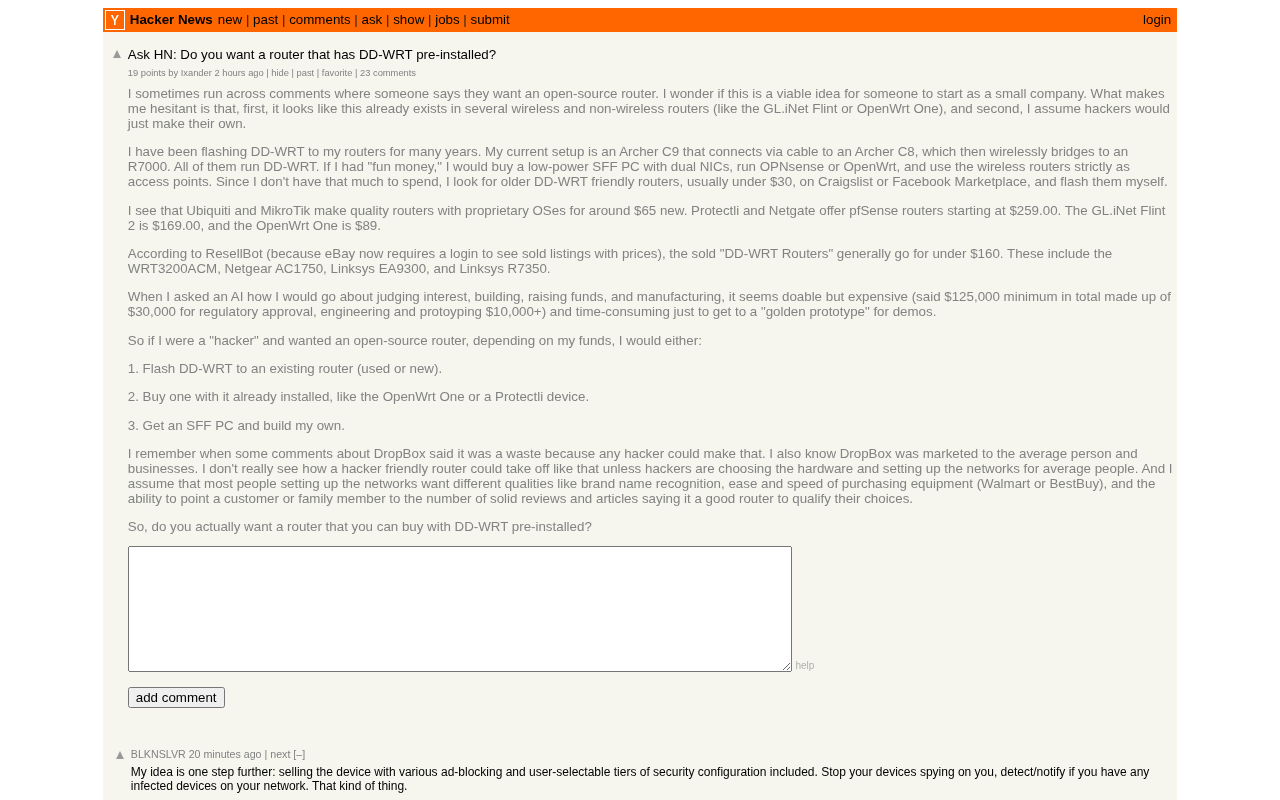
A brief but thought-provoking post recently appeared on the Hacker News community: "Do you want a router that has DD-WRT pre-installed?" (Ask HN: Do you want a router that has DD-WRT pre-installed?). The post itself contained nothing but a title and a discussion link, yet it touched on a long-standing pain point in the networking hardware space — the tension between open-source firmware availability and an out-of-the-box experience.
For those unfamiliar, DD-WRT is a Linux-based third-party router firmware that tech enthusiasts have long used to replace the closed, vendor-supplied software on their devices. It unlocks a wide range of advanced features — more granular QoS traffic shaping, a VPN server, VLAN segmentation, bandwidth monitoring, and more powerful wireless management capabilities. The catch? Flashing DD-WRT has never been a simple endeavor.
Why "Pre-installed" Is Worth Talking About
The Flashing Process Turns Most People Away
Flashing DD-WRT yourself requires precisely matching your router's hardware model with the correct firmware version. One misstep can turn your device into a brick. The entire process involves entering recovery mode, uploading firmware via TFTP, understanding bootloaders, and navigating a series of steps that are far from user-friendly. Even people with a technical background often spend considerable time combing through forums and compatibility lists.
This is exactly where the value of "pre-installed" comes in. If a manufacturer were willing to ship devices with a validated version of DD-WRT out of the box, they could remove the most dangerous and tedious steps from the user's hands — making the full power of open-source firmware genuinely accessible.
TFTP (Trivial File Transfer Protocol) is a lightweight file transfer protocol commonly used to push firmware images to a router when it enters "recovery mode." The bootloader is the low-level program that runs first when a device powers on, responsible for initializing hardware and loading the operating system. Flashing DD-WRT often requires intervening before the bootloader loads the original firmware — a very narrow window. The risk of bricking a device stems primarily from an interrupted write or a model mismatch that corrupts the bootloader. Once that happens, the device won't boot normally, and recovery requires serial port debugging or hardware-level intervention — essentially impossible for the average user.
The Real Use Cases Behind the Demand
The kind of person asking this question typically has a few specific user profiles in mind: home-lab enthusiasts who want full control over their network, small offices that need to run a private VPN, and privacy-conscious users wary of vendor firmware backdoors or abandoned update cycles. For them, an out-of-the-box open-source router means retaining the freedom to tinker — without the risk that comes with tinkering.
This Isn't Without Precedent
It's worth noting that routers pre-loaded with open-source firmware are not a new idea. Products built around OpenWrt or similar open-source systems have existed on the market for some time, and niche vendors have offered pre-flashed units for years. This confirms that the demand is real — but it has never broken into the mainstream.
There are several reasons for this. Maintaining compatibility between open-source firmware and hardware is costly, requiring vendors to continuously push security updates. Mainstream consumers tend to prefer the complete after-sales support and app ecosystems offered by major brands. And the core user base willing to pay a premium for open-source firmware is simply too small to support a scalable commercial model.
OpenWrt is one of the most actively maintained open-source router firmware projects today. Like DD-WRT, it's based on the Linux kernel, but it leans more toward a modular, extensible architecture — users can install functional components on demand via the
opkgpackage manager, making it feel more like a full embedded Linux distribution. DD-WRT, by contrast, offers a more complete, batteries-included feature set with a more approachable configuration interface, and has historically enjoyed broader name recognition among home router enthusiasts. Notably, brands like GL.iNet have already commercially validated the model of selling hardware pre-loaded with OpenWrt-derived firmware. Their products target developers and privacy-focused users, and they offer full hardware warranties and firmware update support — making them the closest real-world example of a mainstream "out-of-the-box open-source router."
A Few Takeaways on This Question
At its core, this Hacker News post is a market validation exercise. Given HN's audience — developers and technical decision-makers — it's actually an ideal venue to test whether a pre-installed DD-WRT router has a real market.
That said, the bare-bones nature of the post makes it hard to gauge genuine community sentiment. The key questions worth watching: Are target users willing to pay a premium to avoid the flashing hassle? How would a vendor handle long-term firmware maintenance? And given the increasing maturity of competing open-source projects like OpenWrt, is DD-WRT still the best choice?
For any startup or hardware team considering entering this space, the more important question isn't "should we pre-install DD-WRT?" — it's: are you serving that small cohort of enthusiasts who love to tinker, or are you trying to lower the barrier and reach a broader audience of privacy-aware users? These two paths lead to completely different product positioning and business strategies.
Final Thoughts
A router pre-loaded with open-source firmware carries the tech community's ongoing pursuit of network autonomy. It's both a product idea and a long-standing question about making open source genuinely usable. Whether it can actually work in the market depends on the depth of demand and the sustainability of the maintenance investment — and that, precisely, is what this brief post is trying to find out.
Related articles

Why Does the Tesla Roadster Need to Fly? A Deep Dive into Musk's Wild Demo
Tesla's Roadster launch showed wall-climbing, upside-down driving, and flying stunts—but The Vergecast notes the demo car may lack a battery, the Rocket version is invite-only and not street-legal, and the website terms don't guarantee delivery. After nine years of delays, why does this car still need to exist?

AI Is Not a Replacement: Human-AI Collaboration Through the Lens of Factory Root Cause Analysis
Starting from factory root cause analysis, this article explains how AI accelerates evidence chain construction rather than replacing human experts, exploring the pragmatic implementation logic and business value of 'AI supporting people rather than replacing them.'

AI Agent Decision Auditing: Building an Evidence Chain in Regulated Workflows
Starting from a Reddit discussion, this article analyzes three core issues in AI agent decision auditing within regulated workflows: what fields audit records should contain, how to handle feedback latency for erroneous decisions, and how to continuously calibrate LLM judge consistency with human judgment.