Row-Bot v4.8.0 Released: Model-Aware Reasoning Controls as the Core Highlight

Row-Bot v4.8.0 adds model-aware reasoning controls, safer context handling, and native protocol routing.
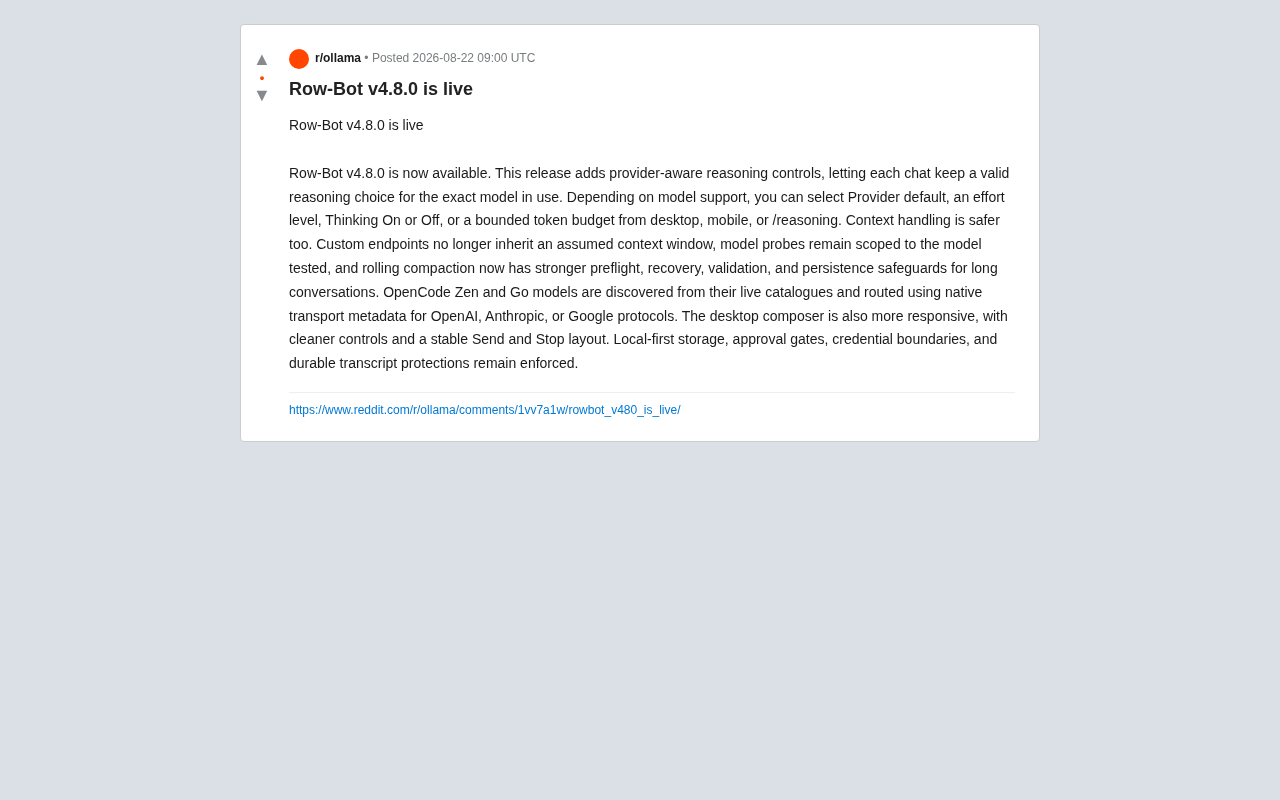
Row-Bot v4.8.0 introduces provider-aware reasoning controls that adapt to each model's capabilities, multiple safeguards for rolling compaction in long conversations, and native protocol model routing with live catalogue discovery. The update focuses on reliability and fine-grained control for multi-model workflows.
Open-source AI chat client Row-Bot recently released v4.8.0, featuring deep optimizations around reasoning controls, context handling safety, and multi-protocol model routing. For developers and power users who rely on multi-model workflows, this is a highly practical iteration.
Model-Aware Reasoning Controls
The most notable feature in this update is the introduction of "provider-aware reasoning controls" — a reasoning control mechanism that adapts to different service providers.
To understand the value of this feature, consider the current reasoning model ecosystem. Since OpenAI launched its o1 and o3 series reasoning models, "letting the model think deeply before answering" has become a key technique for improving performance on complex tasks. Anthropic followed with extended thinking in Claude, and Google's Gemini offers similar capabilities. However, these providers support reasoning in fundamentally different ways: some use a reasoning_effort parameter to control thinking depth, some trigger chain-of-thought via an explicit thinking toggle, and others support setting token limits for the thinking process. If a client blindly passes reasoning parameters to unsupported models, it may result in rejected API requests or unpredictable output behavior.
Previously, AI chat clients handled reasoning settings across different models with a one-size-fits-all approach, often forcing unsupported reasoning options onto models and causing errors or abnormal behavior. v4.8.0 ensures that each conversation retains a valid reasoning selection for the specific model being used.
Flexible Reasoning Options
Based on each model's supported capabilities, users can now select from multiple reasoning modes via desktop, mobile, or the /reasoning command:
- Provider default: Use the provider's default settings
- Effort level: Specify reasoning effort (e.g., low, medium, high)
- Thinking On / Off: Explicitly enable or disable thinking mode
- Bounded token budget: Set a bounded token budget for the reasoning process
This design acknowledges the differences in reasoning capabilities across models (e.g., OpenAI's reasoning models, Anthropic's thinking models) and returns control to users at an appropriate granularity. For scenarios requiring trade-offs between cost and reasoning depth, token budget control is especially practical — thinking tokens in reasoning models typically count toward billing, and setting limits effectively prevents runaway costs per request.
Safer Context Handling
The second major improvement focuses on context handling robustness, directly impacting the reliability of long conversations.
Custom Endpoints No Longer Assume Context Windows
The context window is the maximum number of tokens an LLM can process in a single request, varying significantly across models: early models might only support 4K tokens, while the latest models support 128K or even 200K tokens. Clients need to accurately know the target model's context window size to correctly perform message trimming and history management.
Previously, when users configured custom endpoints, the client might automatically inherit an "assumed" context window size. If this assumption didn't match the actual model, it could lead to unexpected content truncation or request failures. v4.8.0 removes this default inheritance, avoiding unnecessary errors.
Additionally, model probes are now strictly scoped to the model being tested, preventing cross-model "contamination" of configuration information and improving isolation and accuracy in multi-model environments.
Multiple Safeguards for Rolling Compaction
For context compression needs common in long conversations, the new version adds stronger protections to the "rolling compaction" mechanism. Rolling compaction is a technique that intelligently summarizes and compresses older history messages when conversation length approaches or exceeds the model's context window. Its goal is to preserve key information valuable to subsequent conversation while controlling total token count. However, the compression process itself relies on LLM-generated summaries — if summary quality is poor, the process is interrupted, or results aren't properly persisted, important context could be permanently lost.
The new version adds a complete protection chain:
- Preflight: Pre-compression checks to confirm compression conditions and model availability
- Recovery: Fallback mechanism after compression failure, reverting to pre-compression state
- Validation: Verification of compression results to ensure summary completeness
- Persistence safeguards: Ensuring compressed results are safely written to storage
Together, these mechanisms ensure that history compression in ultra-long conversations won't cause data loss or conversation state corruption — critical for complex tasks that depend on context continuity.
Native Protocol Model Routing
The third noteworthy update enhances support for OpenCode Zen and Go models.
Row-Bot can now dynamically discover available models from these services' live catalogues, rather than relying on static hardcoded lists. This means users can access new models as soon as providers launch them, without waiting for client updates.
Furthermore, model routing uses native transport metadata, adapting separately for the OpenAI, Anthropic, or Google protocols. Current major AI providers each maintain different API protocol specifications: OpenAI uses the Chat Completions API with role/content message structures; Anthropic uses the Messages API with its own conventions for system prompts and tool use formats; Google Gemini uses its proprietary request format with different multimodal content delivery methods. If a client adapts all protocols through a single generic conversion layer, provider-specific advanced features (such as Anthropic's cache control or OpenAI's structured outputs) often can't be properly conveyed. Native protocol routing builds requests specifically for each protocol, maximizing functional completeness and request correctness.
Desktop Experience Improvements and Security Commitments
Beyond underlying capability enhancements, the desktop composer has become smoother: cleaner controls, and stable "Send" and "Stop" button layouts that avoid accidental clicks and layout jitter.
Row-Bot continues to uphold its core security principles in this update:
- Local-first storage: Conversation data is saved on the user's local device by default, not in the cloud
- Approval gates: Sensitive operations require explicit user confirmation
- Credential boundaries: API keys for different providers are strictly isolated
- Durable transcript protections: Preventing accidental deletion or corruption of conversation records
Summary
Row-Bot v4.8.0 is not a feature-packed major release, but rather a pragmatic iteration focused on reliability and fine-grained control. Model-aware reasoning controls solve a major pain point when mixing multiple models, multi-layered context handling safeguards significantly improve long conversation stability, and native protocol routing with live model discovery makes the tool more future-proof.
For technical users who value privacy (local-first) and need to flexibly switch between multiple AI providers, this version's improvement direction is clear and solid.
Key Takeaways
Related articles

RAG Getting Started in Practice: From Principles to Building an Enterprise Knowledge Base
Bilibili RAG course highlights: from retrieval-augmented generation principles, document chunking and vectorization, to five accuracy factors and enterprise knowledge base boundaries, with fine-tuning vs RAG selection advice.

AI Model Selection Guide: DeepSeek vs. Qwen3 in Practice
How should AI developers choose models? Based on a Bilibili tutorial, this article breaks down the Function Calling differences between DeepSeek V3 and R1, Qwen3's programmatic thinking mode switching and agent capabilities, and outlines a multi-model learning path and practical selection logic.

Anchoring, Loss Aversion, and Nudges: 5 Psychological Tactics Retailers Use to Make You Spend
Behavioral economics reveals how retailers use anchoring, framing, loss aversion, and nudge theory to manipulate your spending decisions. This article breaks down 5 common psychological tactics and offers counterstrategies like slowing down decisions and setting your own anchors to see through the pricing design behind discounts.