Rubric-Based Alignment for Knowledge QA: A Paradigm Shift from Preferences to Principles
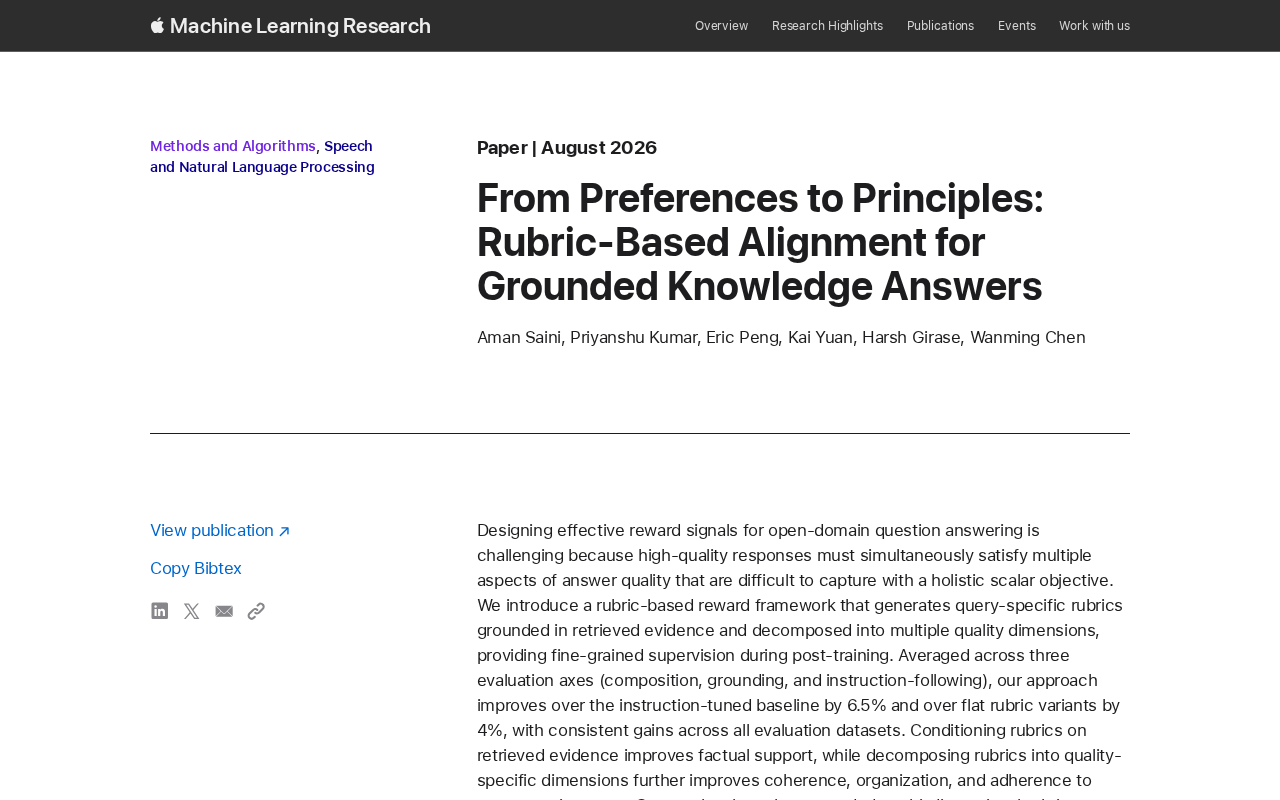
Rubric-based alignment transforms LLM training from implicit preferences to explicit principles via fine-grained, query-specific evaluation criteria.
This article examines a novel rubric-based reward framework for aligning large language models in open-domain QA. Unlike traditional scalar rewards, it generates query-specific evaluation criteria grounded in retrieved evidence, decomposing answer quality into composition, grounding, and instruction-following dimensions. This paradigm shift from preferences to principles delivers significant performance improvements while enhancing interpretability and controllability in model alignment.
The Reward Challenge in Open-Domain QA
Designing effective reward signals during the post-training phase of large language models has been a core challenge. Post-training refers to the process of additional training steps after a large language model completes pre-training, aimed at making its behavior better align with human expectations. During pre-training, models learn language patterns and knowledge from massive text corpora, but this doesn't guarantee outputs that align with human values, follow instructions, or avoid harmful content. Post-training typically includes techniques like supervised fine-tuning (SFT) and reinforcement learning from human feedback (RLHF), with the goal of teaching models "what makes a good response." The central challenge at this stage is defining "good"—that is, designing effective reward signals to guide model optimization.
For open-domain question answering (QA) tasks, this problem is particularly thorny. Open-domain QA refers to scenarios where models must answer diverse questions without a constrained knowledge scope, as opposed to closed-domain QA. The difficulty lies in: questions may involve knowledge from any domain, requiring answers to be extracted or inferred from vast amounts of information; evaluating answer quality involves complex dimensions—requiring both factual accuracy and clear expression with logical coherence. A high-quality answer must satisfy multiple dimensions simultaneously: clear content organization, verifiable facts, and strict adherence to user instructions. However, traditional alignment methods typically rely on a holistic scalar objective, attempting to capture complex, multi-dimensional quality with a single score.
Scalar rewards refer to methods that use a single numerical value to represent answer quality, essentially compressing multi-dimensional complex quality into a one-dimensional signal. The limitation is: when a model performs poorly on one dimension (like factual errors) but well on others (like fluent language), scalar rewards produce confusing signals—the model cannot determine the optimization direction. This is like a teacher grading an essay with only a total score, without indicating whether the issues are structural, evidential, or related to understanding the prompt—naturally making it difficult for students to improve in targeted ways.
Addressing this pain point, a novel rubric-based reward framework has emerged, transforming vague "preferences" into clear "principles."
Core Method: Query-Specific Rubric Generation
From Holistic Scoring to Fine-Grained Supervision
The core innovation of this method lies in introducing a query-specific rubric generation mechanism. Unlike previous approaches that evaluate entire responses with a single score, this framework dynamically generates a dedicated rubric for each specific query.
This rubric has two key characteristics:
-
Grounded in retrieved evidence: The rubric isn't generated arbitrarily but is built upon actual evidence retrieved for answering the question. This employs Retrieval-Augmented Generation (RAG) technology, where models first retrieve relevant document fragments from external knowledge bases before generating answers, then produce responses based on this evidence. The evaluation criteria themselves are anchored in real documents retrieved for specific questions, ensuring criteria are tightly aligned with the actual information needs of the question while making the "grounding" dimension operationally assessable.
-
Decomposed into multiple quality dimensions: Answer quality is broken down into independently assessable dimensions, avoiding conflation. In machine learning, the granularity of supervision signals directly impacts model learning efficiency and final performance. Fine-grained signals can reduce the number of samples needed for alignment and improve the final model's multi-dimensional balance.
Through this approach, models can receive fine-grained supervision signals during post-training, clearly understanding their performance on each quality dimension.
Advantages of Decomposed Reward Signals
Decomposing reward signals into multiple dimensions essentially breaks down a complex, hard-to-optimize objective into several more manageable sub-objectives. This approach echoes "divide and conquer" in software engineering and multi-task learning in machine learning. Multi-objective optimization theory suggests that decomposing complex objectives into multiple sub-objectives and optimizing them separately is typically more effective than directly optimizing a single mixed objective. When reward signals become more transparent and structured, both model learning efficiency and interpretability improve significantly.
Three Core Evaluation Dimensions Explained
The research team measures answer quality along three core evaluation axes, each with its own focus.
Composition
This dimension focuses on the structure and expression quality of the answer itself. A good answer must not only contain correct information but also have clear logic, organized structure, and fluent language. For open-domain QA scenarios, well-organized answers enable users to acquire needed information more quickly and accurately.
Grounding
This is a crucial dimension in knowledge QA scenarios. "Grounding" means every claim in the answer should be traceable and verifiable against reliable evidence obtained through retrieval. In an era where large model hallucinations remain prevalent, alignment methods emphasizing factual grounding have strong practical significance.
The hallucination problem in large language models refers to models generating content that sounds fluent and confident but is actually false or unverifiable. This phenomenon stems from the model's generation mechanism: during pre-training, models learn statistical patterns in text rather than causal relationships in the real world, so when lacking clear evidence, models will "reasonably infer" content that sounds like answers based on language patterns. The rubric-based method introduces explicit rewards for the "grounding" dimension, incentivizing models at the alignment level to generate content only based on verifiable evidence—directly constraining models to "speak with sources"—thereby reducing hallucination tendencies during training.
Instruction-Following
The third dimension evaluates whether the model accurately understands and executes user instructions. User questions often contain implicit or explicit constraints, such as format, scope, or tone of the answer. The strength of instruction-following capability directly determines model utility and user experience.
By providing supervision separately across these three dimensions, this framework achieves a more comprehensive and multi-faceted characterization of answer quality.
Experimental Results and Key Findings
After averaging across the three evaluation axes of composition, grounding, and instruction-following, the rubric-based method achieved significant improvements over baseline approaches. This demonstrates that structuring and fine-graining reward signals indeed brings substantial performance gains.
A Paradigm Shift from Preference Learning to Principle Learning
The most profound value of this work lies in the paradigm shift it represents—"From Preferences to Principles":
-
Traditional methods like RLHF (Reinforcement Learning from Human Feedback) primarily rely on preference data, where human annotators provide relative preferences between different answers. RLHF's core workflow includes: collecting preference rankings from human annotators, training a reward model to predict human preferences, and using reinforcement learning algorithms to have the generative model maximize predicted rewards. Such signals are inherently implicit and difficult to interpret—models only know "this is better" without knowing "why it's better" or "what makes it better."
-
The rubric-based method explicitly transforms these implicit preferences into clear principles, letting models know "why this answer is better," not just "this answer is better."
This shift from implicit preferences to explicit principles not only improves alignment effectiveness but also brings stronger interpretability and controllability to the alignment process. Interpretability refers to the degree to which an AI system's decision-making process and internal mechanisms can be understood by humans. In large model alignment, interpretability has multiple strategic values: when alignment effects are suboptimal, interpretable reward signals help researchers quickly identify problems; as AI systems are deployed in high-stakes scenarios, regulators and users demand the ability to audit and understand models' decision-making rationale. Researchers and practitioners can directly examine and adjust rubrics, thereby more precisely guiding model behavior.
Future Directions for Structured Rewards
This work provides an inspiring direction for the large model alignment field. As model capabilities continue to grow, how to design reward signals that are both precise and interpretable will become a key factor determining alignment quality.
The rubric-based method has several noteworthy extension directions:
-
Quality of automated rubric generation: The rubrics themselves are generated by models, and their quality directly impacts final alignment effectiveness. Ensuring the accuracy and completeness of rubrics is an ongoing challenge to tackle.
-
Cross-domain generalization capability: Currently, this method focuses on knowledge QA. Whether it can be extended to other open-domain tasks like code generation and creative writing merits further exploration.
-
Deep integration with Retrieval-Augmented Generation (RAG): Since rubrics are built upon retrieved evidence, this method naturally aligns with RAG architectures. The combination of RAG and fine-grained rewards represents an important direction for building verifiable, trustworthy AI systems. Their synergy holds promise as a key pathway for constructing trustworthy AI QA systems.
Overall, this research sends an important signal: while pursuing more powerful model capabilities, making the model's "evaluation system" more transparent, structured, and principled may be the crucial step toward truly reliable AI. By transforming the definition of "good answers" from implicit preferences to explicit principles, we are essentially building a readable, auditable, and modifiable alignment framework—this is critical for responsible large model development.
Key Takeaways
- Traditional alignment methods rely on holistic scalar rewards, which struggle to provide clear guidance across multiple quality dimensions for open-domain QA tasks
- The rubric-based approach dynamically generates query-specific evaluation criteria grounded in retrieved evidence, decomposing answer quality into composition, grounding, and instruction-following dimensions
- Fine-grained, structured reward signals significantly improve learning efficiency and interpretability compared to single-score approaches
- This method represents a paradigm shift from implicit preference learning to explicit principle-based alignment, offering better controllability and auditability
- Future directions include improving automated rubric quality, expanding to other domains, and deeper integration with RAG architectures
Related articles
Vercel AI SDK TUI: A New Option for Terminal-Based AI Interaction
Vercel AI SDK introduces @ai-sdk/tui for terminal AI interactions, bringing streaming output, tool calling, and AI conversations to the command line.
Microsoft Copilot Copyright Lawsuit: 8.2 Million Conversations Reveal the Truth About AI Content Copying
Microsoft discloses 8.2M Copilot conversations in NYT copyright lawsuit, claiming AI rarely copies news content. Explore the key data, legal disputes, and implications for the AI industry.

HydraFusion Explained: How GitHub Copilot's Multi-Model Orchestration Cuts Costs by 67%
Deep dive into GitHub Copilot's HydraFusion multi-model orchestration: its Plan-Build-Critique-Complete workflow, how it cuts costs by 67%, and the paradigm shift from model selection to orchestration.