Ruby2ßhell Vulnerability: Default Rails Apps Exposed to Pre-Auth RCE Risk
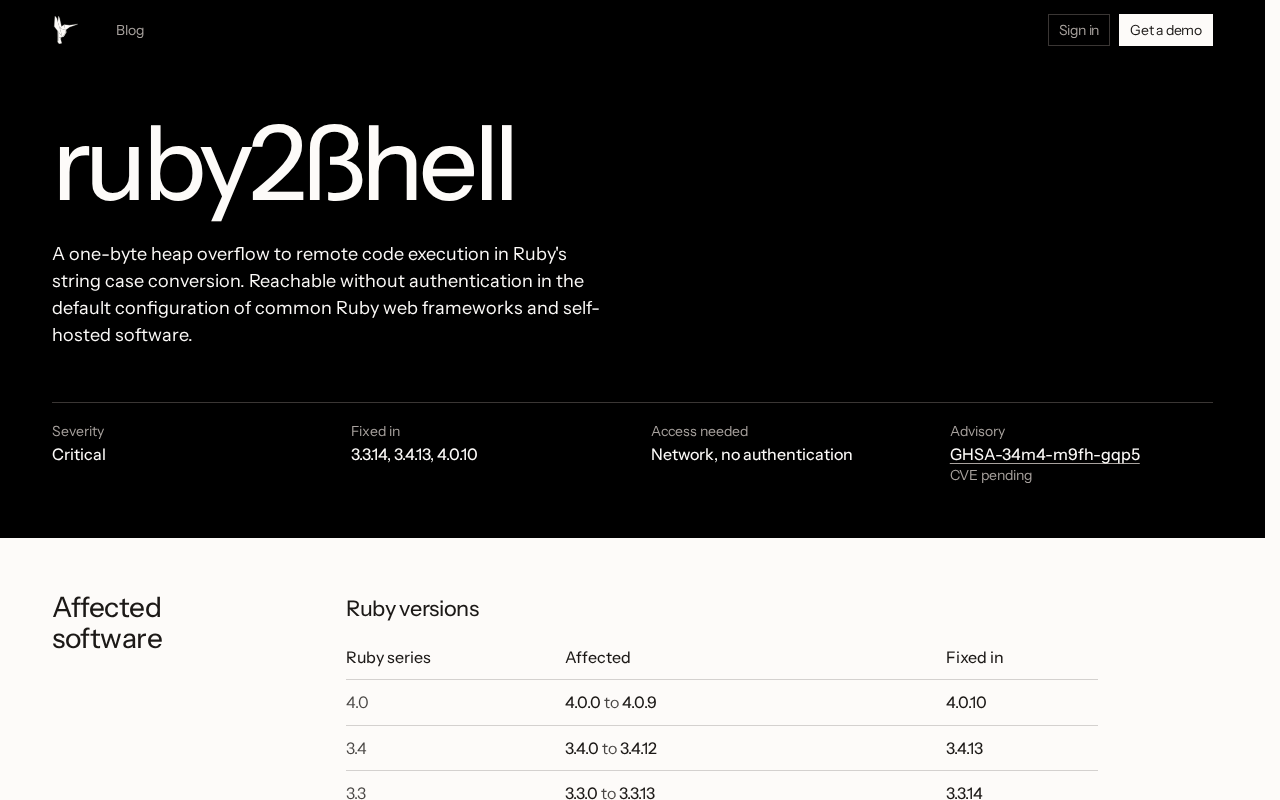
Ruby2ßhell reportedly triggers pre-auth RCE on default Rails apps; details pending disclosure.
The article discusses the "Ruby2ßhell" vulnerability hotly debated in the security community, which is exploitable on unmodified default Rails applications and occurs before authentication, allowing attackers to attempt remote code execution without valid credentials. The author notes that the combination of pre-auth and RCE greatly amplifies the harm, and the qualifier "stock Rails" suggests the issue may lie in framework default behavior rather than individual application code, so impact should be assessed by framework version and default middleware stack. Since public information currently includes only the title and community attention, lacking affected versions, trigger conditions, and official responses, the author advises developers to first practice basic security hygiene: verify Rails versions and dependencies, check exposed debug or admin endpoints, monitor anomalous requests, and wait for official security announcements and patches.
A Pre-Authentication RCE Vulnerability Targeting Default Configurations
The "Ruby2ßhell" vulnerability, which has sparked discussion in security circles on Hacker News, takes aim at Ruby on Rails' "stock" state. Unlike many vulnerabilities that require specific configurations or third-party plugins to trigger, this one is reportedly exploitable on default Rails applications without additional modification, and it occurs before authentication (pre-authentication). This means an attacker may be able to execute remote code against the application by crafting requests without even logging in.
For the large number of web services that are quickly built with Rails and deployed directly to production, this kind of risk at the default-configuration level deserves particular vigilance—the framework's "convention over configuration" philosophy greatly boosts development efficiency, but it also means the security boundary is often assumed to be secure by default.
"Convention over Configuration" is Rails' core design philosophy: the framework provides sensible defaults for routing, database mapping, middleware order, and more, so developers can launch quickly without declaring each item individually. This philosophy dramatically lowers development costs, but it also means the security boundary is defined by framework defaults rather than explicitly by the application author. When there are flaws in the default middleware stack or default serialization behavior, all "stock" applications without additional hardening are exposed simultaneously. When assessing this kind of risk, it is necessary to distinguish between framework-level default behavior and application-level code defects: the former's impact is counted by framework version, while the latter is usually confined to a single project.
Why Pre-Authentication Exploitation Is More Damaging
Pre-authentication is a key dimension when assessing vulnerability severity. Once the attack chain does not require valid credentials, every web entry point exposed to the public internet becomes a potential attack surface. Combined with remote code execution (RCE) capability, an attacker could theoretically read data, implant backdoors, or move laterally within the permissions of the server process.
At present, the discussion thread on Hacker News itself contains limited information, without full exploitation details or technical analysis, but the qualifier "stock Rails" is worth noting: it suggests the problem may lie in the framework's default behavior rather than an isolated application code defect. If this premise holds, then assessing the affected scope cannot be limited to individual projects but must return to the framework version and default middleware stack level.
The severity of a pre-authentication vulnerability lies in the fact that the attack chain can be triggered without valid credentials, so all reachable entry points exposed to the public internet—login pages, API endpoints, static resource routes, and so on—may become attack surfaces. In contrast, post-authentication vulnerabilities usually require an attacker to first obtain a legitimate account, and both the exploitation threshold and the scope of impact are constrained by the permission model. In the CVSS scoring system, a PR (Privileges Required) value of None often directly drives up the base score. For a full-stack framework like Rails that includes routing, middleware stack, and session management by default, the code paths reachable during the pre-authentication phase include request parsing, parameter binding, session deserialization, and more; any defect in default behavior in any of these could be exploited before authentication.
Practical Guidance for Rails Developers
Before official details become clear, what developers can do is return to the most basic security hygiene: confirm whether the Rails version and dependency manifest are in a supported state, check whether the production environment exposes debug or admin endpoints that should not be externally reachable, and maintain monitoring for anomalous inbound requests.
That said, do not underestimate its seriousness just because the vulnerability name contains playful wording like "ßhell"—the security community often uses such naming to create buzz, but the technical problem behind it is often a real framework-level defect. For applications carrying sensitive business operations, waiting for the pace of official disclosure and patch synchronization is more prudent than blindly guessing at exploitation methods.
Information Still Needs to Be Completed
It must be pointed out that the currently available material only includes the vulnerability title and community attention, and lacks key information such as affected version ranges, trigger conditions, and official responses. In the absence of technical details, any discussion of mitigation measures can only remain at a general level. It is recommended to keep following the official Rails security announcements and the original disclosure channels, and to take targeted action only after a complete analysis is made public.
One-line Summary
Ruby2ßhell is reportedly able to trigger pre-authentication RCE on default-configuration Rails applications, with details still pending disclosure.
Paragraph Summary
The article discusses the "Ruby2ßhell" vulnerability that is hotly debated in the security community. Its characteristic is that it is exploitable on default Rails applications without additional modification, and it occurs before authentication, so an attacker can attempt remote code execution without valid credentials. The author points out that the combination of pre-authentication and RCE significantly amplifies the harm, and the qualifier "stock Rails" suggests the problem may lie in the framework's default behavior rather than in an individual application's code, so the affected scope should be assessed by framework version and default middleware stack. Because the currently public information includes only the title and community attention, and lacks affected versions, trigger conditions, and official responses, the author recommends that developers first practice basic security hygiene: verify the Rails version and dependencies, check for exposed debug or admin endpoints, monitor anomalous requests, and wait for official security announcements and patches.
Related articles

Jensen Huang Returns to Nvidia: The Power Game Behind an "Aggro Reset"
Nvidia's board reappointed Jensen Huang as CEO less than two weeks after his scandal-driven resignation. This analysis explores the board's decision-making, Trump's political intervention, media power failure, and market reaction behind the dramatic return.

Why Voice AI Can't Understand Kenyans' Everyday Conversations
Swahili speech recognition hits 3.24% error on read text, but everyday Kenyan speech mixes English, Sheng slang, and accents—leaving mainstream voice AI struggling.

Data Centers Build Their Own Natural Gas Plants: AI Compute's Breakout Around a Decade-Long Grid Wait
Grid interconnection approvals can take a decade, so xAI and others are building off-grid natural gas plants to power AI clusters. This article analyzes the drivers, costs, and impact of behind-the-meter generation on AI infrastructure.