Ruflo Open-Source Framework: Claude Multi-Agent Orchestration Platform Architecture and Practical Guide

Ruflo is an open-source multi-agent orchestration platform for the Claude ecosystem, powered by swarm intelligence.
Ruflo is an open-source multi-agent orchestration platform with 42,000+ GitHub Stars, built with TypeScript and designed specifically for the Anthropic Claude ecosystem. Its core features include self-learning swarm intelligence (dynamic task assignment and adaptive collaboration), enterprise-grade architecture, native RAG integration, and deep Claude Code/Codex integration. Compared to general-purpose frameworks like LangGraph and CrewAI, Ruflo focuses on the Claude ecosystem and emphasizes a swarm intelligence paradigm, representing the important trend of AI engineering evolving from single model capabilities to system-level orchestration.
Introduction
As large language model applications evolve from simple conversations to complex workflows, Agent Orchestration is becoming critical infrastructure for AI engineering in production. Agent orchestration refers to the systematic management of task allocation, communication protocols, execution sequencing, and result aggregation when multiple AI agents work collaboratively. This concept originates from Service Orchestration in microservices architecture, popularized during the containerization era by tools like Kubernetes. As LLM capabilities advanced rapidly in 2023-2024, single model calls could no longer meet complex business requirements, and the industry began applying distributed systems orchestration principles to the AI domain. The core problems agent orchestration must solve include: state management (how to maintain each Agent's context), communication mechanisms (how Agents pass information to each other), error recovery (how to rollback or retry when a step fails), and resource scheduling (how to maximize throughput within limited API call quotas).
A GitHub project called Ruflo has recently attracted widespread attention — with over 42,000 Stars, it has become a leading multi-agent orchestration platform for the Anthropic Claude ecosystem. This article provides an in-depth analysis of Ruflo's core architecture, key features, and practical value in AI engineering.
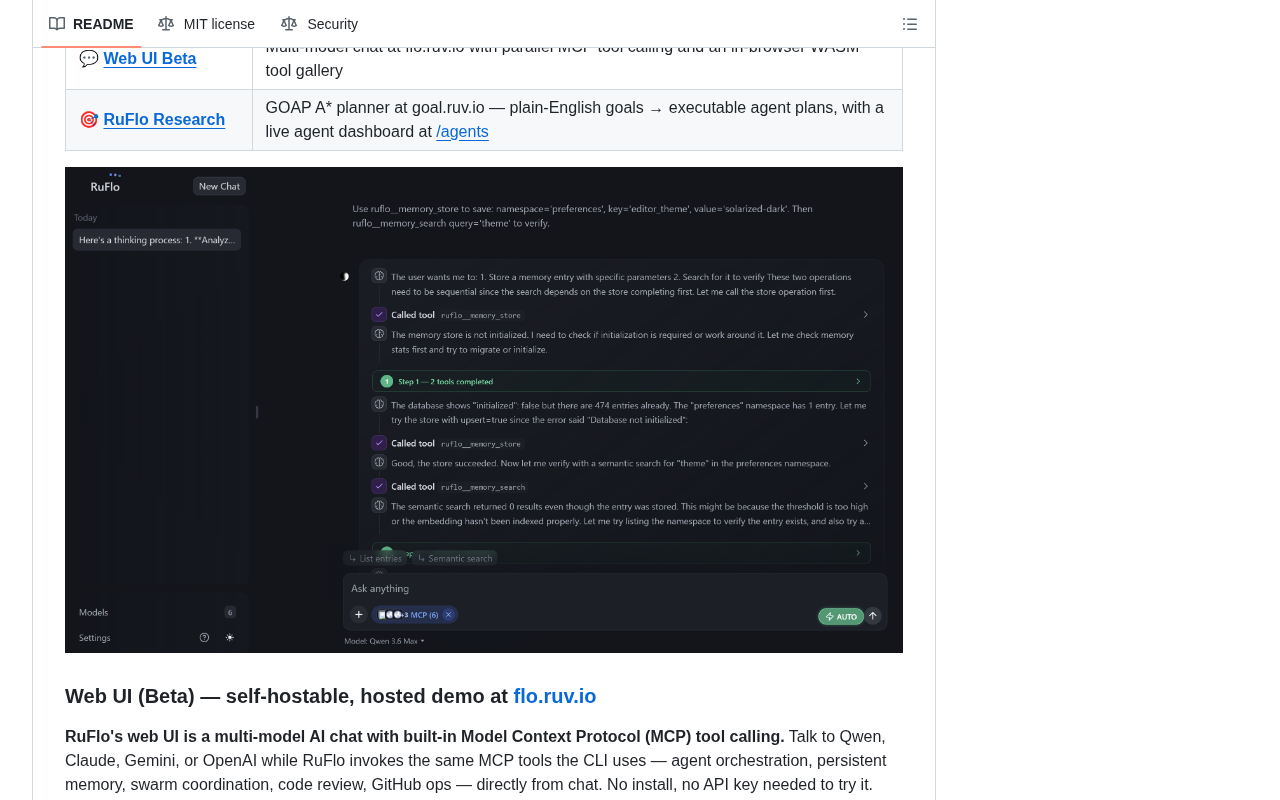
What is Ruflo? Positioning and Core Capabilities
Ruflo (repository: ruvnet/ruflo) is an agent orchestration platform built with TypeScript, designed specifically for Claude series models. Its core positioning is: enabling developers to deploy intelligent multi-agent swarms, coordinate autonomous workflows, and build conversational AI systems.
To use an analogy: if a single AI Agent is an employee, then Ruflo is a complete enterprise management system — responsible for assigning tasks, coordinating communication, monitoring execution, and aggregating results.
Key Project Metrics
| Metric | Data |
|---|---|
| GitHub Stars | 42,620+ |
| Forks | 4,752+ |
| Primary Language | TypeScript |
| Ecosystem Position | Claude Code / Codex Native Integration |
This scale of community engagement places it among the top projects in the AI Agent framework space, reflecting strong demand for Claude ecosystem-specific orchestration tools.
Deep Dive into Ruflo's Core Features
Self-Learning Swarm Intelligence
Ruflo's most distinctive capability is its self-learning swarm intelligence mechanism. Swarm Intelligence is a computational paradigm originating from biology, first proposed by Gerardo Beni and Jing Wang in 1989. Its core idea is that large numbers of simple individuals, through local interactions and self-organizing behavior, can exhibit collective intelligence that surpasses individual capabilities. Classic examples include Ant Colony Optimization, Particle Swarm Optimization, and Bee Colony algorithms. In the AI Agent domain, applying swarm intelligence means: each Agent doesn't need to understand the global state — it only needs to make decisions based on local information and simple rules for the system to exhibit intelligent behavior overall. This contrasts with traditional centralized orchestration (where a master Agent coordinates everything), offering better scalability and fault tolerance, though it introduces challenges in consistency guarantees and result predictability.
Unlike traditional linear Agent chains (such as simple Agent A → Agent B → Agent C), Ruflo supports dynamic swarm collaboration patterns:
- Dynamic Task Assignment: Automatically distributes work based on task complexity and Agent capabilities
- Adaptive Learning: The swarm continuously optimizes collaboration strategies during execution
- Fault Tolerance: A single Agent failure doesn't crash the entire workflow
This design draws from distributed systems and swarm intelligence principles, making complex task processing more robust and efficient.
Enterprise-Grade Architecture Design
Ruflo explicitly positions itself with Enterprise-Grade Architecture, targeting production environments rather than experimental use. This is reflected in:
- Comprehensive error handling and logging systems
- Scalable modular design
- Security and access control
- Stability guarantees under high-concurrency scenarios
The choice of TypeScript as the primary development language also reflects this consideration. TypeScript is a superset of JavaScript developed and maintained by Microsoft, providing compile-time error checking through a static type system for large-scale application development. Choosing TypeScript over Python (the traditional dominant language in ML/AI) in AI engineering has deep reasoning: First, modern AI applications often require unified front-end and back-end development, and TypeScript can unify the tech stack; Second, TypeScript's type inference and interface definition capabilities make complex Agent communication protocols clearer and more maintainable; Third, Node.js's asynchronous I/O model is naturally suited for handling large numbers of concurrent API calls, which is particularly important in multi-Agent systems. Additionally, with the maturation of TypeScript AI toolchains like Vercel AI SDK and LangChain.js, the JavaScript/TypeScript ecosystem's competitiveness in the AI application layer is rapidly growing.
Native RAG Integration: Knowledge-Driven Multi-Agent Collaboration
Native integration of Retrieval-Augmented Generation (RAG) is another major highlight of Ruflo. RAG was first proposed by Meta AI's research team in 2020. Its core idea is to retrieve relevant document fragments from external knowledge bases before the LLM generates an answer, injecting them as context into the prompt. The standard RAG pipeline includes three phases: the indexing phase (splitting documents into chunks and converting them to vectors via embedding models for storage), the retrieval phase (vectorizing user queries and performing similarity search in vector databases), and the generation phase (inputting retrieved relevant documents along with the original question into the LLM to generate answers).
Since 2024, RAG technology has evolved rapidly, with advanced variants emerging including GraphRAG (knowledge graph-based retrieval), Agentic RAG (Agents autonomously decide when and what to retrieve), and Corrective RAG (quality assessment and correction of retrieval results). In multi-Agent scenarios, RAG architecture design becomes more complex, requiring consideration of knowledge base partitioning strategies, caching mechanisms, and differentiated knowledge granularity needs across different Agents.
Ruflo amplifies RAG's value in multi-agent scenarios:
- Different Agents can share a unified knowledge base
- Supports context-aware dynamic knowledge retrieval
- Effectively reduces LLM hallucinations, improving factual accuracy of outputs
This makes Ruflo particularly suitable for building enterprise applications requiring extensive domain knowledge, such as technical documentation Q&A, compliance review, and research analysis.
Claude Code / Codex Native Integration
Ruflo achieves native integration with Anthropic's Claude Code and Codex. Claude Code is a command-line AI programming tool launched by Anthropic in early 2025, allowing developers to interact with Claude models directly in the terminal for code writing, debugging, refactoring, and other tasks. Its core difference from traditional code completion tools (like GitHub Copilot) is that Claude Code possesses full Agentic capabilities — it can autonomously read file systems, execute commands, and perform multi-step reasoning. Codex was originally a code generation model brand launched by OpenAI, which later evolved into a broader code intelligence platform.
Ruflo's native integration with these tools means developers can invoke multi-Agent orchestration capabilities directly from their programming environment. For example, a group of Agents can collaboratively perform code review: one Agent handles security vulnerability detection, another handles performance analysis, a third handles code style review, and the orchestration layer aggregates all feedback. The advantages of deep integration include:
- Seamless Connection: No additional adaptation layers needed, reducing integration complexity
- Performance Optimization: Specifically tuned for Claude model characteristics
- Ecosystem Synergy: Naturally compatible with other tools and services in the Claude ecosystem
Technology Trends: Why Multi-Agent Orchestration Matters
The Inevitable Evolution from Single-Agent to Multi-Agent
In 2024-2025, one of the most significant trends in AI is the shift from single Agents to multi-Agent collaboration. Driving factors include:
- Complex Task Decomposition: Real-world tasks often span multiple domains and steps, beyond what a single Agent can handle
- Specialized Division of Labor: Different Agents focusing on different capabilities (code generation, data analysis, document writing) achieve far greater collaborative efficiency than a generalist Agent
- Improved Reliability: Multi-Agent systems can enhance output quality through cross-validation, voting mechanisms, and other approaches
Multi-Agent system reliability is one of the core challenges for production deployment. Unlike single model calls, multi-Agent systems face combinatorially explosive failure modes: communication between Agents may be lost or delayed, one Agent may hallucinate causing downstream Agents to reason based on incorrect information, and race conditions may occur during concurrent execution. Current industry reliability strategies include: cross-validation (multiple Agents independently complete the same task then compare results), progressive delegation (simple Agents handle first, escalating to more powerful Agents upon failure), circuit breaker patterns (automatically breaking when an Agent fails consecutively), and Human-in-the-Loop (introducing human review at critical decision points). Ruflo's fault tolerance mechanisms are based on these mature distributed systems patterns, adapted for the specific requirements of AI scenarios.
Ruflo vs LangGraph vs CrewAI: Competitive Landscape Comparison
Current mainstream Agent orchestration frameworks include LangGraph, CrewAI, AutoGen, and others. LangGraph is an Agent orchestration framework launched by the LangChain team in 2024, with its core abstraction modeling Agent workflows as directed graphs. Nodes in the graph represent computation steps (such as calling an LLM, executing tools, making conditional decisions), while edges represent state transitions. The advantages of this design include: support for loops (Agents can iterate repeatedly until conditions are met), branching (taking different paths based on intermediate results), and human-machine collaboration (pausing at specific nodes to await human approval). LangGraph uses a checkpoint mechanism for state persistence, enabling long-running workflows to resume from any node. Compared to Ruflo's swarm intelligence paradigm, LangGraph emphasizes determinism and controllability, making it suitable for scenarios requiring precise process control, but offering relatively less flexibility in highly dynamic and uncertain tasks.
Ruflo's differentiated positioning:
| Dimension | Ruflo | LangGraph | CrewAI |
|---|---|---|---|
| Model Binding | Claude-specific | General-purpose | General-purpose |
| Core Philosophy | Swarm Intelligence / Self-learning | Graph State Machine | Role-playing Collaboration |
| Development Language | TypeScript | Python | Python |
| Target Audience | Full-stack / Frontend Developers | Python Developers | Python Developers |
This focused strategy carries clear strategic value given Claude's growing market share.
Ruflo Use Cases and Practical Applications
Ruflo is particularly well-suited for the following scenarios:
- Automated Software Development: Multi-Agent collaboration for requirements analysis, code writing, testing, and deployment
- Enterprise Knowledge Management: Building intelligent knowledge bases and Q&A systems with RAG integration
- Data Analysis Pipelines: Multiple Agents handling data collection, cleaning, analysis, and report generation respectively
- Intelligent Customer Service: Building multi-tier, multi-skill intelligent customer service systems
- Compliance and Auditing: Leveraging RAG and multi-Agent cross-validation for automated compliance review
Conclusion: The Leap from Model Capability to System Capability
Ruflo represents an important direction in AI engineering: the leap from model capability to system capability. No matter how powerful a single large model is, it needs an engineered orchestration framework to deliver value in complex real-world scenarios. Through swarm intelligence, enterprise-grade architecture, RAG integration, and native Claude support, Ruflo provides developers with a powerful foundation for building complex AI systems.
For developers exploring the Claude ecosystem or multi-agent architectures, Ruflo is a project worth deep investigation and hands-on practice. As the agent orchestration space continues to evolve, ecosystem-focused orchestration platforms like this will play increasingly important roles.
Key Takeaways
- Ruflo is a multi-agent orchestration platform for the Claude ecosystem, earning 42,000+ GitHub Stars, built with TypeScript
- Core features include self-learning swarm intelligence, enterprise-grade architecture, native RAG integration, and deep Claude Code/Codex integration
- Unlike general-purpose frameworks like LangGraph and CrewAI, Ruflo focuses on the Claude ecosystem, emphasizing adaptive swarm behavior over simple process orchestration
- Suitable for complex multi-Agent collaboration scenarios including automated software development, enterprise knowledge management, and data analysis pipelines
- Represents the important trend of AI engineering evolving from single model capabilities to system-level orchestration capabilities
Related articles
Deep Dive into AI Agent Skill Design: …
Deep Dive into AI Agent Skill Design: Engineering Practices from Anthropic and Perplexity
A deep dive into Skill design philosophy from Anthropic's Claude Code team and Perplexity's Agent team, covering the Tax Test, Gotchas Flywheel, progressive disclosure, and Eval-First practices for building high-quality AI Agent skill systems.
Deep Dive into OpenAI's Official GPT-5…
Deep Dive into OpenAI's Official GPT-5.6 Prompting Guide: The Shift from Manual to Automatic
A deep dive into OpenAI's official GPT-5.6 Sol prompting guide: conciseness-first, outcome-oriented design, autonomy boundaries, tool routing, and reasoning intensity tuning.
 Deep Dives
Deep Dive into How OpenClaw (Open-Source Crayfish) AI Agent Works
Deep analysis of OpenClaw AI Agent internals: System Prompt, tool calling, SubAgents, Skill system, memory, and Context Engineering explained.