Rumor: NVIDIA May Discontinue RTX 5090, Redirecting GB202 Chips to RTX PRO Professional Cards

Unconfirmed rumor: NVIDIA may discontinue RTX 5090 and shift GB202 chip supply to higher-margin RTX PRO professional cards.
Unconfirmed reports suggest NVIDIA may discontinue its consumer flagship RTX 5090, redirecting GB202 chip capacity to the higher-priced RTX PRO professional line. The GB202 — Blackwell's top-spec die — is in high demand for both gaming and local AI inference. Reassigning it to professional cards makes business sense given their 2–4× price premium and stable enterprise contracts. If true, high-end gamers and individual AI developers who rely on the RTX 5090 for local large-model inference would be hit hardest. The article urges readers to await official confirmation and focus on AI demand's broader structural impact on the consumer GPU market.
The Rumor: RTX 5090 Could Be Discontinued Early
Recent rumors suggest that NVIDIA is considering discontinuing its flagship consumer GPU, the RTX 5090, and reallocating the GB202 chip at its core to the professional-market RTX PRO product line. The story first sparked discussion on Reddit and other communities, where many hardware enthusiasts expressed disbelief.
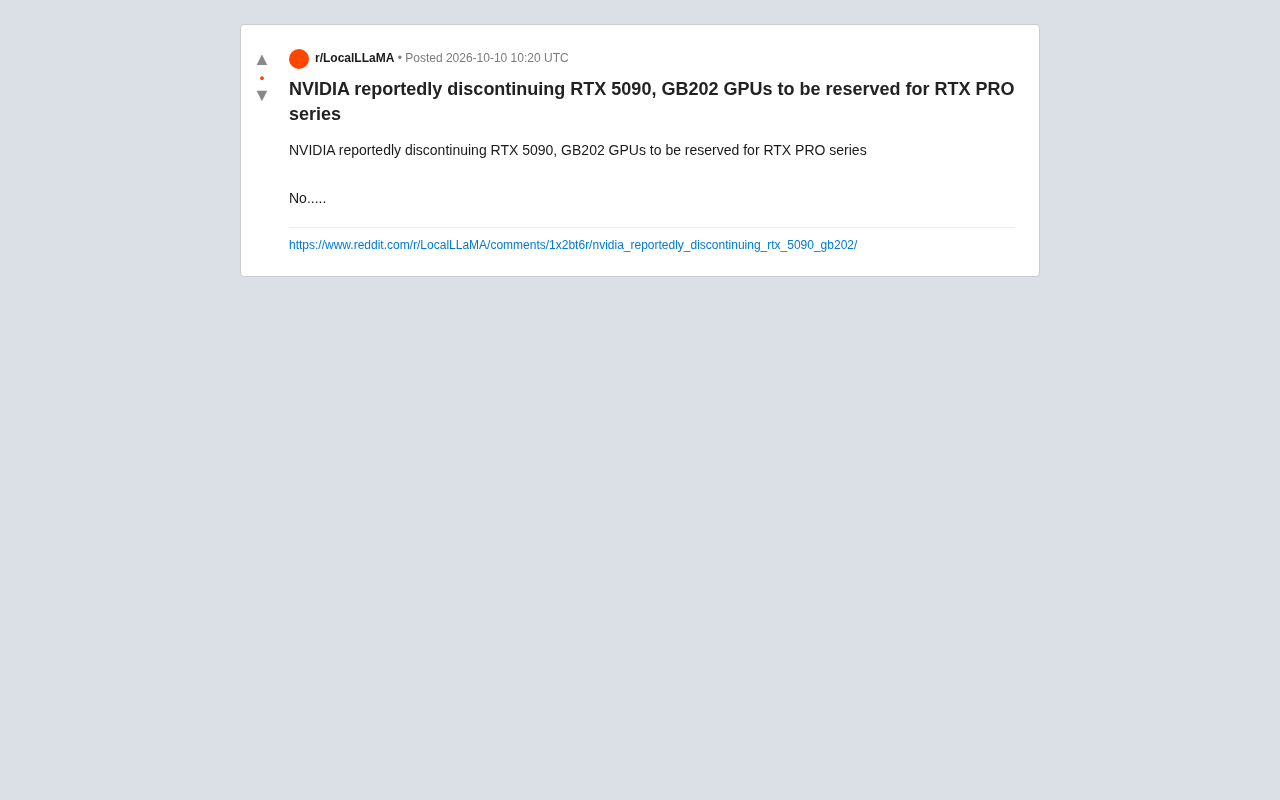
It's important to emphasize that this remains an unconfirmed rumor — NVIDIA has not issued any official statement. The analysis below assumes the rumor is true and should be taken as speculative only.
Why the GB202 Chip?
The GB202 is NVIDIA's highest-spec flagship GPU die under the Blackwell architecture, and it forms the foundation of the RTX 5090. As the performance and memory ceiling among consumer cards of its generation, the GB202 excels not only in gaming but also in parallel compute workloads — making it a popular choice for local AI inference, model fine-tuning, and professional content creation.
This cross-domain demand is precisely what makes the GB202 a scarce resource. If the rumor holds true, it would be commercially rational for NVIDIA to shift limited GB202 supply toward the higher-margin RTX PRO professional line.
Manufactured on TSMC's 4N process, the GB202 packs 92 billion transistors — among the highest transistor counts of any consumer GPU. Its full configuration in the RTX 5090 includes 170 streaming multiprocessors (SMs), 21,504 CUDA cores, and 32GB of GDDR7 memory on a 512-bit bus, with theoretical memory bandwidth exceeding 1.7 TB/s. This spec allows it to run mainstream 70B quantized models — such as 4-bit quantized versions of LLaMA 3 70B — making it uniquely valuable for local AI inference. As a result, the GB202 has long transcended the traditional gaming GPU category, finding its way into research, film rendering, and generative AI development, which has significantly elevated its supply scarcity.
The Consumer vs. Professional Supply Tug-of-War
The Profit-Driven Trade-Off
Professional-grade GPUs (such as RTX PRO, and the former Quadro/RTX A-series) are typically priced far above their consumer counterparts and are sold to workstation, data center, and enterprise customers. Against a backdrop of sustained demand for high-end AI compute, prioritizing top-tier chips for the professional line translates into higher revenue per unit.
For NVIDIA, this is a classic capacity allocation equation: the same GB202 wafer used for an RTX 5090 versus an RTX PRO could yield meaningfully different financial returns.
The RTX PRO series is NVIDIA's new brand targeting creators and professional workstation markets, positioned between consumer GeForce and data-center H/B series cards — replacing the former RTX A-series (previously Quadro). Professional card premiums come from more rigorously validated drivers, longer product lifecycle support, ISV (Independent Software Vendor) certifications, and enterprise procurement compliance. The same GB202 chip, when placed in the RTX PRO line, typically commands 2–4× the price of its consumer equivalent — and enterprise customers often place bulk purchase orders, providing more stable revenue. This makes prioritizing professional-line wafer allocation the more financially attractive choice for NVIDIA when supply is constrained.
Potential Impact on Gamers and Developers
If the RTX 5090 is truly discontinued or significantly supply-constrained, the two groups most directly affected would be: high-end gamers seeking peak gaming performance, and individuals or small teams relying on large-VRAM GPUs for local AI development and inference. The latter group is particularly sensitive — compared to expensive professional cards, the RTX 5090 has consistently represented the best value option for running large models locally.
Should this path narrow, the barrier for individual developers to access top-tier compute power could rise further.
A Level-Headed Take: The Rumor Still Needs Official Confirmation
The hardware industry is never short of rumors about discontinuations, product transitions, and supply adjustments. This particular rumor about the RTX 5090 reflects the market's ongoing anxiety over how NVIDIA allocates resources between "gaming GPUs" and "AI/professional compute."
Until NVIDIA provides an official response, readers are advised to stay cautious: there's no need for panic buying, nor should the rumor be treated as established fact. What's truly worth watching long-term is the structural disruption that AI compute demand is bringing to the consumer GPU market — a trend far more significant than the fate of any single product SKU.
Related articles

Should U.S. College Fraternities Be Banned? A Researcher's Incisive Observations
Why not just ban U.S. college fraternities? A researcher finds the key resistance comes from decision-makers' own fraternity identities and schools' "willful ignorance."

Microsoft Discovery: Accelerating Scientific Discovery with AI Agents
Microsoft's Discovery platform runs specialized AI agents to help researchers screen and prioritize the most promising compounds and experimental paths, reducing experiments and accelerating scientific discovery.

Cambridge Heavy Industries Secretly Develops Desktop-Scale Nuclear Fusion Device
Cambridge Heavy Industries is secretly developing a desktop-scale laser-driven nuclear fusion device, targeting the equipment supply market for fusion power plants. This article analyzes its miniaturization technology path, commercialization logic, and unique positioning in the fusion startup wave.