Run 8K Images on 6GB VRAM! Hands-On Test of Fudan's Open-Source MOSS-Image Model

Fudan OpenMouse and MOSS Intelligence open-source the 500M-parameter MOSS-Image model, runnable on 6GB VRAM with strong text and layout control.
MOSS-Image is a lightweight text-to-image model jointly open-sourced by Fudan University's OpenMouse team and Shanghai MOSS Intelligence, with only around 500 million parameters and a DT (Diffusion Transformer-class) architecture, focusing on three capabilities: small VRAM footprint, strong text rendering, and controllable layout. According to a Bilibili creator's demo, it can generate images smoothly and locally on 6GB VRAM and 3060-class older GPUs, and claims support for 8K resolution output. Text rendering is accurate in both Chinese and English, with natural typography and no obvious garbled characters or typos, suitable for text-dense promotional posters and product detail pages; for layout, it uses structured GSM to specify element coordinates and sizes, combined with 4K Tokens ultra-long prompts for one-shot results. Style coverage includes anime and realistic, suitable for e-commerce operations and individual creators for low-cost local deployment, but claims about 8K time requirements and "zero censorship" still require readers to verify and judge for themselves.
A noteworthy contender has recently emerged in the open-source text-to-image space: MOSS-Image (pronounced "Mouse Image" in the video), jointly open-sourced by Fudan University's OpenMouse team and Shanghai MOSS Intelligence. What makes it most appealing isn't parameter stacking, but rather that it achieves usable levels of three things simultaneously: small VRAM footprint, strong text rendering, and controllable layout.
According to a hands-on demo by a Bilibili creator, this model has only around 500 million parameters and adopts a DT architecture, yet it can generate images locally and smoothly on older GPUs with just 6GB of VRAM, and even claims to produce 8K resolution images. This article combines the video demo content to outline its core capabilities, use cases, and local deployment approach.
Why Small Parameters Can Produce Good Images: DT Architecture and Engineering Trade-offs
500 million parameters is "lightweight" by today's text-to-image model standards, but it doesn't mean compromising on image quality. The video author repeatedly emphasized that "the output quality is truly astonishing" — behind this statement is actually the efficiency dividend brought by architectural choices.
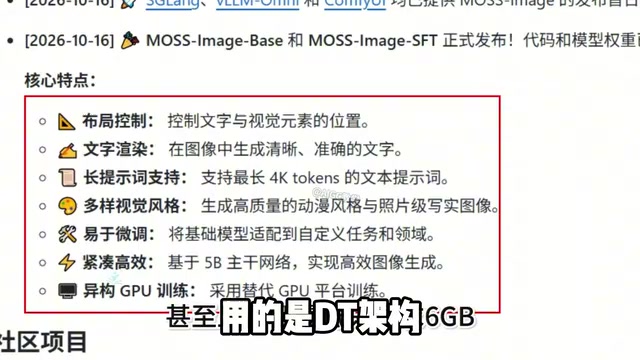
The value of the DT architecture lies in carrying generative capability with more compact parameters, compressing VRAM usage to a range that consumer-grade GPUs can handle. For individual creators and small teams, this means no need to rent cloud compute or upgrade hardware — a 3060-class older card can run the entire image generation workflow. Another benefit of low-cost local inference is privacy and freedom — materials never leave your machine, and you control the generation pace entirely.
About the DT Architecture: DT typically refers to Diffusion Transformer, which uses Transformer as the denoising backbone network of the diffusion model, replacing the U-Net commonly used in early Stable Diffusion. The advantage of Transformer is clearer scaling behavior, more natural modeling of long sequences, and easier unified encoding with structured conditions like text tokens and layout coordinates. Compared to U-Net's reliance on convolution and multi-scale downsampling, DiT-class architectures often have higher parameter utilization efficiency, which explains why 500 million parameters can still maintain considerable image quality.
About the "500 million parameters" magnitude reference: For comparison, SD 1.5 has about 860 million parameters (U-Net portion), SDXL has about 2.6 billion, and mainstream closed-source models generally exceed several billion. 500 million is clearly in the lightweight tier, with significantly reduced VRAM usage and inference latency, but typically requires compensation through training data quality, text encoder selection, and distillation strategies.
Text Rendering: Filling the Gap Among Open-Source Models at the Same Level
Text generation has always been a weakness of open-source text-to-image models, with common problems including garbled characters, typos, and inconsistent font sizes. MOSS-Image's performance in this regard was described by the video author as "directly crushing a bunch of open-source models at the same level."
Both Chinese and English render accurately, with natural and coordinated font sizes and typography. Even for text-dense promotional posters and product detail pages, the generated text is clear and sharp, with no garbled characters or typos throughout, and even supports precise control over font styles.
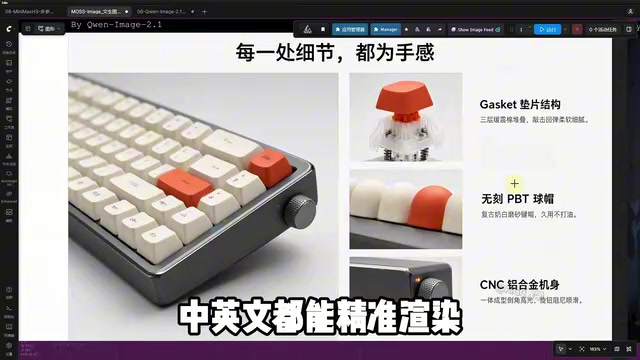
This is most significant for e-commerce scenarios. In traditional workflows, manually typesetting text in design software after AI generates the background is an unavoidable step; but with a model that has usable text capabilities, "image generation" and "text generation" can be merged into one step, significantly improving the efficiency of producing poster drafts.
Structured Layout Control: One-Shot Results, No Repeated Trial and Error
Beyond text, another differentiating capability of MOSS-Image is layout control. It precisely specifies the coordinates and size of each element through structured GSM (as described in the video), achieving one-shot layouts without repeated debugging and modification.
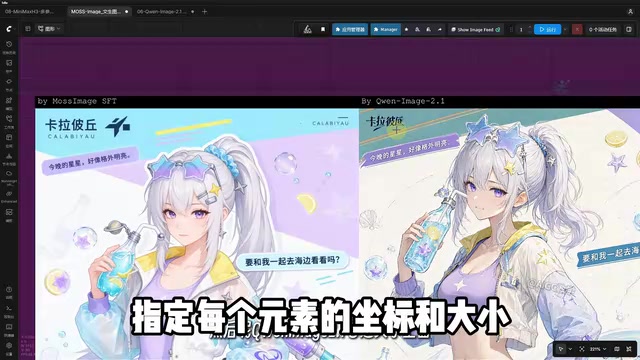
For creators making product pages and event posters, this is more practical than pure image quality improvement. Conventional text-to-image relies on "luck" with prompts — if the composition isn't satisfactory, you re-roll; but coordinate-level layout constraints put controllability back in the user's hands, reducing wasted trial and error. Combined with 4K Tokens of ultra-long prompt support, complex multi-element scenes can be clearly described with a detailed paragraph.
About "4K Tokens ultra-long prompts": Here, Token refers to the smallest semantic unit after text encoder segmentation. 4K Tokens roughly corresponds to thousands of English words or tens of thousands of characters of description, far exceeding the typical 77 or 225 Token limits of most text-to-image models. The practical value of long prompts is that you can write multiple subjects, their respective positions, attributes, and style constraints as a "specification sheet" rather than compressing them into a few vague adjectives; but the longer the prompt, the higher the cost of text encoding and attention computation, requiring a supporting encoding scheme to truly take effect.
About "structured layout control" and re-rolling: Conventional text-to-image relies on CFG and random seed sampling, with composition implicitly determined by prompt semantics and non-reproducible results; coordinate-level layout constraints are equivalent to adding spatial priors to the diffusion process, with common implementations including encoding element boxes as additional condition tokens or applying regional masks in attention layers. Such methods can significantly improve composition accuracy, but occlusion relationships and lighting consistency between elements still require the model's own capabilities as a fallback.
Style Coverage and Hardware Requirements
In terms of style, both anime illustration and realistic styles are covered, following a "one model, multiple uses" approach. Hardware requirements are kept very low — the video explicitly mentions that "even an outdated 3060 GPU can run it directly," with 6GB VRAM sufficient for smooth local operation, and claims the ability to generate 8K images.
It's worth noting that details such as the specific time required for 8K generation and peak VRAM usage were not elaborated in the video, and actual experience will be affected by GPU model, drivers, and inference configuration. It's recommended to first validate results at medium resolution before gradually increasing output size. As for the "zero censorship" claim, this is a promotional statement by the video author; the behavior of locally deployed models still depends on the weight version and usage method, and readers should judge compliance boundaries themselves.
About the technical meaning of "8K resolution": Diffusion models are typically natively trained at only 512 or 1024 resolution. Directly generating 8K generally requires block generation followed by stitching, latent upscaling, or multi-stage cascaded upscaling, with each stage introducing additional VRAM and time overhead. Therefore, "can generate 8K" often means supporting a high-resolution upscaling pipeline rather than direct single-pass forward inference output. With 6GB VRAM, high-resolution pipelines typically require tiling and VRAM swapping strategies, with actual time significantly higher than 1024-level image generation.
Local Deployment Approach and Target Users
The video itself is primarily a demonstration and doesn't provide complete environment configuration steps, but several things are certain: the model has open-source weights and supports local inference; VRAM requirements are low, with 6GB-class GPUs sufficient to get started; and with structured layout and long prompts, workflows can be organized around "define layout first, then fill in content."
The target users are quite clear: e-commerce operators who need to batch-produce product images and promotional posters with text; individual creators who want to incorporate AI image generation into their daily workflows without additional hardware investment; and design assistance scenarios requiring precise, controllable layouts. If the community subsequently provides deployment scripts and workflow files, the practical adoption of such small-parameter models will be faster than expected.
From a trend perspective, MOSS-Image represents a pragmatic approach — not pursuing parameter scale, but doing engineering optimization on real pain points: text, layout, and VRAM. For the vast majority of content producers, being able to run and produce usable images is more convincing than leaderboard scores.
One-line Summary
Fudan OpenMouse and MOSS Intelligence open-source the 500M-parameter text-to-image model MOSS-Image, runnable on 6GB VRAM, with strong text and layout control.
Paragraph Summary
MOSS-Image is a lightweight text-to-image model jointly open-sourced by Fudan University's OpenMouse team and Shanghai MOSS Intelligence. With only around 500 million parameters and a DT (Diffusion Transformer-class) architecture, it focuses on three capabilities: small VRAM footprint, strong text rendering, and controllable layout. According to a Bilibili creator's demo, it can generate images smoothly and locally on 6GB VRAM and 3060-class older GPUs, and claims support for 8K resolution output. Text rendering is accurate in both Chinese and English, with natural typography and no obvious garbled characters or typos, suitable for text-dense promotional posters and product detail pages; for layout, it uses structured GSM to specify element coordinates and sizes, combined with 4K Tokens ultra-long prompts for one-shot results. Style coverage includes anime and realistic, suitable for e-commerce operations and individual creators for low-cost local deployment, but claims about 8K time requirements and "zero censorship" still require readers to verify and judge for themselves.
Related articles
Microsoft Fabric Database Agent in Action: From Reactive Firefighting to Intelligent Detective
A deep dive into the Microsoft Fabric Database Agent: how to enable it, supported monitoring scenarios, a blocking-issue demo, and the roadmap from reactive to autonomous operations.

Zendesk Uses ChatGPT Enterprise to Build a Sales Agent with 1,000 Daily Active Users
Zendesk opened ChatGPT Enterprise to all employees, who built about 600 apps themselves, including a sales expansion agent with about 1,000 daily active users. This article analyzes how it turns internal data into sales opportunities and its "don't wait" implementation strategy.
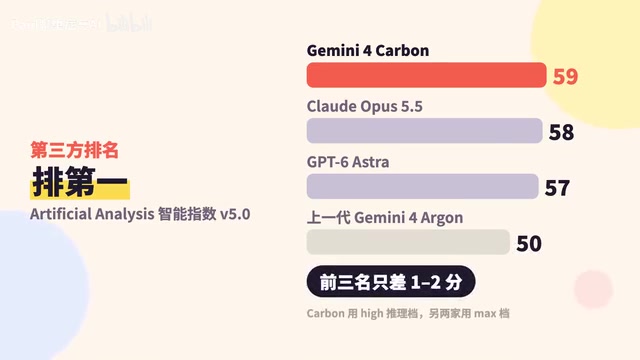
Google Releases Gemini 4 Carbon: Its Strongest Model Yet, Debuting with a Cybersecurity Focus
Google releases Gemini 4 Carbon, calling it its strongest model, with a cybersecurity focus. It tops the third-party composite ranking at 59 points but leads by only one or two. This article analyzes its security test results, staged rollout, token pricing, and the divergence between self-reported and third-party tests on hallucinations.