Run a 125-Billion-Parameter LLM on a Home PC? Inside the 25k-Star Strata Local Deployment

Open-source Strata lets hundred-billion-parameter MoE models run locally and offline on home PCs.
GitHub open-source Strata, with nearly 25,000 stars, demonstrates running a hundred-billion-parameter LLM locally on an ordinary gaming PC, tested on Tongyi Qianwen's 125B version. Its core is MoE architecture: 20,000+ expert modules with only a few activated per inference, frequently used weights in VRAM and the rest in RAM, bringing peak VRAM demand to consumer-GPU levels. Requirements: 12GB+ VRAM, 32GB+ RAM, 80GB+ disk (about 70GB initial download). OpenAI API compatible—just change the endpoint URL.
An open-source project called Strata on GitHub has recently drawn attention. Behind its nearly 25,000 stars is a promise attractive enough to matter: no need to rent servers—fit a hundred-billion-parameter-class large model onto your own computer, and use it even offline. According to a hands-on share by a Bilibili creator, this project got an ordinary gaming PC to run Tongyi Qianwen's new flagship—the 125-billion-parameter version.

How do you squeeze a hundred billion parameters into a home machine?
A 125-billion-parameter model would traditionally require data-center-grade hardware for inference. Strata's core idea is the MoE (Mixture of Experts) architecture—the model contains over 20,000 small expert modules, and each inference call activates only a relevant handful of experts rather than running through all parameters.
The hardware allocation strategy is also pragmatic: frequently used expert weights live in GPU VRAM, while everything else is stored in system memory and fetched on demand. This tiered approach—"hot data in VRAM, cold data in RAM"—brings peak VRAM requirements down to what consumer-grade GPUs can handle.
Once installed, you can open a browser to chat, write code, view images, and connect coding assistants—all inference happens locally. The author tested it on a gaming PC and achieved generation speeds of dozens of tokens per second, and even faster when reading long documents.
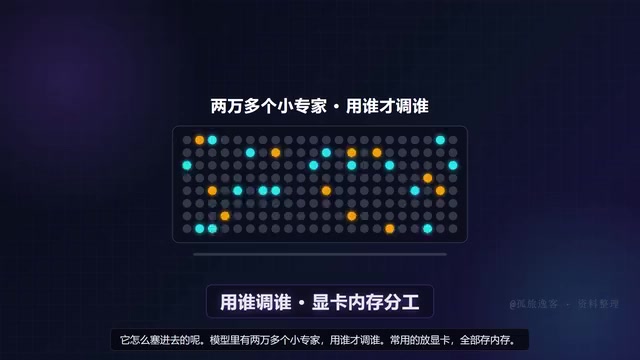
MoE (Mixture of Experts) architecture is a sparse-activation design that places multiple parallel sub-networks (the "experts") inside the model. Unlike traditional dense models that engage all parameters for every inference, MoE uses a router network at each layer to determine which experts should process the current input, activating only a few experts while the rest stay silent. This allows the model's total parameter count to be enormous while the actual compute per inference scales only with the number of activated experts. This is also the theoretical premise behind "a hundred-billion-parameter model running on a consumer-grade GPU."
It's important to distinguish "total parameter count" from "activated parameter count": the former determines the model's knowledge capacity and storage requirements, while the latter determines the compute cost during inference. Solutions like Strata exploit the huge gap between the two—trading memory for VRAM and sparsity for speed. However, MoE comes with trade-offs: routing judgment errors, imbalanced expert loads, and loading latency for large numbers of expert weights all affect real-world experience. This is also why local deployment requires actual testing based on the model and task.
OpenAI API compatible, plug into your existing toolchain
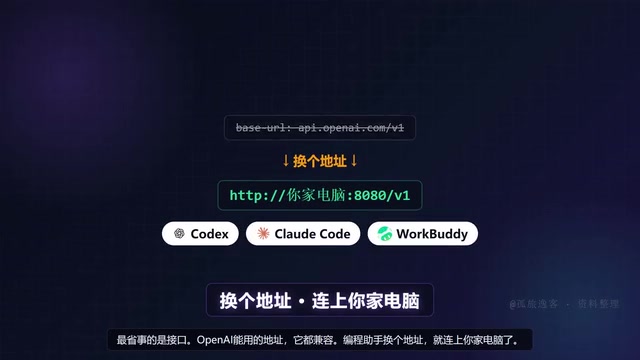
Strata's most convenient design feature is interface compatibility. Any tool that supports an OpenAI API endpoint—coding assistants, chat clients, automation scripts—only needs its request URL changed to your local Strata service to call the local model directly, with no other configuration changes needed.
For developers already accustomed to cloud API workflows, the migration cost is nearly zero. Data never leaves your machine, and you can chat without an internet connection—the value in privacy-sensitive scenarios is obvious to everyone.
OpenAI API compatibility typically means the server implements request and response formats consistent with OpenAI Chat Completions (/v1/chat/completions) and similar endpoints, including fields like model, messages, temperature, and stream. As long as the interface behavior is consistent, the client doesn't need to know whether the backend is a cloud service or a local inference process.
This compatibility mode greatly reduces migration costs, but there are boundaries: different tools may rely on specific model names, function calling, multimodal message formats, or streaming incremental returns. If the local implementation doesn't fully cover these, errors or degraded behavior can still occur. So "just change the URL and it works" generally refers to basic chat and completion scenarios—complex features still need to be verified through actual testing.
Check the hardware threshold before installing
The most common failure point is hardware. The author explicitly lists three hard requirements:
- GPU VRAM: 12GB or more
- System memory: 32GB minimum
- Disk space: Reserve 80GB or more (initial download is about 70GB)
The first launch will stutter for one to two minutes—this is normal loading, so don't close it midway.
The division of labor between VRAM and system RAM is key to understanding local LLM deployment. VRAM bandwidth is far higher than system memory, making it suitable for storing weights that are frequently accessed during current inference; system memory has large capacity but limited bandwidth, making it suitable as "cold storage," moving experts to VRAM via the PCIe bus when they're called upon.
When the needed experts aren't in VRAM, the system must load them temporarily, which creates extra latency—manifesting as response speeds that fluctuate. Model files on disk serve as persistent storage; the first run requires decompressing, mapping, or copying weights into memory/VRAM, which is why the first launch is noticeably slow. To judge whether it can run, besides looking at parameter scale, you also need to consider quantization precision—with the same model, 4-bit quantization can reduce size and VRAM usage to less than half of the original precision, which is also an important reason why 12GB of VRAM can host a hundred-billion-class MoE model.
What local deployment really means
Strata represents a trend: as MoE architectures mature and quantization techniques advance, the inference threshold for hundred-billion-parameter models is shifting from data centers down to personal devices. Converting monthly API rental fees into a one-time hardware investment is easy math for heavy users.
Of course, the cost of running locally is hardware expense, electricity, and maintenance effort. Whether it's worth it depends on your usage frequency, data sensitivity, and tolerance for network dependency. But at least now, fitting a hundred-billion-parameter model into a home computer is no longer just theory.
One-line Summary
Open-source project Strata lets hundred-billion-parameter MoE models run locally and offline on home computers.
Paragraph Summary
GitHub open-source project Strata, with nearly 25,000 stars, demonstrates the possibility of running a hundred-billion-parameter LLM locally on an ordinary gaming PC, tested on Tongyi Qianwen's 125-billion-parameter version. Its core is the MoE mixture-of-experts architecture: the model contains over 20,000 expert modules, activating only a relevant few per inference, and placing frequently used weights in VRAM while the rest go into RAM, bringing peak VRAM demand down to consumer-GPU levels. Hardware requirements: 12GB+ VRAM, 32GB+ RAM, 80GB+ free disk (initial download about 70GB). OpenAI API-compatible, existing tools connect by simply changing the endpoint URL. Tested generation speed reaches dozens of tokens per second, supports offline use, and keeps private data on-device.
Related articles

Gemini 4 Argon Hands-On: AI Builds Board Games, Constructs Temples, and Trains Robots Autonomously
Gemini 4 Argon hands-on roundup: AI autonomously builds a desk racetrack and temple in Blender, writes a ray tracing engine, trains a humanoid robot to sink 7 shots, plus API pricing and developer access.

The Magic Octagonal Coin: Why Only 9% of People Can Predict Its Flip?
Only 9% of people can correctly predict the Magic Octagon coin flip. This article explains its spatial rotation mechanism, common cognitive pitfalls, and a new hypothesis based on Relevance Theory, exploring the limits of human spatial reasoning.

Sam Altman: AI Is Entering the Era of Scientific Discovery — Math Breakthroughs Will Replicate in Biology and Energy
Sam Altman says AI is entering the era of scientific discovery — math breakthroughs will replicate in biology, materials science, and energy to help develop new drugs and energy sources.