Running Qwen3 MoE on 32GB VRAM? Real-World Testing of a New Local Deployment Solution

AMD R9700 runs Qwen3 MoE at 80+ tokens/s with 256K context via Straighta's tiered GPU/RAM scheduling.
A Bilibili creator tested running Qwen3 MoE quantized locally on an AMD Radeon R9700 (32GB VRAM) using a deployment solution called Straighta. The key innovation is MoE's sparse activation: frequent experts stay in VRAM, others load from RAM on demand, with GPU-CPU co-inference and speculative decoding achieving 80+ tokens/s at 256K context — over 25% faster than a 27B dense model on the same card. The IQ3_XXS quantization handles scene generation well but struggles with creative writing. Straighta supports both OpenAI and Anthropic-compatible APIs for direct Agent integration, though near-full resource usage and slow cold starts remain real trade-offs.
The two pain points of running LLMs locally are simple: it doesn't fit, and quantization makes it dumb. The first gets you killed by VRAM limits; the second turns your model into artificial stupidity. After picking up an AMD Radeon R9700 (32GB VRAM), this Bilibili creator has been pushing the card to its limits. He claims that through a deployment solution called "Straighta," he got this card running Qwen3's MoE version — previously out of reach — instead of being stuck with just the 27B dense model.
Note: The original material was transcribed from speech, so model names contain obvious recognition errors (e.g., "QM3.8 Fleshnex", "QAM3.827B"). Based on context, these refer to the MoE (Flash/Next) variants and the Qwen3-27B dense model in the Qwen3 series. This article presents a reasonable interpretation — please verify actual model names against your deployment.
Core Numbers: 256K Context + 80 tokens/s
Let's start with the most eye-catching figures: 256K context window, output speed of 80+ tokens/second, on an R9700 with 32GB VRAM, running a quantized MoE model.
According to the creator's tests, with 256K context fully enabled, VRAM usage hit 31.5GB and RAM usage exceeded 48GB — both nearly maxed out. Prefill speed came in at over 1,600 tokens/s; short-context generation hit 80–100+ tokens/s; even long-context output held at 45 tokens/s — more than 25% faster than the 27B dense model he ran previously.
In practical terms: a task with 40,000+ tokens takes about 10 minutes to complete. For Agent workflows like Codex, Claude Code, or DeepSeekAd, that's fast enough.
How Do Tens of GBs of Weights Fit in 32GB VRAM?
The key lies in the MoE (Mixture of Experts) architecture. The creator used a great analogy: this model has over 20,000 "experts" — like a company with 20,000 employees. You can't keep everyone at their desks at all times.
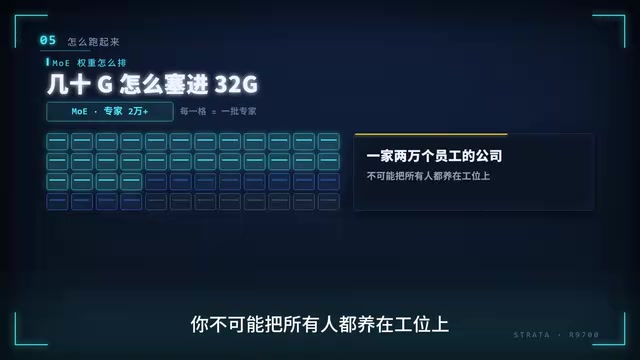
What Straighta does is tiered scheduling:
- The most frequently used experts reside permanently in VRAM
- The rest are held in RAM and loaded on demand
- The storage drive keeps an "index" so any expert can be located instantly
During inference, the GPU and CPU work together, augmented by speculative decoding (called "NPP" in the original, likely referring to a similar multi-token prediction technique) to guess several tokens at once. In short: every available resource in the machine gets mobilized just to push tokens out faster.
This mechanism also explains why it's "GPU-agnostic" — according to the creator, both AMD and NVIDIA cards are supported, and the latest version even supports Intel graphics. A minimum of 12GB VRAM paired with sufficient RAM and NVMe storage is enough to run it.
The fundamental difference between MoE (Mixture of Experts) and traditional dense models is this: dense models activate all parameters on every inference pass, while MoE models only activate a small subset of "expert" sub-networks during each forward pass (dynamically routed by a gating network). In Qwen3's MoE version, for example, total parameter count may reach hundreds of billions, but the parameters actually involved in generating each token are far fewer. This means that even if the total weight file far exceeds VRAM capacity, inference can continue as long as the right experts are swapped in when needed. This is the physical basis for tiered scheduling: the sparse activation property of MoE architectures naturally fits an "on-demand swap-in" memory management strategy — unlike dense models, which require all parameters to be loaded into VRAM before they can run.
Intelligence Test: Is the Quantized Version Smart Enough?
Beyond speed, the more critical question is whether quantization makes the model "dumber." The creator used Cherry Studio for testing, with clearly defined conditions: no Agents, single-sentence prompt, one-shot output, IQ3_XXS quantized model.

Test one: generating a "cycling" scene. No clipping or positional errors, and it could adjust posture for uphill and downhill terrain. The creator noted that under the same conditions, this result was noticeably better than the 27B Q4 quantized model he'd run previously, and by his subjective feel also better than some versions of GLM and DeepSeek (he emphasized this is subjective, not a benchmark).
Test two: generating a "Shanghai Bund" scene. Visually impressive, with day/night time-of-day switching. The full test output over 40,000 tokens at 70+ tokens/s, completing in about a minute.
Conclusion: the IQ3_XXS aggressively quantized version is capable enough to serve as a local workhorse for Agent-based workflows.
IQ3_XXS is an extremely aggressive non-uniform integer quantization format in the llama.cpp ecosystem. The "3" refers to an average of approximately 3 bits of quantization precision; "XXS" indicates further compression to an extra-small size. Compared to common formats like Q4_K_M (~4.5 bits) or Q5_K_M, IQ3_XXS reduces model file size and VRAM usage by another 30–40%, at the cost of greater information loss — which can lead to capability degradation on tasks requiring precise reasoning, long chains of logic, or nuanced language expression. However, the IQ series uses importance matrix-guided non-uniform quantization, giving more bits to critical weights, so it generally outperforms older uniform quantization schemes at the same compression ratio. The creator's observation that image/scene generation held up while creative writing "broke down" is consistent with this quantization level's known pattern: relatively robust on structured outputs, more fragile on open-ended language generation.
Integration and Deployment: Dual OpenAI/Anthropic Compatibility
The barrier to integrating Straighta is low. It supports both OpenAI-compatible and Anthropic-compatible APIs — once locally deployed, just point the API endpoint and you're good to go.
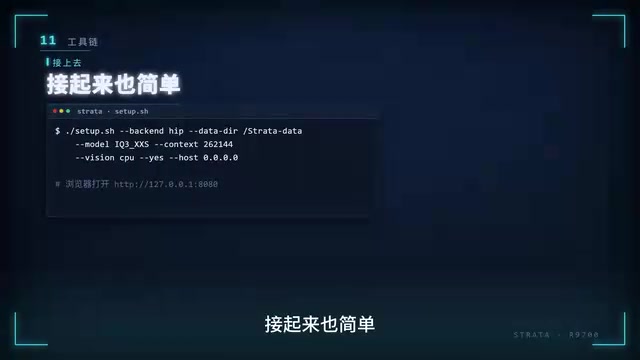
Tools like Codex, Claude Code, and DeepSeek Harness can connect directly, making this quite developer-friendly for anyone building local Agent workflows.
Three Current Pain Points
The creator was also honest about the current limitations:
- VRAM and RAM are genuinely maxed out — running other programs simultaneously will conflict with it; not friendly for multitasking;
- Initial load requires warm-up — cold start is slow;
- Creative writing and pure text reasoning still breaks down — the limitations of aggressive quantization persist on these tasks; the creator says he'll keep testing.
Who Should Try This?
The creator's recommendations are clear:
- 32GB VRAM: Strongly recommended — faster than 27B, more capable than 27B, viable as a primary model in the near term;
- 12GB VRAM + large RAM + NVMe: Worth trying;
- 12GB VRAM + small RAM: Don't bother.
For AMD R9700 users who have long suffered from ecosystem limitations, this kind of tiered scheduling solution offers a genuine new path — using the MoE architecture combined with VRAM/RAM/storage co-processing to sidestep the hard requirement of stacking raw VRAM. That said, the capability tradeoffs from aggressive quantization and the multitasking conflicts from near-full resource usage remain unavoidable realities of local deployment.
Related articles

Should U.S. College Fraternities Be Banned? A Researcher's Incisive Observations
Why not just ban U.S. college fraternities? A researcher finds the key resistance comes from decision-makers' own fraternity identities and schools' "willful ignorance."

Microsoft Discovery: Accelerating Scientific Discovery with AI Agents
Microsoft's Discovery platform runs specialized AI agents to help researchers screen and prioritize the most promising compounds and experimental paths, reducing experiments and accelerating scientific discovery.

Cambridge Heavy Industries Secretly Develops Desktop-Scale Nuclear Fusion Device
Cambridge Heavy Industries is secretly developing a desktop-scale laser-driven nuclear fusion device, targeting the equipment supply market for fusion power plants. This article analyzes its miniaturization technology path, commercialization logic, and unique positioning in the fusion startup wave.